Showing posts with label fresh pasta. Show all posts

Saturday, July 7, 2012

Red Rover, Red Rover, Let Dante Come Over

Prepare yourself, gentle reader, for a lengthy blog post today. In trying to give Dante Boccuzzi's new Akron-based D.B.A. restaurant as much chance to impress as possible (or not), I ended up going to the restaurant twice during its opening week and have included both experiences in this one post.

D.B.A. (aka Dante Boccuzzi Akron) is Dante's latest restaurant opening and his first in the Akron area. Located in the old Vegiterranean space situated across the street from Luigi's, it doesn't represent a brand new concept for him, but merely an extension of his current offerings at Restaurant Dante in Tremont and The DC Pasta Company in Strongsville. That being said, there are far fewer restaurants in Akron to compete directly with D.B.A., both in terms of cuisine and price.

D.B.A. was located at 21 Furnace Street, Akron, OH 44308 and can be reached at 330-375-5050 or by fax at 330-375-1670. While there is parking available in a lot across the street from D.B.A., it can be tricky to find a spot as Luigi's shares the same parking space. I was easily able to find a space to park during my first visit on a Tuesday. For my second visit on a Friday night, I gladly paid the $4 valet charge to not have to worry about it.

Once inside, I was impressed at how the interior had been transformed from the rather hard and edgy space of its predecessor to the more broken up and darker look that the restaurant space currently has. One of the problems that Vegiterranean always seemed to have in the past was that when full, the noise levels were extremely high and it was often difficult to have a conversation with dinner companions without having to yell at them. Smartly, the bar area now has a wall between it and the main dining room and the space at the front of the restaurant has been converted into small nooks, each containing three or four tables.

As Dante is also a musician, cleverly, the dinner menu comes presented on an LP album with an actual record inside:

D.B.A.

D.B.A. Dinner Menu Back

Just as with Dante's other restaurants, many of the dishes are offered at various sizes, from a tasting to an appetizer to an entree sized portion. As a restaurant reviewer, I greatly appreciate this because it can be difficult when going out by yourself to get as many tastes as possible during a single visit. Immediately, my brain began to devise a plan on how to get the maximum number of courses for a minimum amount of cash.

While there was no prix fixe meal available at D.B.A. (at least, my server didn't indicate that there was one available on my first visit), I decided to take matters into my own hands and ordered a five course progression, three from the appetizer section, one from the pasta section, and a final course from the entree section of the menu.

Within just a few seconds of placing my order, standard Restaurant Dante bread service arrived at my table:

Bread Service

The breads are sourced from a variety of locales (one of which is Mediterra in Pittsburgh) and arrived in an old vinyl LP that has been heated, remolded, and shaped into a bread basket. The hummos that accompanied the bread was also identical to what is served at Restaurant Dante. Both were fresh and delicious and a nice way to start the meal.

What came next was the onslaught of food I had originally ordered, each course skillfully arriving at my table only mere moments after my previous course had been removed and new silverware carefully placed in front of me. First up was the half portion of the Mackenzie Goat Cheese appetizer:

Fried Squash Blossom

I had assumed that the chevre would be inside the fried squash blossom, but it was actually under the dressed salad greens. The squash blossom was exquisitely fried -- crispy, tender, and not greasy -- and seasoned perfectly. All of the elements on the plate worked very well together, but the one standout that made my mouth swoon was the zucchini agrodolce. It was sweet and sour (as the name would imply) with just a touch of heat to it.

The next course was one of the menu's many vegan offerings, the half portion of the Asparagus Salad:

Asparagus Salad

In addition to the shaved asparagus, there were asparagus spears, frisee, pickled Chanterelles, and an eggless bearnaise that served as the dressing. The seasoning of this dish was a bit uneven as the frisee was more heavily salted and the asparagus a little less. But, at the end of the day, when combining a little bit of each element from the plate, everything evened out and I thought it was quite tasty. The eggless bearnaise (I'm assuming the yellow color probably comes from the use of tumeric) worked quite well and gave the salad an acidity and richness that really balanced the other flavors well.

The next course to cross my table was the Crispy Calamari and Rock Shrimp appetizer:

Crispy Calamari and Rock Shrimp

Accompanying the fried items was a chile-spiced mayonnaise and sliced pickled Shiitake mushrooms. The spiced mayonnaise had a considerable amount of heat, but nothing that I would consider excessive. The squid and shrimp were very tender and the coating on both was crispy and not greasy. The only real complaint I had regarding this dish was that the rock shrimp were fairly aggressively seasoned and the calamari a tad underseasoned. Eaten together, they balanced each other out, but woe to the diner who decided to eat three or four rock shrimp in a row.

Having finished three appetizer courses, my fourth course came from the middle portion of the menu. Items from here were available as a taste, an appetizer-sized portion, and as a full entree. I decided to go with an appetizer-sized portion of the Arborio Risotto Carbonara:

Arborio Risotto Carbonara

The portion was HUGE. It might be because I had already eaten three courses already, but I realized as soon as this was sat in front of me that I should've ordered the tasting size. I immediately knew that I would be leaving the restaurant with leftovers.

Nestled in the center of the dish was a soft poached egg with a small dollop of black truffle puree next to it. The trick, of course, is to break open the egg and stir the contents of the bowl together before eating it (much like the Korean bibimbap). After thoroughly mixing, I took my first bite. First, the good points. It was rich. It was earthy. It was creamy. The pancetta has excellent texture. Second, the not-so-good points. It was incredibly salty.  Just to rule out the possibility of the pancetta's salt being the culprit, I made sure I found a forkful that had none in it. I repeated the experiment several more times. I quickly reached for my water. Don't get me wrong, it wasn't inedible. It just wasn't balanced. I ate about one-third of this dish before asking for the remainder to be boxed up.

The final course of this first evening at D.B.A. was the Seared Sea Scallops:

Seared Sea Scallops

Perched atop three potato cakes, the scallops were dressed with balsamic glazed strawberries and lemon zest strips. In between the scallop mounds was fresh arugula, baby Shiitake mushrooms, and sliced dehydrated strawberries. As opposed to my fourth course tonight, this one was spot on. The scallops were cooked perfectly, seared brown on the outside and beautifully translucent on the inside, the strawberries and balsamic played so well together on my tongue. The salad had a lovely bit of pepperiness to it and the dehyrdrated strawberries really reinforced the fresh strawberry flavor nicely. The only thing I didn't care for was the texture on the lemon zest "strips." While I dig the visual presentation of the strip, I think I might have preferred a more finely grated zest.

My second visit to D.B.A. was during the same week as my first, but this time on a very busy Friday evening. Whereas I had been seated at a small corner table in the main room before, this time we were seated at a small two top right by the front window. One of the trickier aspects of food photography when done in a restaurant setting is the natural light coming in through the windows in the evening. The color temperature of the light can change rapidly as the sun sets and over the course of our two and a half hour meal, I found myself recalibrating the white balance on my camera in between each course and actually having to use light painting on my dessert course because of the lack of good light.

To start off tonight's meal, I went with the half portion of the vegan-friendly Cold Soup:

Cold Soup

Made from heirloom tomatoes, it also had a basil cream mousse and was dotted with bits of crisped pita bread. The acidity and sweetness of balsamic vinegar added to the complexity of flavor in this quite delicious and refreshing dish. The seasoning was spot on and the crispy pita added a wonderful textural contrast to the smoothness of the soup and the mousse. Truly, this was an excellent way to start my second visit at D.B.A.

My next course was also from the appetizer portion of the menu and was something I had been eying since I first gazed upon the on-line menu, the Hudson Valley Foie Gras:

Hudson Valley Foie Gras

Served over a raspberry short cake and topped with duck prosciutto, this dish truly delivered in every way possible. As I took my first bite, I think my eyes must have rolled back in my head just a little bit as I savored the wonderful balance of salty, sweet and tart from the various components of the dish. While this is one pricey appetizer at $19 (indeed it is more expensive than several of the entrees), I decided to consider this my entree for the evening and was very happy that I did. The raspberries, both used as a garnish and baked into the short cake added a very necessary amount of acid to combat the heavy richness of the foie gras. I'd order this again in a heartbeat.

For the next course, my dining companion and I each ordered a "tasting" portion ($5 each) of one of D.B.A.'s pastas and decided to share them with each other. The Pappardelle alla Bolognese is a popular dish at Restaurant Dante and makes its appearance on D.B.A.'s menu, too:

Pappardelle alla Bolognese

This dish was rich and hearty, the pasta was cooked perfectly, and the veal, pork, and beef ragu that dressed the noodles was present without being too much. Honestly, if I wasn't attempting to get in as many tastes of the menu as possible, I could be a happy man with a nice big plate of this pasta.

I, on the other hand, ordered the Green Spaghetti:

Green Spaghetti

Topped with garlic braised rock shrimp, spinach, poor man's cheese, and finished with crispy bread crumbs, this pasta also delivered, albeit with a little less intensity than the pappardelle. Once again the pasta was cooked and dressed perfectly, but I felt that the rock shrimp were a bit too salty. I had first noticed this when I tried the Crispy Calamari and Rock Shrimp appetizer on my first visit. I'm not sure whether the shrimp themselves are naturally salty or if the coating used on the shrimp is the culprit.

My final savory course on my second visit was the appetizer-sized portion ($12) of the Hong Kong Style Mussels:

Mussels 'Hong Kong' Style

As opposed to the appetizer-sized portion of the Arborio Risotto I had ordered during my first visit, this time, the portion was perfectly in line with what I had room for in my stomach. The mussels were tender and flavorful and all except one of them had steamed open during the cooking process. The broth had been infused with chiles, lime and cilantro and while the broth by itself was a bit aggressive in seasoning, when paired with the sweet mussels, it was a nice complement. One thing that was missing from this dish was a nice piece of grilled bread to soak up some of the broth. Fortunately, I asked my server for some fresh bread and she was happy to oblige.

While I didn't have room for dessert on my first visit, on this second one I purposely made sure not to stuff myself such that I couldn't sample something from the dessert menu:

D.B.A. Dessert Menu

Continuing in the vein of cleverness, while the regular dinner menu was presented on the album cover of an LP, the dessert menu came on the liner notes of a Compact Disc.

After considering all of my options, I ended up going with the Double Baked Chocolate Brownie:

Double Baked Chocolate Brownie

I had originally thought that perhaps the brownie would be more like a biscotti, the twice-baked Italian pastries that are often dipped into coffee or espresso to soften. Instead, what arrived was a nut-free brownie wrapped in phyllo, brushed with butter and then baked until golden brown. Paired with a stone fruit compote, chocolate sauce, and a scoop of apricot sorbet, this turned out to be an unusual, but delicious dessert. The brownie, even though it had been twice baked, was decadent and moist and the tartness from the apricot sorbet did a great job of cleansing my palate from the rich and sweet brownie. The chocolate sauce didn't do a whole lot for me and something like a raspberry coulis might have better served this dessert.

Over the course of two visits, I was able to try eleven of the twenty-nine dishes on D.B.A.'s current dinner and dessert menus. Of them all, while the seasoning on a few of the dishes was a little uneven, and one of them was way too salty, on the whole, I think the flavors were spot on, and most dishes I tasted had no issue with seasoning.

Service between my two visits was interesting. With only a third full restaurant on my first visit, it took approximately one and a half hours to enjoy a five course meal. During my second visit during a busy Friday night service with a full restaurant, a similar five course meal took two and a half hours. As you can imagine, the first visit felt a bit rushed as the minute my plate was cleared and silverware replaced, the next course appeared, really giving me little time between courses to relax. On my second visit, the pacing at the beginning of the meal was much better, but as the courses progressed, so did the lag time between each course. Between the pasta course and the mussels, my dining companion and I probably waited a good thirty minutes.

While the servers during both visits were knowledgeable about the menu, the server during my second visit forgot to bring a glass of wine requested by my dining companion and decided to drop off the final check to our table before we had actually finished our meal. I realize that this is the first week of D.B.A. being open and I can easily chalk up these glitches to the staff getting its collective feet wet. Given a few weeks, these problems should correct themselves.

As you can imagine by looking at the menu and some of the prices I've quoted along the way, eating at D.B.A. can be reasonable or expensive. I had water with both of my meals and the totals for each of my meals, with tax and a twenty percent gratuity were $80 and $65, respectively. I imagine that were you to throw in a cocktail and a glass of wine, you could easily approach $100 per person. That being said, if you stick to three or four of the $5 options or simply choose one entree, you could get away with a check totaling closer to $25 to $30. While this is certainly comparable to what you would spend at some of Cleveland's more upscale restaurants, D.B.A. finds itself on the pricier end for an Akron-based restaurant.

Noise levels during my Friday night visit were light to moderate and I had absolutely no problem carrying on a conversation with my dining companion. Unlike Restaurant Dante where, at times, it can be nearly impossible to carry on a conversation without yelling at the person across the table, D.B.A. was much more conducive to productive conversations.

Everything said and done, I would recommend that you check out D.B.A. The food and the service have a lot of promise and given a couple of weeks to get everything running like a finely-oiled machine, I imagine an experience will be similar to any of Dante Boccuzzi's other restaurants. While the menu isn't a huge departure from Restaurant Dante, it also offers a nice assortment of vegan, vegetarian, and meat-based options that can be enjoyed by all audiences. I know that I am looking forward to returning soon and giving some of the remaining menu items a try.

Dba [Dante Boccuzzi Akron] on Urbanspoon

Sunday, February 19, 2012

Preview of Dante Boccuzzi's The DC Pasta Company

Dante Boccuzzi seems to be on a roll. Having established his very popular restaurant in Tremont, Restaurant Dante, he added Ginko to that list, and starting two nights ago, his latest venture, The DC Pasta Company. The newest restaurant, a collaboration between Dante and Carmela del Busso, was designed around the concepts of affordability and sharing a lovely meal with the other members at your table. The DC Pasta Company was located at 12214 Pearl Road, Strongsville, OH 44149 and can be reached at (440) 238-8500. Parking was in front of the restaurant and the rear of the complex.

My friend and partner in crime for this evening's dinner was Edsel, who not only made the reservation for tonight's dinner, but was also almost immediately recognized by the general manager, John Williams, as he stopped by our table to check on us and introduce himself. While having the food paparazzi suddenly show up at your restaurant can often unnerve the staff, tonight's complement seemed to handle it in stride.

Having arrived slightly earlier than my table companion, I had the chance to check out and photograph the one page menu:

The
I immediately liked three aspects of DC Pasta's menu. First, it all fit on one page. Second, even though it fit on one page, it had plenty of choices. Third, this menu was definitely designed around affordability. As a patron, you could go a more traditional appetizer - salad - entree route, or if you were feeling a bit more adventurous, you could build a meal entirely on small plates and get to try a greater number of tastes. I'm sure that you can already guess which route that Edsel and I took tonight, gentle reader.

To start out our meal, we decided to order a trio of Le Cose Marinate (i.e. "marinated stuff"):

Le Cose Marinate
DC Pasta was offering marinated items that originate both from Italy and are made in house. Tonight we choose the carciofi (artichokes), melanzane (eggplant) and peperoni picante (peppers). While this was the first I've had artichokes where they didn't have that canned flavor, they also didn't have a lot of other flavor either. They were so-so. The peppers, however, really stepped up the game and by the time I tried the eggplant, I was blown away. Of the three, the eggplant was not only delicious, but also paired well with some of the cured meats we ordered.

Next up was the sole appetizer that we ordered, the Fritto di Mare:

Fritto di Mare
This dish was a combined trio of fried shrimp, calamari, and smelt. Honestly, what caught both my eye and Edsel's were the smelt. Smelt is a small oily fish that is by far more popular in Italian cuisine than in American. Always on the lookout for something unique and interesting, when I mentioned possibly ordering this dish to Edsel, he quickly agreed. Served along with the fried seafood was a lemon-caper-olive dipping sauce that most closely resembled a sauce remoulade. The seafood was fried perfectly with a crispy exterior and tender interior. While it could've used just a touch more seasoning after coming out of the fryer, the sauce remoulade made up for this slight shortcoming. This dish is highly recommended.

Along with our marinated vegetables and fried seafood, we decided to add a trio of house-cured meats, or Salumi Affetati. First up was a plate of the Coppa Dolce and Sopressata:

Coppa Dolce, Sopressata, Gressini
On a second plate was some additional Sopressata and the Mortadella:

Mortadella, Sopressata, Gressini
All three were delicious, but the coppa dolce and the mortadella really stood out. Each plate was also adorned by several gressini (e.g., breadsticks), which was a very nice touch and added something with a bit of crunch to balance the softness of the meats. With the exception of the Prosciutto de Parma, all of the salumi listed on the menu were being cured at Restaurant Dante. If you are a cured meat aficionado, you'll want to pay special attention to this part of DC Pasta's menu.

Our appetizer portion of the meal now complete, something familiar to Restaurant Dante appeared on our table after ordering our second round of food, the bread service:

Bread Service
Our server dropped off some fresh bread served in a reshaped vinyl record accompanied by a rosemary bean dip. While delicious, I was kind of curious why this was served in the middle of the meal instead of at the beginning. Regardless, Edsel and I scarfed it down with contentment.

As I mentioned earlier, one of the key points of DC Pasta's menu was the ability to customize the dining experience to suit many different moods. All of the pastas were offered as a taste ($4), an appetizer ($8) or as a full-sized entree ($15). Continuing along our sharing theme for the evening, we decided to round out our meal with a pasta tasting. First up was the Bucatini Con Salsa Di Agnello:

Bucatini Con Salsa Di Agnello
The bucatini had been infused with lovely tomato-braised lamb and fresh chopped mint. Of the four pasta tastes we would enjoy tonight, this was by far the stand-out and the one I would have no reservations about ordering as a full-size entree. The lamb was tender and the mint added a lovely bit of contrast that was at the same time unusual and delicious.

Our second pasta was the Lumache e Polipo:

Lumache e Polipo
The pasta was dressed with toasted garlic, octopus, snails, broccoli, parsley, and chile flakes. Of the four pastas, this was definitely the most spicy, nothing obnoxious, but the heat still hitting you at the back of the throat after that first bite. The octopus and snails were lovely, having a bit of chew to them without that "rubber band" effect that can happen if overcooked.

The third pasta taste of the evening was the Linguine Alla Carbonara Con Tartufo:

Linguine Alla Carbonara Con Tartufo
Having had a very similar dish at Restaurant Dante, both Edsel and I knew what we were in for and this dish didn't disappoint. Dressed with a barely cooked egg on top, the first thing Edsel did after we snapped our pictures was to break the egg open and allow the golden, runny yolk to ooze out over the linguine, enriching an already rich dish. While this pasta was indeed delicious, I didn't really pick up too much on the earthy truffle notes that I was expecting. Even without the truffle, this was still a dish worth seeking out.

Our final pasta taste of the evening was the rather unusual Pizzoccheri Con Patate:

Pizzoccheri Con Patate
Consisting of a buckwheat noodle, this vegetarian dish was also complemented with cabbage, potatoes and Fontina cheese. Interestingly, both the noodles and the potatoes had a rather firm texture to them. One might be inclined to think that they were undercooked, but they weren't. While tasty, by the time I got to this last dish, I was ready to cry "Uncle!" and as such, managed to just get in a taste of it before throwing in the towel.

When the check finally came, Edsel and I were shocked that between the two of us, without wine, we had only managed to spend $44, including tax. For a mere $22 per person, we had managed to try a trio of marinated vegetables, a trio of cured meats, a seafood appetizer, and four different tastes of pasta. If DC Pasta was going for affordability and value, they certainly achieved it. Edsel had also decided to accompany his meal with two glasses of wine, priced at a very reasonable $5 each.

While technically this "review" is a preview since we went on the day after their big opening, there were no service or kitchen glitches during our visit. In fact, our visit was on par with a restaurant that had been open for several months. I can safely say that I really enjoyed my experience tonight at The DC Pasta Company and Edsel expressed more or less the same opinion at the end of the meal. I am still not a fan of the location of this restaurant, but I can definitely recommend that you take the time to find and check them out. I think you'll be pleasantly surprised.

The D.C. Pasta Company

Sunday, July 31, 2011

Kitchen Challenge: Gnocchi with Garlic, Bacon, and Kale

Necessity is often the mother of invention. When I first moved back from Columbus to Akron in late 2004, I quickly discovered a lack of good gnocchi in local restaurants and supermarkets. Now, that's not to say it didn't exist, but I didn't have the connections or knowledge to successfully seek it out. Having gotten hooked on the gnocchi served at Monte Carlo Italian Restaurant in Columbus during my five year stay, I knew that I couldn't subsist on the heavy, dense, sit-at-the-bottom-of-my-stomach variety that were available in the area. Thus, I decided to teach myself how to make it from scratch.

Homemade pasta scares a LOT of people. And to be honest, I think I was fairly intimidated by it as well. I had seen it made many times on television, and in theory, it looked simple enough. Depending on the type of pasta one was making, the basics were flour, eggs, sometimes oil, sometime water, and salt. One day, fed up with what was available and craving good gnocchi, I searched around the Internet for several recipes. Over the years, I have honed in on a single recipe that has served me well.

Gnocchi, at its most basic, is an Italian potato-based pasta. It isn't like pierogi, which are a pasta-like dough dough filled with potatoes (much like ravioli). Rather, the potato is actually in the dough itself, no filling necessary. Good gnocchi are ethereally light, almost pillow like. Bad gnocchi ... well, I've already described those to you, so I won't belabor the point. I suppose somehow along the way I've learned to channel a little old Italian grandmother inside of me when I am rolling out the dough, cutting the individual gnocchi and rolling them off the back of a fork to create the ribbed texture.

The recipe for gnocchi is almost stupid simple. In fact, let's get that out of the way right now.

Potato Gnocchi
2 pounds Idaho potatoes, peeled, boiled, and mashed
2 cups of All-Purpose flour, plus additional for kneading
1 egg
Salt and pepper to taste

You can really use any starchy potato for gnocchi, but I would avoid waxy potatoes, such as New or Fingerling, as they tend not to give you the creamy texture you are after. Also, I would stick with All-Purpose flour instead of stronger bread flour. You want the gnocchi to be ultra-tender and using bread flour could create a tougher pasta because of the higher protein content. For a single recipe, I generally don't measure the salt too closely, but if I were pressed to give a measurement, it would probably be a tablespoon of kosher (or coarse) salt. That may seem like a lot, but remember, you are making several pounds of pasta. To be fair, if I salt the dough, I tend not to salt the water in which I cook them.

The first step is to prepare the potatoes. For those really green in the kitchen, I will give a quick primer. First, peel the potatoes. Then cut the potatoes into thirds or quarters so that they cook more quickly. Just make sure to cut all of the potatoes into the same size pieces so that they cook evenly. Fill the pot with COLD water to cover the potatoes by at least an inch or two. Then place on stove and turn the burner on high until the water just starts to boil. Turn the stove down so that the potatoes cook in gently boiling water until a sharp knife easily goes in and comes out of the potato wedges. Drain the water in a colander, return the potatoes to the still hot pan and pull out your potato masher. Without adding anything additional (like milk and butter for regular mashed potatoes), mash away until they are smooth.

The great news is that you can do this step ahead of time (up to one day ahead). If you want to store them for later, place them in a container and place a piece of plastic wrap so that it touches the mashed potatoes before placing a lid on the container. This prevents the outer surface from drying out. Refrigerate until about thirty minutes before you need the potatoes. At that point, remove the container from the refrigerator and set it on the counter to take the chill off. Note that while you will start with two pounds of raw, unpeeled potatoes, after peeling, cooking, and mashing, you will end up with closer to a pound-and-a-half of finished potatoes.

To make the pasta, place the flour in a mound on your work surface. Using a fork, lightly scramble the egg in a small bowl. Using your finger, make a circular motion in the very center of the flour to create a well. Dump the egg into this well, along with the salt and the freshly ground pepper. Using the fork, slowly start to mix the flour from the edges of the well into the liquid egg, being careful not to break through the walls of the well. When enough flour gets mixed into the egg, it will thicken considerably and lose its "runniness." At this point, you can set the fork down and pick up the second most handy tool in the kitchen, the bench scraper. This tool is invaluable for making breads and pastas and at only a couple of dollars, is a multi-tasker that is an excellent investment.

The next step is to add the potatoes to the top of the flour/egg mound. I will tell you that at this point, you will be thinking to yourself, "What in the hell kind of a mess is this?" Trust me, it will all come together with a little love and time. Take the potato out of the container in chunks and run it through your fingers to break it up. If the mashed potatoes are freshly made (you did let them come down to room temperature, right?), you won't need to break them up. It will look like a LOT of potatoes compares to the amount of flour, but that is what makes the resulting gnocchi so tender.

Once the potatoes are on top of the flour, start using the bench scraper to lift and fold the mound onto itself over and over again, pressing down as you fold it over, compacting the dough. Every now and again, you can use the bench scraper to separate the dough from the work surface and simply rotate it or flip it over entirely. Continue doing this for a good five minutes or so, resisting the urge during this time to add more water or flour. The flour is being hydrated during this period and needs a few minutes of adjustment time before you can accurately tell how much adjustment it will need.

Once the dough is holding together (even if there are still visible areas of potato), switch to the best tool in the kitchen: your hands. Begin kneading the dough, using the bench scraper to separate the dough from the work surface as necessary. It is at this stage of the process that you will need to make the judgement call of adding either more flour or a little bit of water. The finished dough should be tacky, but not sticky. In the end, from start to end, it probably takes about ten minutes to make the pasta dough.

Once the dough looks and feels right, you will need to give it time for the gluten that has been activated in the flour to rest and relax. If you are going to roll out the gnocchi right away, mound the dough into a round and cover it with a damp towel or a piece of plastic and let it sit for at least twenty minutes. You could also put the dough into a covered container and refrigerate it overnight. Just make sure that if you refrigerate it, take it out about thirty minutes before you want to roll it to take the chill off the dough.

So, gentle reader, now we've made the dough. Let's take it one step further and make gnocchi.

Using your bench scraper, cut off a hunk of the dough, maybe about 1/2-3/4" thick. Have bench flour available for your work surface in case the dough is still a little sticky, but remember, the less flour used, the more tender the pasta will be, so it's always a balancing act. With the hunk of dough, use your fingertips to roll the dough into a long snake. The length of the snake will depend on how big your hunk of dough started at, but you generally want the cylinder (the snake) to be a thicker than a Tootsie Roll.

With your snake rolled out, use a small knife or the bench scraper (man that thing's gettin' a lot of use, no?) to begin moving from one end to the other cutting out the individual gnocchi, maybe 1/2-3/4" wide. You generally want the width to be less than the width of a fork. Once you've cut the entire snake, the final step is to give each pasta piece their characteristic ridges. Using the backside of a fork, take a single gnocchi and using the thumb of your non-fork-wielding hand, press and roll the dough against the fork. Do this for every dough piece that you cut.

Place the finished gnocchi on a parchment-lined 1/2 sheet pan (or cookie tray), making sure that the gnocchi don't touch each other. Now, simply cut another hunk of pasta dough from the mound and repeat the process until you've run out of dough. Typically, one batch of gnocchi dough will fill about 1 1/2 sheet pans (of the 1/2 sheet variety). If you are going to use the finished gnocchi immediately, now would be a good time to put a large pot of water on the stove to boil. Your other option is to freeze the gnocchi on the sheet pan. Once they are rock hard, scrape the gnocchi off the parchment and put them into a freezer bag. They'll keep in the freezer for quite some time, although they've never been in my freezer for more than a month.

Once the water has come to a boil, if you salted the dough, do not salt the water, too. If you didn't salt the dough, add a couple of tablespoons of kosher salt (or half as much table salt). Working quickly, add about half of the gnocchi to the pot of water and stir gently to make sure they aren't sticking to the bottom or each other. If you have previously frozen the gnocchi, add them straight from the freezer; do not defrost first. When the gnocchi start floating to the top of the pot, you know they are very close to being done. Fresh gnocchi will take just a few minutes to float and add another minute or two if you are boiling them from frozen.

One note about boiling the pasta. While it's okay to bring the water to a hard boil before adding the pasta, once the pasta is added and comes back to the boil, adjust the heat level so that it cooks the gnocchi on a gentle boil. Continued hard boiling of the pasta can cause it to break up. Also, make sure to gently stir the gnocchi while they are cooking.

Once the gnocchi is cooked, use a slotted spoon or a strainer to remove them from the boiling water. Depending on how you will be serving them, you can add them straight to a pan of sauce or you can place them into a bowl with just a touch (and I do mean just a touch) of oil to coat them so that they won't stick together. If you have additional gnocchi to cook, continue to do so in batches until they are all finished.

While I love gnocchi that have been finished in a bit of brown butter and sage, you could also do a simple tomato sauce, a spicier puttanesca sauce, or do what I did today at the market demonstration today, and finish the gnocchi in a saute pan with some freshly chopped garlic, pre-rendered bacon, and a tender green of some kind, like spinach, Swiss chard, or kale.

To a heated saute pan, add a bit of oil (I use grapeseed oil, but you could also use a neutral oil like Canola or light olive) and, if you remembered to keep it while cooking the bacon, some of the rendered bacon fat. When the oil is hot, add about a tablespoon of chopped garlic and cook for a minute or so until you smell the garlic and it gets just a hint of color to it. Add your gnocchi to the saute pan and stir (or flip the contents if you know how) to coat the gnocchi in the garlic and oil. In addition to adding flavor to the gnocchi, sauteeing it for a few minutes allows you to add some crispy outer texture to it as well.

If you prefer a little bit of spice to your dish, add just a smidgeon of crushed red pepper to the pan. Not so much that it makes the dish spicy, but just enough so that it gives character to the finished dish. Next, add some of the crumbled bacon. Stir/toss to combine. Finally, add a large handful of fresh greens, and about 1/4 cup of the pasta cooking water to the pan. Quickly cover the pan with the lid and allow the greens to steam for about forty-five seconds. Remove the lid and toss the pasta one final time before tasting it to make sure it has enough salt and pepper. Adjust accordingly.

To serve, either plate on a family-style platter or in individual servings in a bowl. Sprinkle freshly grated Parmesan or Romano cheese on top and serve. This recipe would probably make 8-10 servings as an appetizer, or 4-5 servings as the pasta course.

While I will be the first to admit that making homemade gnocchi can be a time-consuming task, because you can break it down into bite-sized pieces (please pardon the expression), you can make it when you have time and freeze it and when you are ready to serve it for dinner, you need to do no more work than walk to your freezer and retrieve it. At the Howe Meadow Farmers Market where I made this exact dish yesterday for market goers, I made two batches of dough (though to be fair, I made the mashed potatoes the night before) and cooked it in three batches for tasters in roughly two hours. That included mixing the dough, rolling it, cutting it, cooking it and serving it.

And, in one of the best compliments I received all day during my demo, when I told a woman who had approached my tent what I was making, she looked apprehensive and said that while she has tried gnocchi many times, none had ever come close to her Italian Nonna. She watched as I finished the boiled gnocchi in the saute pan and spooned a portion into the small paper cup that the market had provided for me. I handed it to her and watched her expression as she tasted one and then a second of the small hot potato dumplings.

"In all the years I've been eating gnocchi, none has ever lived up to my Nonna's until now. Yours is as good as hers."

High praise, indeed! I hope you give this recipe a try for yourself. Once you learn the basics, it is quite easy to do and the results are really worth it. Even cooked from frozen, this gnocchi blows away anything you could purchase in a local supermarket.

Friday, April 29, 2011

An Akron Institution For Eighty-One Years

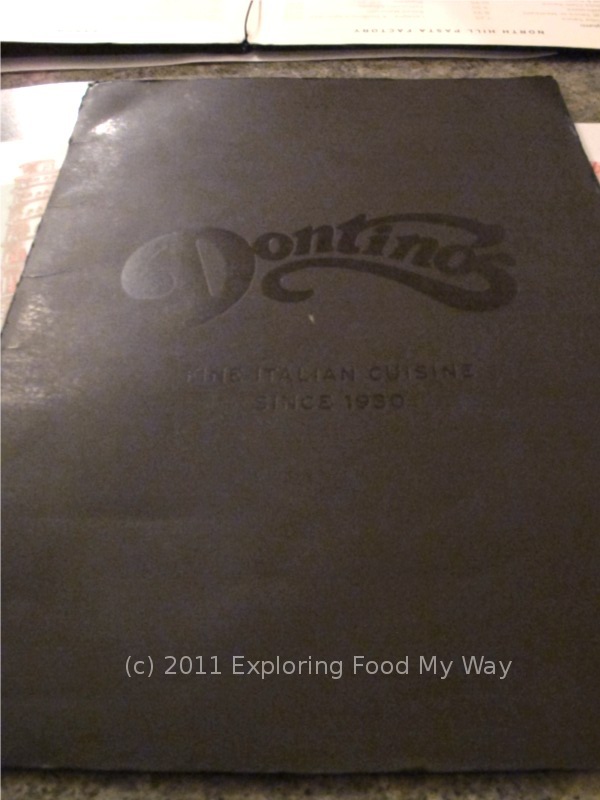
About a month ago, friend and fellow food blogger Kathy from Carano's Cucina and I were having a casual conversation on-line when the idea of grabbing a meal together came up. When she suggested Dontino's Fine Italian Cuisine, I was definitely intrigued by the notion. Having driven by the restaurant hundreds of times, nothing had ever prompted me to consider actually stopping in for a meal. Until today. Seeing as we were both slammed for the holidays, we agreed to wait until the new year to check out this long-time Akron staple.

Having been around for eighty-one years, the restaurant itself was fairly simple to find. Located at the corner of East Cuyahoga Falls and Linden Avenues, there was ample parking behind the restaurant. Technically the restaurant was located at 555 East Cuyahoga Falls Avenue, Akron, OH 44310 and can be reached at 330-928-9530. Interestingly, there were two entrances to Dontino's. The first was the door at the front of the restaurant on the corner. The second was towards the rear of the restaurant on Linden Avenue. Either led you into the restaurant.

Here was a shot of the front of the restaurant:

Front Entrance to Dontino's in Akron, Ohio
Tonight Kathy and I decided to enter the rear entrance (since we had parked in the lot behind the restaurant and this was the closer of the two entrances) and once inside, we were greeted with tonight's specials board:

Dontino's Specials Menu for Thursday Night
I'm not quite sure what "Guinness" was doing underneath the dessert selection for the day, but I've often considered Guinness to be substantial enough for a meal, so I didn't really give it a second thought. We indicated two for dinner and our hostess led us to an incredibly dimly lit table just off the lobby.

She left us with the menu to peruse:

Dontino's Dinner Menu Page 1
Dontino's Dinner Menu Page 2
Dontino's Dinner Menu Page 3
Dontino's Dinner Menu Page 4
[Ed. Note: For the camera geeks out there, in order to get a non-blurry handheld shot of the menu panels, I had to jack my camera up to an ISO of 3200 and the exposures still took nearly 1/2 a second. Thank goodness for image stabilization and some serious post-processing work in the GIMP. Fortunately, I was able to return to a more sane ISO of 200 for the food pictures since I had my tripod.]

After placing our food order, the server was quick to return with a basket of sliced seedless Italian bread:

Bread Basket
When the bread first came out, it was reasonably fresh, but it quickly staled and by the end of the meal, would've made a good candidate for croutons or French toast. The bread was served room temperature and while useful for sopping up red sauce off my dinner plate, was entirely unremarkable on its own.

As Kathy and I had both ordered an entree for our dinners, each came with a side salad with choice of dressing:

House Salad with Italian Dressing
Among the myriad of salad dressings our server named, only the house Italian was homemade. Both Kathy and I decided to go in that direction. The salad was about as tasty as it looked. The tomato was mealy and hard (it was a January tomato after all), the salad was completely unseasoned, and the dressing had split into oil and vinegar components. Hoping that the seasoning would be in the dressing, I liberally applied it to the greens. While there was definitely a lovely garlic flavor in the dressing, it lacked the kind of seasoning needed to punch up the flavors. Fortunately, a glass jar of grated Parmesan cheese (from the "green" can, I would assume) sat at the edge of our table. I generously dusted the top of my salad with the cheese, "tossed" my salad slightly, and took another bite. Eureka! Kathy repeated the experiment to her salad and came to a similar conclusion.

Tonight I decided to go with the Thursday evening special for my entree, Sausage and Peppers:

Sausage and Peppers with Dried Pasta
At the time I ordered this dish, I hadn't realized that it came with a side of pasta. For an additional $0.75, you can upgrade any of the pastas to homemade pasta. So, unfortunately, it was dried pasta for me. As I lifted the spoon from beneath my pasta, I noticed one of my pet peeves: a pool of water under the pasta. While one can argue whether plain noodles should be topped with sauce or whether the almost-cooked pasta should be finished by tossing it thoroughly in the sauce, one thing that should never be present is a puddle of water under the pasta. Fortunately, the water was fairly minimal and the red sauce thick enough that when I got around to eating it, the two integrated into a decent consistency.

As for the flavor, the spaghetti and red sauce were good, consistent with most mom and pop Italian restaurants. The pasta hadn't been cooked to death and once I topped the pasta with a bit of hot pepper flakes, it was spiced to my personal preference. The sausages were a little on the dry side, but definitely not so dry that it crumbled. While there was seasoning in the sausage, I missed the anise flavor that fennel seeds would have brought to the party (a traditional flavor found in most Italian sausage). There was also an absence of any chile heat that red pepper flakes usually provide. I didn't find the flavor objectionable, per se, but more uninteresting.

Kathy, knowing that her entree came with a side of pasta, opted to upgrade to the homemade spaghetti topped with the same red sauce that I had:

Chicken Parmesan with Homemade Pasta
Kathy ordered the Chicken Parmesan and she let me try a bit of her chicken (I had let her try some of the sausage from my dish). It certainly wasn't the best Chicken Parmesan I've ever had (that honor goes to Monte Carlo Italian Kitchen), but it wasn't bad either. It was clear the breading had herbs in it as not only could I taste them, but I could also see them.

When the subject of dessert came up, our server rattled off a list of several usual suspects (tiramisu and spimoni) as well as one that had been highlighted on the specials board at the front of the restaurant, Chocolate Peanut Butter Pie:

Chocolate Peanut Butter Pie
Not surprisingly, Dontino's didn't make any of their desserts and this was more than likely standard food service fare that you could get at any of the national chain restaurants. But, since Kathy and I wanted to end our meal on a sweet note, we each donned a fork and split the wedge of pie within just a couple of bites. It tasted good, but as I suspected, it wasn't exceptional or even really that unique.

Our meal complete, the server brought our check. Since Kathy and I had ordered virtually identically priced meals and split the dessert, she agreed when I suggested we divide it right down the middle. With tip and tax, each of us shelled out $18 for our meal tonight at Dontino's. While this certainly didn't break the bank for either of us, it wasn't exactly inexpensive either. Neither of us left physically hungry, but I can't help but think that tonight's visit didn't really quench my craving for really GOOD Italian food. I'm certain that being around for eighty-plus years has made for some arduous fans of Dontino's food. Based on the food from this first visit, I remain unconvinced.

Dontino's on Urbanspoon

Sunday, June 13, 2010

Kitchen Challenge: Roasted Beets And Whole Wheat Pasta

I won't go on and on about how much I enjoy the challenge of cooking from ingredients I find at the local farmer's market because I've done that before and I don't want to sound like a broken record. That being said, today's visit to the Howe Meadow farmer's market in Peninsula, Ohio, yielded me some tasty ingredients. Besides my usual stop at the Humble Pie Baking Company table to pick up my pie from my friend Diane, I made several other stops while wandering around the partially shaded grassy field. What I walked away with were some fresh beets along with their tops, a small container of goat cheese from Lake Erie Creamery, two pounds of freshly ground whole wheat flour from Mud Run Farms, a one pound sack of fresh sugar snap peas, and a bag of fresh, lovely smelling basil.

In trying to come up with dinner tonight for my grandmother, I decided to do a roasted beet salad for a starter and finish it up with a entrée of seared pork chops, a homemade whole wheat pasta that I would toss in the cooked beet greens, some rendered bacon and garlic, and the sugar snap peas, first blanched and then finished off by searing in some butter. The only complication was that I didn't have my pasta rolling machine with me and I've never rolled pasta by hand before. Then again, given that these machines are only recent additions to the home kitchen and pasta has been around for thousands of years, it was obviously possible and I was certainly capable of giving it the "old college try."

When I got to my grandmother's condo, I set about making the roasted beets. Here was a shot of the ingredients required to roast the beets:


My first task was to turn on the oven and set the thermostat to 400 degrees Fahrenheit. Next, I cut the beets from the stalks, placed a single piece of aluminum foil inside the pie tin and placed the cut and washed beets in the center of the foil. I added just enough olive oil to coat the beets. Here was a shot of the beets ready to be packaged up and roasted:


To package the beets, I simply folded the sides of the aluminum foil up over the top of the beets and crimped it shut. Depending on the size of your beats (and the number), the roasting time will vary. I checked after fifty minutes and while my paring knife slid easily through the outer layer of the beets, there was still just a tiny bit of resistance left. So, I let them roast another five minutes.

After they came out of the oven, I opened up the package to let them cool slightly:


After about ten minutes, they were cool enough to handle. To remove the skins and minimize staining, run the beets under cold water. To remove the skins, I just used a paper towel to rub the skins right off. It really was a pretty simple thing to do. Here was a shot of the finished roasted beets:


You could eat them warm right now or put them in the refrigerator for later if you wanted to eat them cold. Since my plan was to use them in a salad, cold was perfect. You could certainly do this step well in advance, even the day before.

Next up I turned my attention to making the whole wheat pasta. Here was a shot of the ingredients:


While you could certainly try and make whole wheat pasta with 100% whole wheat flour, it can get a little tricky and that flavor might be off-putting to some people. And since I was cooking for more than just me today, I decided to do a 50/50 blend between the whole wheat flour I got from Mud Run Farm and the AP (all purpose) flour I knew that my grandmother already had. The basic rule of thumb for fresh pasta is two large eggs for every pound of flour. So today I used:

227 grams whole wheat flour
227 grams AP flour
2 large eggs
1 tbsp extra virgin olive oil
2 pinches (roughly 1/4 tsp.) course sea salt

If you are using fine granulated salt, use half as much. You will also need about 1/8-1/4 cup of water, depending on how humid the air is as well as how old the flour is. Today I probably ended up needing the entire 1/4 cup. Also know that whole wheat flour absorbs more water per ounce than AP flour does, so if you decide to make the pasta with 100% AP flour, you would probably need less water.

After mixing the salt with the flours, I dumped it out onto my grandmother's counter and made a large well in the middle. I then scrambled the eggs and olive oil until it was well blended and then poured it into the middle of the well:


Using a fork, I gradually began to incorporate the flour from the inner edges of the wall and stirred it into the egg mixture. Don't be alarmed if, as you get close to the outer edge, you get an egg leak. I did and that was about the time that I switched from a fork to this VERY handy tool:


This is a metal bench scraper and is your best friend when making pasta. It allowed me to fold over large section of the emerging dough onto itself and keep the work surface clean. I used this while getting the dough to come together. At first the dough stayed quite crumbly and didn't want to come together, but after working at it for about five minutes and adding additional water, it eventually became a ball of dough. I could tell, however, based on the feeling of the dough and the fact that when I kneaded it under my palm (it basically tore instead of stretched), that I need to let this dough ball rest for about twenty minutes or so. This would give it time to allow the flour to fully hydrate and the gluten to begin to form. I formed the dough into a ball and covered it with plastic wrap:


After the twenty minute rest, I unwrapped and began to knead it again for another five minutes or so. BIG DIFFERENCE. The one rule that I always tell people when working with pasta or bread dough ... if something isn't working, if it isn't rolling out properly, cover it and give it a rest. Even five minutes of resting time will make a big difference. After the five minutes of additional kneading, the dough felt supple and when I stretched it with the palm of my hand, the dough didn't tear. I reformed it into a ball and then flattened it slightly into a disc, re-covered it with plastic wrap and this time I put it into the refrigerator since I wouldn't be rolling the pasta out for several more hours.

Here was what I put into the refrigerator:


You could also do this part ahead of time, although I wouldn't make the pasta too far in advance (maybe a day or two max). You could also freeze the dough at this point by double wrapping in plastic wrap and then placing in a freezer bag. Frozen dough could be made well in advance. The multi-hour rest also helped the gluten in the dough to relax, which made rolling the dough out much easier.

To roll the dough out, I unwrapped the dough, cut it into quarters, and then dusted both my work surface and the top of the quarter of dough:


Using my grandmother's rolling pin, I began at the center of the dough and rolled outward. Always start at the center and work your way outward. You'll get a more evenly rolled out piece of dough that way. Also, lift, rotate, and flip the dough often so that you make sure it doesn't stick to the counter. Add additional flour as needed, but try and use as little as possible as too much flour at this point will toughen the pasta. As I was rolling out my first piece, I noticed that the dough was fighting me, springing back when I rolled it out. So I decided to set it aside and work on the second piece. Each piece fought me and as each did, I set it aside.

When I got back to the first piece, it had relaxed and I was able to roll out this final shape:


I then used my chefs knife to trim off the irregular sides to make it either a square or a rectangle (depending on how good your rolling skills are). I then made sure the side facing me had a nice light even layer of flour on it and folded the pasta twice, both in the same direction, bottom to top. This made cutting the noodles really easy as I could go through four layers at the same time. After cutting all the noodles (and I was going for a wider fettuccine noodle today, you could certainly do spaghetti or angel hair if you are a true masochist), I opened each one up and loosely piled them together. To this "nest," I added a sprinkling of more AP flour and then used to my hands to "fluff" the nest, thus coating each noodle with just a little bit of the flour so that the noodles wouldn't stick together. After rolling out my four quarters of dough and cutting into noodles, I noticed that I had enough scraps of dough from the four quarters to mash together and get a fifth nest out of it.

Here was a shot of the fettucine nests, floured and ready to be cooked:


As it turned out, only three of these nests were required for dinner tonight, so I individually froze the other two nests in plastic baggies and then put them together inside a freezer bag for long term storage. That gives my grandmother two additional portions of fresh pasta she can use whenever she wants them. To cook them, dump them into boiling water still frozen and boil for about 4-5 minutes or until the noodles float to the top.

My pasta noodles cut and bundled, I turned my attention to the sugar snap peas. One of my favorite tricks with vegetables is to blanch them and shock them in cold water to stop the cooking. Once drained, they can hang out for hours until you are ready to finish them off. After snapping the peas and removing the string that runs along the inside of the vegetable, I set them next to the pot while I waited for it to come to a boil:


If you have more vegetables than will fit in your pot in a single layer, blanch them in stages. Today, I was able to fit them all in:


Once I tossed the peas into the boiling water, I blanched them for four minutes. You want them to be at the same time tender, but also still have a little bit of texture to them. Once the four minutes was up, I used a wire mesh strainer to move them to a bowl of iced water I had already prepared.

Knowing that the whole wheat pasta would cook within just a few minutes, I turned my attention next to the condiment in which I would toss the finished pasta. For my beet greens today, I removed the greens from the woodier stems, minced three cloves of garlic, and sliced five pieces of good old bacon:


The item on the bottom left was crushed red pepper flakes. Although grandma doesn't like it too spicy, I knew that a small pinch would add some character without making it too offensive. In my pre-heated skillet, I tossed in the bacon and cooked it until the bacon fat had rendered out and the bacon was crispy, maybe about five minutes.


To the cooked bacon, I added the garlic and sautéed it until I could smell the garlic and it began to brown slightly. I then added a pinch of the crushed red pepper and my chopped beet greens. Knowing that the greens needed some time to cook, I added about 1/2 cup of chicken stock to the pan, turned it down and covered it. This allowed the greens to steam. After about ten minutes, I checked on the greens and discovered that they had cooked down nicely and the chicken stock had now evaporated. Since I was still working my mojo with the four other components of the meal, I simply turned the burner off and let it stand until needed.

Next up, I turned my attention to the thick cut pork chops I had picked up at the local Giant Eagle. Here was my pork chop prep station today:


I seasoned each side of the pork chops with salt and freshly ground pepper. I then dredged each side in unseasoned AP flour, tapping to remove any excess. I added about a tablespoon of butter and a tablespoon of grapeseed oil to a pre-heated skillet, let the butter melt and brown slightly and added my massive chops. After cooking on the first side for three minutes, I flipped them over and sautéed them for three minutes more.

Here was a shot of the golden brown crust on the pork chops:


After three minutes on each side, I removed the chops from the pan and placed them on the foil lined tray of my grandmother's toaster oven (which I had set for 350 degrees Fahrenheit). I then finished them in the oven for another twelve to fifteen minutes or so. Ideally you want the chops to cook to about 155 degrees internally, because they will come up another 5 degrees or so while resting. And while I do enjoy my pork medium, that definitely wouldn't be acceptable for grandma.

By removing the pork from the sauté pan after cooking the chops also gave me a chance to build a pan sauce, too. I dumped out most of the fat (but without wiping out the pan) and added a healthy amount of chicken stock to the pan. Using my wooden spoon, I scraped all those lovely bits up from the bottom of the pan (also known as the fond). I then let the sauce reduce until it had a nice consistency and turned off the heat to whisk in two or three healthy pats of butter. I seasoned it with salt and pepper and added just a drop or two of sherry vinegar to balance out the mouth feel from the butter.

Just before dropping the pasta into the boiling water, I turned my attention to the roasted beet salad. I quartered the beets and arranged them on small salad plates. I then topped them with some of the goat cheese from Lake Erie Creamery (use a fork for this, it saves getting your hands all messy ... just scrape the fork tines repeatedly over the goat cheese and it will form crumbles), some fresh orange zest and a chiffonade of the fresh basil leaves I had obtained earlier in the day. To this, I added a sherry vinaigrette I had made from equal parts sherry vinegar and olive oil seasoned with a bit of salt and pepper to taste.

Here was the finished roasted beet salad:


I dropped the pasta into the boiling water and cooked it until it started floating on the surface, perhaps about three minutes. I then scooped it out using a mesh strainer and dumped it straight into the cooked beet greens, where a tossing with some tongs mixed the ingredients together. I then prepared a plate of food for myself and my grandmother. A couple slices of pork, a nest of pasta topped off with some freshly grated Romano cheese, and a spoonful of snap peas quickly sautéed in some butter and seasoned with salt and pepper:


Wow, so delicious and even with the additional fats I added (butter and olive/grapeseed oil), this still felt healthy. Having not eaten since the morning, I greedily devoured my portion. While grandma only ate about half of hers, she saved the rest of hers and ate it for lunch the next day. Even with having cooked only three of the five fettuccine bundles for tonight's dinner, the amount of food I had made today would've easily fed four hungry adults. And since nothing goes to waste (and I do mean nothing) in my grandmother's kitchen, I made up two extra plates of food, one destined for my grandmother's neighbor and one that I would have the next day for lunch, too.

My grandmother normally does the dishes when I cook, but because today had been a little hectic getting all of the components ready at the same time, I had used a few more dishes than usual. Not wanting to leave her with the mess that I created, I also helped her clean up and within about twenty minutes, other than the extra plates of food in the refrigerator, you couldn't even tell that I had been here today.

I know that homemade pasta isn't on everyone's radar, even though it is quite lovely and delicious and pretty easy to make, even if it does take a bit of time. The roasted beets, however, are a no-brainer and in my opinion, one of the easiest and tastiest ways to enjoy this vegetable. I grew up with only canned beets in my house and until I discovered the deliciousness that roasted beets bring to the table thought that I was a beet hater. My eyes have been opened and my taste buds are much happier for it.
Related Posts with Thumbnails