Showing posts with label Ann Arbor. Show all posts

Friday, August 20, 2010

eGullet Heartland Gathering: Sunday Brunch

The last official event of this year's 2010 eGullet Heartland Gathering in Ann Arbor, Michigan was to be held at Zingerman's Roadhouse. The Zingerman's brand has many food-related establishments under its umbrella and the Roadhouse seems to be the one place to bring all of the other brands under one roof and serve them to the public in a restaurant setting. The last time the Gathering had been in Ann Arbor (which just so happened to be the first Gathering I had ever attended), the weekend had been finished off with a brunch at the Roadhouse. I was eager to return again and sample the food one more time.

Zingerman's Roadhouse was located at 2501 Jackson Avenue, Ann Arbor, MI 48103 and can be reached at 734-663-3663. Parking was available outside the restaurant in the lot surrounding the building.

Here was a shot of the front of the restaurant:


Once inside, I was shown to our table and when I sat down, I noticed the pre-printed menu sitting at each diner's location. The difference this time around versus the last was that today's brunch had a theme: Everything's Better with Bacon. Instead of just selecting dishes off the regular menu, co-founder Ari Weinzweig had put together a five course bacon tasting menu for our little intrepid band of foodies.

Here was a shot of the menu today (one of the courses was a surprise course and not listed on the menu):


Our server today, Shea, walked around and efficiently filled everyone's drink orders. Knowing that the Zingerman's brand also included a coffee roasting facility, I felt it would be more than acceptable to order a cup of decaffeinated coffee:


The coffee was bitter, rich, and complex all at the same time. It was the perfect accompaniment to the sweet components of this morning's brunch.

The first dish we would be served today was a simple plate with four strips of bacon on it:


It was at this point that Ari joined us at the table and began to explain the four pieces of meat currently in front of us.

* At the left was a piece of bacon from Sam Edwards. The pork used was of a Berkshire variety that was free range and dry cured in salt before being smoked using green hickory wood.

* Second from the left was a bacon from Allen Benton in eastern Tennessee. It was also a Berkshire variety pig and while the most meaty, it was also the most heavily smoked, spending several days in the smoker with hickory wood smoke after being dry cured.

* Second from the right was a bacon from Nueske's in Wisconsin. It was done using a wet cure made from water, salt, and sugar. Wet cures are traditionally done in cooler, wetter climates and dry cures are typically done in hotter, drier climates.

* At the right was a piece of Arkansas peppered bacon from the Schlosser family. It was also wet cured using brown sugar.

I tasted each as Ari went over a description of the curing and smoking process of each. As Ari pointed out, each was an excellent piece of bacon, but each had its own personality. Where one type might pair well with something delicate like fish (i.e., the first variety), others would definitely only stand up to something much heartier (i.e., the second variety). Just based on the boldness of the smoke flavor, I really liked the second sample, the Allen Benton bacon. Some people might think it was too smoky, but it really reminded me of camping out when I was a young child. The other bacons were good, but that one was superb.

After our bacon tasting, the next two courses appeared at our table on the same plate:


On the left was the "Grits and Bits Waffle" and to the right was the "Pimento Cheese & Peppered Bacon Scrambled Eggs." Let's take a closer look.

First, the Grits and Bits Waffle:


These were waffles that actually had bits of Anson Mill's organic grits in the waffle batter itself and was topped with Vermont white cheddar cheese and applewood smoked bacon. Accompanying the dish were small pitchers of Ralph Snow's Michigan maple syrup. I tried the dish sans syrup and while interesting, it didn't quite feel like a breakfast dish without the addition of a little maple syrup. Not so much syrup that the sweetness destroyed the delicate balance of flavors, but just enough to get that sweet / salty combination just right. I think what surprised me the most was that I could really taste the "corniness" from the grits inside the waffle batter. The bacon and cheese served as a source of saltiness, but amazingly, neither was too overpowering.

On the opposite side of the plate were the pimento cheese and peppered bacon scrambled eggs:


The pimento cheese was a homemade concoction consisting of Grafton two-year-old cheddar cheese, mayonnaise and pimentos and was scrambled into eggs with some of the Arkansas peppered bacon. Personally, I've never had pimento cheese before, but I have to say that I could taste each of the unique flavors that made up Zingerman's version, including the creaminess of the mayonnaise. Again, it was a very well balanced dish and the salt and pepperiness already present in the bacon meant that this needed no additional seasoning at all.

The next dish up on our tasting menu was the "Biscuits and Chocolate Bacon Gravy":


As Ari would tell us as this was being served, the tradition of using cocoa powder is quite old, about one hundred and twenty-five years, from the Appalachian region of the country. Since chocolate was too labor intensive to move into the mountains, it wasn't until cocoa powder became available that this incredibly regional dish became popular for family and special occasion dinners. Essentially a bacon gravy that had been studded with large amounts of cocoa powder, the resulting gravy was ladled over Zingerman's homemade buttermilk biscuits and topped off with just a few crumbled bits of the applewood smoked bacon.

How was this rather unique dish? It was actually pretty good. It wasn't particularly sweet, but at the same time I wouldn't call it entirely savory either. It had the consistency of a fudge sauce, but the smokiness from the bacon cut through to let you know that this wasn't exactly a topper for a scoop of vanilla ice cream. It's probably not something I would crave on a regular basis, but at the same time I found the flavor combination fascinating.

When we thought we had finished, Ari had one final dish for us to try:


This was a small dish of maple bacon gelato that they had whipped up just for the occasion. A small scoop, it was the perfect way to end our decidedly savory brunch today. The maple flavor was quite strong and balanced nicely with the saltiness and smokiness from the bacon pieces embedded in the gelato. I don't know that I would order this from a gelateria if I was just looking for something cold to cool me down on a hot day, but as a finisher to our bacon brunch, I think this did an admirable job.

While I decided not to include Zingerman's Roadhouse's regular brunch menu in this write-up because we didn't actually eat anything off of it, I will say that their commitment to quality ingredients does pay off with exceptional flavor on the plate. That being said, expect to pay a bit more for dishes here because of that fact. The prices aren't outrageous, but if the ultimate expression of a dish isn't your cup of tea, then the Roadhouse might not be for you. That being said, the place was packed from the moment we got there to the moment we left, so clearly they are doing something right.

From my two visits, I can definitely recommend that you give Zingerman's Roadhouse restaurant a try if you happen to live in or are driving through Ann Arbor, Michigan. The food might be a little on the pricey side, but you will be getting quality local ingredients and premier artisan products that are expertly prepared and quite delicious to eat. As the saying goes, you get what you pay for. [Ed. Note: Although my old English teacher might rephrase that as "For what you pay, you get." She hated dangling prepositions.]

Zingerman's Roadhouse on Urbanspoon

Wednesday, August 18, 2010

eGullet Heartland Gathering: The Main Event

[Ed. Note: For those visiting my blog for the first time coming from the Akron Beacon Journal article that Lisa Abraham wrote and published today, welcome! You are invited to come in, take your time and look around, and get comfy while reading about my adventures in food. All constructive feedback is welcome here, either in the comments area of each blog entry or in an email to me directly by clicking here. While I appreciate that not everyone will like my writing style or my take on food, I wanted to thank you in advance for taking the time to check out my little dog and pony show.

And for my regular readers, thank you for coming back time and again. Interacting with you is what makes writing this blog lots of fun!]


So the day for the main event has finally arrived: Saturday's dinner! I have to say that this has been the one day I've most looked forward to every year since I started attending these Heartland Gathering weekends. What started out with me knowing just a handful of on-line screennames and avatars on the eGullet forums has genuinely developed into real, honest to goodness personal relationships that I've come to value both on-line and off.

As has been my tradition since I started attending this dinner, this year I was to provide bread for the afternoon noshing as well as for the dinner proper. Fortunately, as opposed to last year, I had access to the kitchen at the common room of the cohousing complex where the dinner was to be hosted. That being said, because both breads I was planning on making required a poolish, or starter, when I got home from the previous night's meal at Grange Kitchen and Bar, I still needed to take a limited amount of bread equipment and ingredients to my hotel room in order to mix up two batches of the pre-ferment. I then parked both containers in the warmest part of my hotel room, the bathroom, and turned on the heat lamp for about thirty minutes to get them started. When I checked them the next morning, they were healthy and happy and I packed everything up and headed to the co-housing complex.

While the cooking would last well into the evening, my portion of the effort would start at around 8:00 am. I was intending to do two batches of French style breads and two half-sheet pans of Italian focaccia topped with a caramelized onion and reduced balsamic vinegar with fresh thyme topping. Fortunately, another eGulleter, Alex, who happened to be staying in the common house, was there to greet me and help me get started. While I started my mise en place for my first and second batches of French bread, he began the time consuming process of slicing and then caramelizing four absolutely huge Walla Walla sweet onions I had purchased the night before.

While I have previously published the recipe for my focaccia, the French bread recipe I used today was just a slight deviation from the classic formula that is still used today. Here is the classic:

Classic French Bread
1000 grams flour
600 grams water
20 grams salt
20 grams fresh cake yeast

My Tweaked French Bread
1000 grams flour
700 grams water
20 grams salt
20 grams fresh cake yeast

Why the change? The extra water gives the finished bread a lightness to it. When you cut into the bread, you can see all the irregular holes that fill the crumb. While the classic works just fine, the holes in the crumb are a bit more evenly spaced. Both taste great, but my version gives you the right artisan feel to it as well. The downside is that the extra 100 grams of water makes the dough just a bit more of a pain to work with on the table when folding and shaping. If you are just starting out, gentle reader, go with the classic recipe. Gradually add additional water each time you make the dough until you reach a level of hydration that is comfortable for you.

While this post wasn't designed to be a tutorial on how to make the breads, I thought it would be good to get this part out of the way before moving on to the dinner so that you could see my contribution to today's activities. Which, with this picture of my almost finished breads (missing the second focaccia that was still in the oven), should give you an idea:


Here was a shot of some of the French loaves cut up and sitting out on the table to be matched with another guest's homemade charcuterie:


While many Americans would think that the crust was too dark, to me it was baked to that perfect point where all of the liberated sugars from the flour had caramelized to a dark reddish, golden brown hue, the crust was chewy, and the crumb had just the slightest give when pulled apart. For a bread with only four ingredients, this recipe really delivered and had simply marvelously complex flavors.

The other bread that I did for today was the focaccia with balsamic caramelized onions and fresh thyme. Here was a side shot of a piece of that bread on my plate for the first course of our meal tonight:


This was another winner (again, notice the open hole structure) and between both breads, whatever was left over from dinner quickly disappeared into take home baggies. When I returned to my bread station to finish divvying up the remainders, I found that I didn't need to do anything because the uncut loaves had just magically disappeared. While I received many in-person compliments during the course of the day, seeing a completely empty cutting board was the best compliment I could've received. Thanks again to Alex and Prasantrin for helping me out today.

Now that you've seen my contribution to dinner, let's take a look at the pre-dinner activities. One of the other guests brought four different kind of homemade dried sausages (aka the charcuterie I mentioned above). He had made them months in advance and then simply frozen them until he needed them. Having been vacuum packed in heavy plastic bags and gently brought back to life in the refrigerator, each presented its own unique flavor and texture.


Here we have pepperoni, sopressata, finocchiona, and lombardia. To me, the true revelation was the humble pepperoni. While a simple combination of pork and a ton of paprika, this was unlike any other pepperoni I have ever had. When I asked the progenitor of the sausage how it was on pizza, his eye twinkled just a little bit and he said, "Unbelievable." I bet. Also visible in the picture above was some smoked Pacific salmon that another member from the west coast had brought, too.

After spending the afternoon casually cooking, noshing, and generally having a good time, it was finally time to get down to business: a six course, plated dinner of today's culinary efforts by six different teams of people.

The first course was a chilled poached Michigan shrimp with tomato and corn salad:


This was the perfect way to start our meal. The Michigan shrimp had been poached in a lobster and shrimp stock and then chilled. The salad consisted of corn, multi-hued grape tomatoes, cucumber, red onion and was dressed in a light vinaigrette containing lime juice and rice wine vinegar. The green "sauce" on the bottom of the plate was actually a fresh basil oil made from the basil leaves plucked right outside the front doors of the common room. This was quite tasty and the portion size was perfect for this type of meal.

The second course was a play on the famous dish Bison and Beets from the Alinea At Home cookbook. As there were several vegetarians at tonight's dinner, instead of making a meat course and vegetarian option, another participant decided to just go with an all vegetarian dish. Here was her homage to Chef Grant Achatz's original dish:


This was a sous vide beet on top of a fennel puree accompanied by pickled blueberries, a freeze-dried blueberry and dehydrated beet crumble, and a toasted Spanish cheese wedge. While I have never had the original dish at Alinea, I can tell you that the level of dedication in order to pull something like this off was quite remarkable. The dish, as much art for the eye as for the mouth, combined many different flavors and textures to make it sort of a "Choose Your Own Adventure" type of course. While this type of cooking isn't for everyone, I definitely found it interesting and playful (as well as tasty).

Our third course tonight was a playful reinterpretation of a popular Portuguese and Brazilian soup, caldo verde:


This was a soup shooter containing a potato and kale soup that had been topped with a chorizo foam. Keeping the vegetarians in mind, the soup had been made with homemade vegetable stock and an alternate "foam" was used to top the non-meat shooters. Personally, I loved the chorizo foam. It was spicy and creamy, but not overbearingly so. The soup itself was luxuriously smooth, warm, and soul-satisfyingly good. You could really taste the kale and the potato with each sip.

In addition to doing the breads for today, I had agreed to help out long-time friend and fellow foodie, Edsel, with his course tonight, hake en papillote. He had originally wanted to do a meat course, but when someone else stepped up and picked grilled lamb, Edsel saw the opportunity to do something wonderfully light. He picked up about five and a half pounds of hake, a sustainable white fish, and between a small group of us, we prepared the vegetables that went inside, portioned the fish, and wrapped it all up in these cute little parchment pouches:


After baking for roughly twenty minutes, we plated the pouches, cut a slit into the parchment to facilitate eating, and distributed them to the guests. Here was a shot of my pouch, completely torn open:


The fish was exquisite (and not just because I had a hand in making them). It was moist, tender, and perfectly seasoned. The fish had been topped with a combination of red dragon carrot coins, batons of zucchini, two different types of oyster mushrooms, and sliced shallots. The vegetable medley had been gently sweated in olive oil and then dressed in a vinaigrette of sherry vinegar, olive oil, a scant touch of toasted sesame seed oil, salt and pepper. While I knew that there were still more courses to come, because a few extra packages remained after serving this course, I had a second helping; it was simply that good. Bravo, Edsel!

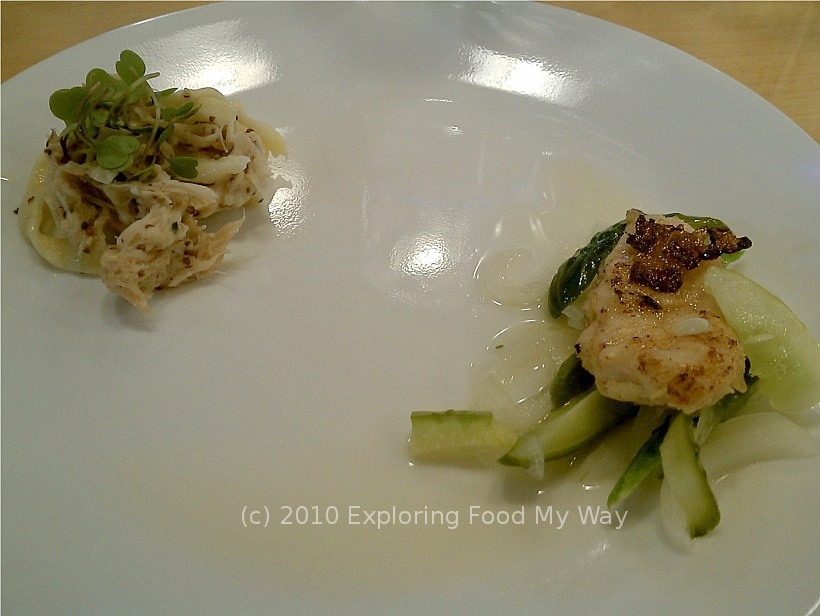
Our fifth course tonight was to be a playful effort by another attendee to showcase some locally caught rabbit in two ways:


On the left side of the plate was a rabbit confit that had been tossed with some grainy mustard and cream and homemade fettuccine noodles and topped with some micro-greens. To the right was a pan-seared tenderloin of rabbit poached atop some lightly pickled cucumbers and onions, drizzled with just a light honey sauce and finished with a small piece of lemon cucumber. Another compliment to portion size must go to the chef of this course, as it could've easily become overwhelming.

The flavor of each component was separate, but at the same time the common element, the rabbit, unified both flavors together nicely on the plate. While rabbit isn't something I have very often, both elements were cooked quite well and plated nicely. I especially liked the acidity that the quick pickled vegetables brought to the pan-seared rabbit loin and the honey sauce added just an ever-so-slight sweetness to the dish that didn't interfere with its savoriness.

Our sixth, and final savory course for the evening was a joint effort between Team Lamb and Team Lebanon:


To the left was a perfectly marinated and grilled leg of lamb and to the right was a wonderful Fattoush that had been prepared by Team Lebanon, Chef Crash and his wife. The lamb was marinated in fresh garlic, rosemary, and some olive oil and sat in the marinade for most of the afternoon. Then, at the last minute, it was cooked on an outdoor gas grill. I was worried that it might be too well done, but as you can see from the picture above, it was cooked to a textbook medium-rare.

The Fattoush was a nice contrast to the lamb as the sour element that the sumac brought to the plate helped cut through the fattiness of the lamb. The toasted pita chips gave the salad a nice texture contrast and overall, while I haven't had the opportunity to enjoy this dish in the past, I think it will be on my "to taste" list the next time I stop in for Lebanese food at my local Cleveland, Akron, or Canton eateries.

While there had been six savory courses to tonight's meal, what people easily forget is that there's always the hidden seventh course, DESSERT! And tonight's participants delivered mightily in that department. While I certainly didn't (and honestly couldn't) taste everything that people brought, I did take pictures of most of it and at the very least, I will tell you what eager eGulleters brought for the sweet end to our amazing meal.

First up were some chocolate cupcakes that had been frosted and decorated with actual edible flowers:


Next up was some homemade baklava that I was fortunate enough to taste:


Adorned with just a little bit of crushed pistachio on each triangle, these were truly delicious. It was sweet without being cloying and the texture of the nuts, phyllo, and honey syrup made this a decadent way to end my meal today.

Next up were some liquor filled truffles and chocolate bark:


And a Four Berry Pie from the Achatz Baking Company as well as some homemade black currant pate de fruit:


Another Lebanese treat that was prepared by two of the guests was the K'nafeh B'jibin:


Made from semolina, a soft Lebanese cheese, and doused in a simple syrup containing both rose and orange blossom water, this was an unusual (to this American anyway) but delicious treat that I was delighted to have a chance to try.

Besides the entire tray of fresh baklava, a smaller pan of Detroit's finest also showed up:


Finally, the same guest responsible for the chocolates and pate de fruit also made a creme Chiboust:


This was a pastry cream that had been lightened with fresh whipped cream, spread out onto foil and then frozen. This allowed the dessert to be cut into squares, placed atop fresh raspberries, sprinkled with a little bit of sugar and then bruleed until the tops were crunchy and brown. Unfortunately, I didn't have any more room in my stomach so I never got to try this.

Our meal now complete, everyone went from cooking, plating, and eating mode to clean-up mode. After cleaning up my bread station and repacking my car with all of my equipment, I was off to return to my hotel room, much more full and weary than when I arrived this morning. Even with me being tired and a little sore, I still had a blast today and would do it again every day without question. While we ended up with roughly thirty guests to feed tonight, I would encourage you to try this on a much more scaled down level. Visit the market in the morning, cook with your family and friends in the afternoon, and just have a great time being around one another the entire day. Sharing a meal with my friends today was just as important to me as cooking the food and I encourage you to do the same.

Monday, August 16, 2010

eGullet Heartland Gathering: Grange Kitchen And Bar

I've written about my experiences at last year's eGullet Heartland Gathering in Kansas City. Between making bread in my hotel room, preparing and eating the dinner we made from shopping at the farmer's market, and the absolutely fantastic outdoor brunch we had at Crum Farm before returning home, it was seventy-two hours of driving, eating, and experiencing some really great food and people.

This year, fortunately, the festivities returned to the same city where I had first attended the gathering back in 2006, Ann Arbor, Michigan. Instead of a twelve hour drive, it would only be three. Seeing as I had a kitchen available to me on the Saturday morning of the feast, I was able to go up a day early to attend a prix fixe tasting at one of Ann Arbor's premier farm-to-table restaurants, Grange Kitchen & Bar. Chef Brandon Johns had prepared a seven course meal for us that highlighted the local, sustainable cuisine that he featured daily at his restaurant. While there would be a wine pairing available for those who wanted it (at an extra cost), I was just excited to try out what looked to be a fantastic menu.

But I am getting ahead of myself. First I should tell you that Grange was located at 118 West Liberty Steet, Ann Arbor, MI 48104 and can be reached at 734-995-2107. Since Grange was essentially located on the campus of the University of Michigan, parking can be tricky. I ended up parking in a garage about a fifteen minute walk from Grange at a cost of only $4.50. However, streetside parking was available if you were lucky enough to snag a spot.

Here was a shot of the street-facing exterior of the restaurant:


Once inside, I was directed up the stairway to the bar area where the staff had set up an extra long table for our group of fifteen or so diners. On each plate, a single piece of paper with tonight's menu had been gingerly placed:


When we finally sat down around 7 PM, we began a three and a half hour odyssey that included some great food, great conversation, and a stop by the chef at our table for each of the seven courses. Before beginning, the chef gave us some background on the type of food they were trying to do at Grange. In addition to having a garden in the back lot of the restaurant, they tried as hard as possible to limit the source of their animal and vegetable products to within a fifty-five mile radius of the restaurant. The chef also mentioned that instead of buying pre-butchered cuts of meat, he bought the entire animal, butchered it entirely himself, and used as much of the animal as was possible. In fact, he added, the menu tonight would reflect this philosophy.

With that, our meal began and the first course arrived at our table:


This was called "Nose to tail house made charcuterie" on the menu and featured a terrine made from multiple parts of the pig, a pig ear aspic, house made coppa, a tomato jam, and pea shoots in the middle of the plate. Everything on this plate was tasty. That being said, the pig ear aspic had a slightly unsettling "crunch" to it that might make the unadventurous eater a bit hesitant. The coppa was nice, being salty and spicy, and the tomato jam added a wonderful sweetness and acidity to the other flavors on the dish. My favorite item on this plate was the terrine.

Our second course were Walleye "brandade" fritters with green tomato jam:


The chef used the word "brandade" not because the fish was actually salt cod, but fresh walleye that he had preserved for one month in the same style as salt cod. He then soaked the dried fish in several changes of water before incorporating the flaked fish with mashed potatoes, formed these tiny fritters and deep fried them to a golden brown. The dish was served with a green tomato jam that added a little sweetness, but mostly the sour flavor from green tomatoes. To say that this was a hit was an understatement. The fritters were delicate and light and perfectly fried and the cured walleye was salty without overpowering the rest of the flavors in this dish. I don't think I would be the only diner tonight to wish that we could've made an entire meal out of this course alone.

The third course tonight was a Fried Pig's Head, mustard, and sauce gribiche:


Not to be confusing, but this wasn't a slice of pig's head, per se, but the meat that had been cooked and shredded from an actual pig's head, formed into patties, breaded and deep fried. While it has been suggested by several friends that anything deep fried is delicious, in this case, it was a bit of a stretch for me. Of course I ate the entire plate, enjoying the subtle mustard flavor running throughout the meat and pairing it with the chopped egg, chervil and caper laden sauce gribiche, but I kind of wish I had gotten to try the vegetarian third course instead: goat cheese stuffed squash blossoms that had been battered and deep fried. That being said, I kept an open mind and an open mouth. I'm glad I tried it, but I don't know that I'd be running back for seconds.

Our fourth course in my mind was an intermezzo, a middle course that separated the beginning tastes from the later ones. Tonight's fourth course was an Heirloom Gazpacho with Michigan Pickled Shrimp Salad:


This was the perfect amount of soup to sate the taste buds; too much would've resulted in tasting fatigue. The pickled shrimp was sour and sweet at the same time and was perfectly cooked and tender. There was a bit of laughter when talking about the fact that the shrimp really was from Michigan, but it smelled quite fresh and tasted even better. Drops of extra virgin olive oil dotted the top of the soup in order to add a bit of unctuousness to the tomato flavor.

In delivering our fifth course, I could tell we were squarely into the main entrée portion of our meal. Here was Duck, Peaches, Coriander, Honey Glaze, and Whole Grains:


The duck breast had been seared to a beautiful medium-rare, sliced, and fanned out on top of cooked wheatberries and spelt. Grilled peaches had been placed atop the duck breast and the entire dish was then sauced with a honey glaze that had been infused with a warming spice, like cinnamon. The whole grains popped in my mouth and gave just a bit of resistance when chewing. The savoriness of the duck breast matched well with the sweetness from both the peaches and the honey glaze, which turned out not to be cloyingly sweet, but fairly subtle. Overall, I'd had to say that this was my favorite savory course, next to the walleye fritters.

Our final savory course, the sixth one overall, was a Whole Roasted Tenderloin, Pickled Oyster Mushrooms, and Heirloom Carrots:


Two slices of perfectly crusted tenderloin sat atop the pickled mushrooms and heirloom carrots. While the outside layer of tenderloin was perfect, the middle was extremely rare (what some might term Black and Blue) and as much as I like beef carpaccio, this was a bit too rare for my taste. Everyone else proclaimed the perfect doneness level to the beef, so perhaps my expectations were off, but I would've liked it at least rare (preferably medium-rare). Nevertheless, the parts that I did eat were absolutely delicious and the acidity from the pickled mushrooms went quite well with the savoriness from the meat. I could also tell that the dish had been finished with a bit of fleur de sel, which I appreciated with every bite.

Dinner now almost complete, our impeccable service staff cleared the table in preparation for the final course, dessert! Tonight we would be having a Plum Upside-down Cake with Goat Cheese Ice Cream:


While it was original supposed to be goat cheese sorbet, apparently there had been a slight change-up at the last minute. I tasted the goat cheese ice cream first and was literally in heaven. The tanginess from the goat cheese paired from the sweetness of the sugar and the creaminess of the ice cream base all came together to make an absolutely delicious combination. I then turned my attention to the upside-down cake. On the top was the crispy cake layer which crunched under my spoon as I cut into it. At the bottom of the cake was a warm layer of cooked plums which thankfully still had some of their acidity in them to cut through the sweetness of the dessert. The combination of the textures and flavors was quite good and had I not already had six courses prior, probably could've eaten another one of these desserts.

Having started dinner at 7 PM, looking at the clock, it was now just a little past 10:30 PM. Dinner service for the restaurant had more or less come to a close and Chef Johns joined us at the end of the meal for a heartfelt round of well-deserved applause. While not everything I was served tonight was something I would've sought out on my own, he definitely expanded my horizons and for that, I am exceedingly grateful. While we didn't have a chance to order anything off of the regular menu, I have no doubt that it is in the same spirit as the menu we enjoyed tonight.

I heartily recommend that if you live in or will be visiting Ann Arbor soon, definitely make Grange Kitchen & Bar a must-stop restaurant for an gastronomic experience that is unlike many others. I will be the first to admit that a meal at Grange isn't inexpensive, but considering the many exciting tastes and preparations you will receive, the value certainly matches the price.

Grange Kitchen & Bar on Urbanspoon
Related Posts with Thumbnails