Showing posts with label Japanese noodles. Show all posts

Thursday, December 15, 2011

Dinner In The Dark - Noodlecat!

Holy moly! I just realized that I haven't written a blog entry about a Dinner In The Dark charity event since April earlier this year. That means that five of these fantastic dinners have come and gone (one month was canceled and another month was skipped due to low attendance) since I have mentioned this wonderful Cleveland-based organization seeking to not only bring together some of northeast Ohio's best chefs, but also help a local charitable cause in the process. While one of the founding members, Ellis Cooley (who was the chef at AMP 150), has left the Cleveland area to return to his home in Florida, he remains a part of the group along with co-founders Brian Okin and Jeff Jarrett (who interestingly enough now presides as chef at AMP 150). The trio has also recently given their website a face lift to feature events, news, bios on the participating chefs, and the pictures that yours truly has taken at prior dinners.

Tonight's dinner was held at Noodlecat, Jonathon Sawyer's recently opened Japanese and American noodle house mashup. This time around, the dinner was being held to benefit Michael Cantu, a Brecksville young man who earlier this year was involved in a gymnastics accident that left him in a wheelchair with many months of hospital stays.

Since the dinner was on Monday night, parking was a breeze. Since there were no downtown events happening that night, the valet next to Lola Bistro on East 4th was only $8 and the walk from the valet to the front of Noodlecat took all of five minutes. For those unfamiliar with the location of Noodlecat, it is just west of the House of Blues on Euclid Avenue in downtown Cleveland.

Once inside the restaurant, my friend Tami and I were quickly shown to our empty table, having arrived prior to the others in our dining party. I quickly got out the necessary camera gear for tonight's shindig and started to get set up. Here was a shot of the front of the menu:


While I know you haven't seen that menu in some time, gentle reader, a lot of the same players involved now are those that have been with the group since the beginning. Probably the one major addition to those sponsoring the event is Fat Casual BBQ, who graciously provided the staff meal for those involved in pulling off this event.

Flipping the menu over, the back contained the usual list of chefs and symbols cryptically suggesting what each course would be:
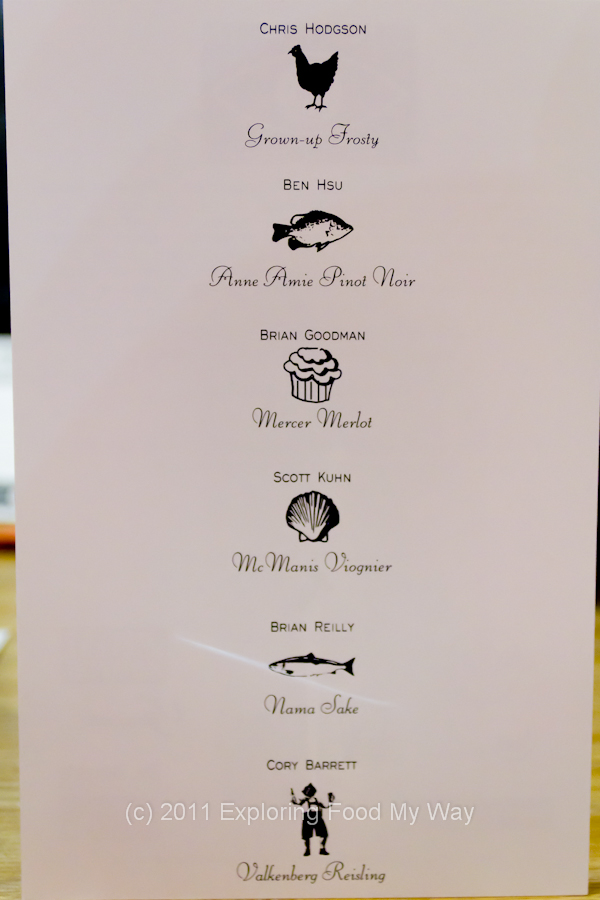

All were pretty straightforward except for the guy in the lederhosen for the dessert course. Knowing that Cory Barrett used to be the pastry chef for Lola Bistro, we knew that whatever it turned out to be, it would certainly be very creative and tasty.

Having finished examining the menu, Tami and I turned out attention to the platter of sliced bread sitting in the middle of the table:


While most DITD events have started with an amuse bouche, we couldn't figure out if this was a pre-amuse or this was the main event. It turned out that the bread with herbed olive oil was either the amuse or perhaps just a pre-dinner nibble and there was no official amuse. Either way, mix tasty bread with tasty oil and my mouth was definitely ready for what was to come next.

To go along with our pre-dinner nibble, Joe Deluca and Tobin Northrup sent out a cocktail called Winter Eve Warmer:


Served hot, this mulled wine had all of the warming spices from the Thanksgiving and Christmas season infused into it. There was just enough in the glass to give you a warm feeling inside while the first course made its way into the dining room.

Speaking of which, the first course was Chris Hodgson's (from Dim and Den Sum, Hodge Podge, and the soon-to-be opened Hodge's) and was a play on a "Wendy's Spicy Chicken Sandwich":


The patty consisted of a combination of sous vide and ground chicken thighs mixed with foie gras, seared on the flat top. It was served on a toasted bun with a waterlily leaf, roasted jalapeno and orange blossom aioli and a sliced grape tomato. When assembled, this was quite the mouthful, but a tasty mouthful at that. The foie gras had done its job of adding lots of moisture to the patty and when taking bite after bite, it was imperative to keep the slider over the plate, lest you wear the juice. The sandwich also had a very subtle spice, which was enjoyed by everyone sitting at my table.

The second course came to us from Ben Hsu (from Sushi 86):


The sushi "sandwich," as Chef Hsu put it, was actually seared Albacore tuna sushi done in an Osaka style presentation (where the sushi is made by pressing it into a box), Ghost Chile aioli, shredded daikon radish, wakame jelly, celery leaf, and scallions to garnish. I had never tried Ghost Chiles before, but I do know they are the hottest chile peppers on the planet. I was intrigued to see how well the chef had controlled the heat.

I took a bite with a little bit of each component in the dish and my mouth was rewarded with culinary bliss. Chef Hsu completely knocked this out of the ballpark. The fish was tender, perfectly seared on just the exterior. The Ghost Chile aioli was creamy with just a hint of spice, the wakame jelly added a bit of seaweed flavor and the gelatin helped to cool off the spiciness from the sauce. This was absolutely delicious. I would have been a very happy man with four more courses of the exact same dish.

Fortunately, for me, more delectable goodness was on its way. Specifically, the third course from Brian Goodman (of Greenhouse Tavern fame):


Jonathon Sawyer has been prepping himself to serve a meal at the James Beard house in the near future. He and Brian turned to Richard Olney's Souffle a la Swissesse to accomplish their task. The cheese souffle was cooked well on the outside and managed to stay tender, moist, and steaming on the inside. The souffle was nestled in a bowl of pureed mushrooms and chestnuts and was garnished with fresh thyme. This was truly an umami "bomb," if you will, with the flavors of mushroom, thyme, and cheese predominating. It was also incredibly good and more than one of us at the table wished it wasn't so verboten to lick the bowl in a public restaurant.

Normally at this point in the meal, an intermezzo is served to clear the palate from the previous courses and to prepare the palate to receive the final dishes in the meal. While an intermezzo is usually something slightly sweet and acidic (like sorbet), in sticking with the theme of Noodlecat, a plate of pickled vegetables appeared at our table for us to share:


Starting at twelve o'clock on the plate, you have pickled beets, pickled turnips, pickled pumpkin rind, pickled radishes and the small ramekin in the middle held kimchee, that wonderful pungent and spicy fermented cabbage that Koreans contributed to the global culinary scene. Each was good, but I particularly liked the pickled turnips because they had a nice balance between the acidity of the vinegar and a natural sweetness.

The fourth course was presented to us by Scott Kuhn (from Washington Place Bistro & Inn):


The scallop had been encrusted with dried porcini powder before being seared to a beautiful medium-rare. The scallop was soft and tender and a delight to eat, although mine was a touch on the aggressively seasoned side. That being said, the Israeli couscous that was served with the scallop was a bit underseasoned, so perhaps they were meant to be eaten together. Having only one type of mushroom on this plate was definitely not enough, so in addition to the porcini, sauteed Chanterelle mushrooms made an appearance as well as impossibly-thin shaved black truffles.

For our final savory course, Brian Reilly (from Noodlecat) gave us a soul-satisfying Japanese noodle dish with a twist:


This was the more traditional Japanese component of tonight's fifth course -- fresh Ohio City Pasta udon in a kombu broth with Enoki mushrooms, softened kombu, and scallions.

The American twist came to us in a Chinese take-out box:


Inside was a battered and fried halibut with nori on a stick -- Americans love anything fried on a stick after all -- sitting on top of micro-greens. After combining the two components, I ended up with this:


By the time we were served this course, many at my table were ready to cry "Uncle!" because we were so full. Some ate a little, some ate it all, I ate about half. I ate all of the crispy and juicy halibut, which was cooked to perfection. The pasta served tonight was a little bit flatter than regular udon and after much debate amongst my tablemates, a table-hopping Jonathon Sawyer finally put it to rest by asserting that it was indeed a form of udon. The noodles were tender while still retaining a bit of toothsomeness. The broth was characteristically Japanese, light with great depth of flavor. Overall, this was a lovely dish, even if I didn't finish it.

Our final taste of the evening came from Cory Barrett, former pastry chef at Lola Bistro and now executive chef:


It turned out that the gentleman in lederhosen on the menu actually referred to a citrus Bavarian cream on top of an almond spongecake all topped with a white chocolate plaquette. Also on the plate was a lime curd, Mardarin orange and ginger beer sherbet, and a cardamom crumble. Garnishing the sorbet was a single red sorrel leaf. This was the PERFECT way to end the meal. The dessert was both sweet and tart and easily cleansed the palate after so much other food had preceded it. The cardamom crumble almost had a peppery spice to it that was a wonderful foil for the sweetness. Cory may no longer be practicing the pastry arts on a daily basis, but he has lost none of his skills at balancing competing and complimentary flavors.

Our three hour culinary journey at an end, we packed up our bags and headed out into the chilly Cleveland air. Before we left, it was announced that next month's Dinner In The Dark event would be held at Rocco Whalen's Fahrenheit in Tremont on Monday, January 16th at 6:30 PM. While tickets for this dinner are the same $65 base price as all the other dinners, with tip, taxes, and fees, it comes out closer to $86. One big difference is that the Fahrenheit dinner only has fifty seats instead of the usual seventy, so if you're interested in going, I'd suggest you get your ticket sooner rather than later.

Saturday, July 10, 2010

Kitchen Challenge: Spicy Stirfry Extravaganza

Three of the main challenges I face when deciding what to cook my grandmother for dinner is keeping it balanced, keeping it new, and keeping it in bounds of what she can and can't eat. While she's never loved to cook, now that she has gotten up there in years, she cooks purely out of necessity. I've tried to convince her countless times that since I love to cook, especially for others, I am only too happy to come over on a Saturday afternoon and cook us both dinner. While shopping at the local farmers market gives me a chance to try out my "mystery basket" skills, when I have a chance to plan ahead a little bit, I often go with a bit more unconventional flavors.

One of the interesting battles I play out with my grandmother on a routine basis is the argument we seem to have over the number of jars and bottles I tend to leave behind. Now, mind you, I am not leaving extra oils, vinegars, and other bottles in an already overcrowded kitchen. But, she insists that I take everything with me when I leave. The problem, from my perspective, is that it will take a couple of dinners to use up an entire bag of Panko bread crumbs or a bottle of balsamic vinegar. If I take them with me, I'll forget to bring them back the next time I need them. Especially if I am cooking off the cuff, which I do quite often.

Today when I called her and asked what she would like for dinner, she hadn't really thought that far ahead. Knowing that she can't eat rice, I suggested perhaps we do a vegetable and chicken stirfry over noodles. I had originally thought of making some egg noodles from scratch, similar to the whole wheat noodles I've made in the past, but as I was driving over to her condo, I began to ponder the possibilities. At first, I thought of doing a sweet and sour chicken. But, having done a similar sauce in a recent meal, I took a decidedly Thai twist and planned to do a slightly spicy peanut sauce instead.

When I got to Giant Eagle, I picked up some red onions and peppers, a knob of ginger and a head of garlic, a package of chicken breasts, and a few extra jars of ingredients which I knew I would need to make a successful dinner. I knew I'd have to be sneaky if I was going to leave the extra bottles at her condo without her noticing.

After arriving back at the condo, I unpacked all of the groceries and assembled the ingredients necessary for the spicy peanut sauce:


From left to right, back to front, you have smooth peanut butter, sesame oil, sweet chili sauce, reduced sodium tamari (similar to soy sauce), grapeseed oil, rice wine vinegar, ginger root, garlic, and a Persian lime. Unfortunately, as with a lot of my cooking, things are generally to taste, so I can't give you a completely accurate recipe. That being said, I can give you some guidelines:

1) I used about 1/2 cup of peanut butter as my base.
2) I minced up enough fresh ginger to give me about 2 tbsp.
3) I minced up 3 cloves of fresh garlic.
4) I added the juice of an entire lime.
5) Be careful with the sesame oil, a little bit goes a long way.
6) I added enough rice wine vinegar until the sauce had just a little bit of an acidic edge.
7) I thinned the sauce with the grapeseed oil and in the very end, about a tablespoon of tap water.
8) I added a surprising amount of sweet chili sauce, maybe as much as 1/4 cup

What you finish with at the end of all this adding, mixing and tasting is this:


It will still be thick, but it will glop off the end of a spoon. Don't worry that the flavor of garlic and ginger is strong, when you add the sauce to the stirfry at the end and toss it around a bit to coat the pasta, they will cook ever so slightly, reducing their pungency. What you are looking for in the end sauce is a balance between peanut, ginger, chili, and sesame as well as some acid from the lime juice and sweetness from the sweet chili paste. If it isn't sweet enough, add a touch of honey.

The peanut sauce finished, I set it aside and turned to the main vegetables in our stirfry tonight, the peppers and red onion:


This was a good sized red onion, so I only used one. I decided to go with a fairly large dice on both the peppers and onion since I wanted them to have a distinct presence on the finished plate. After dicing, I placed them into a bowl and set them aside for the stirfry portion in a little bit:


While I was standing in the international food aisle of the grocery store gathering the necessary ingredients for my sauce, I looked over at the Japanese food section and noticed that they were selling Udon:


Of course, calling them Japanese Udon Noodles is terribly redundant (if they are labeled udon, then they are always noodles and they can only be Japanese), but the thought occurred to me that these noodles would make a perfect replacement for the homemade egg noodles I had originally contemplated making.

My final preparation step for my mis en place tonight was to trim up the boneless chicken breast I had bought at the supermarket. While we certainly weren't about to eat nearly two pounds of chicken, I figured I would cook all three breasts that were in the package and save the other two for future meals or late night snacks. Here were the trimmed up chicken breasts:


To these I simply added some sea salt and fresh cracked black pepper. I took a moment (and I encourage all home cooks to do the same) to think about the length of time each element of the dinner would take tonight. The chicken would take 2 1/2 minutes of searing on each side, 12-13 minutes in the oven at 350 degrees Fahrenheit, and then 5 minutes of resting before slicing. The package of udon stated that they needed to cook in barely simmering water for about 13-14 minutes. The stirfry of the vegetables themselves would probably take about 10 minutes.

My plan now in place, I heated up my grandmother's stainless steel sauté pan, added a bit of grapeseed oil and placed the chicken breasts, seasoned side down into the pan. After 3 minutes, I flipped the breasts to reveal a nice golden color:


I continued to sear the breasts on the second side for another two minutes or so before transferring them to a pre-heated, aluminum foil lined tray and put them into the oven to cook for the remainder of the time. It was at this point I slid in two of the udon bundles into an already simmering pot of water on the back of the stove. I quickly stirred the noodles to avoid their nasty habit of sticking together.

Not wanting to waste the wonderful brown bits (aka, the fond) at the bottom of the sauté pan, I added about a cup of tap water to the pan, returned it to the back of the stove on a extra hot burner and proceeded to scrape up all the little brown bits on the bottom of the pan with a wooden spoon. They dissolved into the water and looked like this:


This I kept over high heat, reducing to almost a dark brown syrupy consistency. I figured I would add it as a flavoring sauce to the stirfried vegetables and noodles.

After getting the sauté pan deglazed, I turned my attention to the nonstick wok my grandmother had retrieved from her storage room and washed. I turned up the heat, added a healthy does of grapeseed oil (which has a wonderfully high smoke point), and added my onions and peppers:


I added a couple of glugs of the low sodium tamari and kept flipping the vegetables in the pan. As they cooked, the began to exude their moisture and reduce in size. After about five minutes or so, I added the reduced chicken jus and continued to flip them in the hot pan until almost all of the liquid had evaporated. At this point, they looked like this:


I tasted them at this point and they had a lovely soft texture and the flavor from the tamari and reduced chicken jus was very nice. It just goes to show you that you should never through away the brown bits on the bottom of the pan after cooking meat. There really is just a ton of flavor that can be liberated by deglazing the pan.

At this point, things began to move quickly, so sadly there weren't any more action shots. The timer for the chicken went off and I checked to make sure that the internal temperature of the chicken was 160 degrees Fahrenheit. It was so I moved the chicken to my clean cutting board and covered it loosely with aluminum foil. I then drained the cooked udon in a colander placed into the sink. After giving the colander a couple of taps to drain any excess moisture, I dumped the entire contents into the wok still sitting on the stovetop burner. I then scooped in about 3/4 of the spicy peanut sauce I had made earlier on top of the noodles. Between using the wooden spatula that my grandmother owned and simply flipping the entire contents in the pan, I managed to coat the noodles and vegetables with the peanut sauce as well as cook out some of the rawness of the garlic and ginger.

After everything was ready, I plated up a portion of the spicy peanut noodles and vegetables on each dinner plate. For the chicken breast, I sliced them into medallions on a 45 degree angle and then shingled them across the top of the stirfry.

Here was a shot of the finished dish:


I offered to let my grandmother use a pair of the chopsticks I had brought along, but she laughed at me and said that she had messed with them many years ago and had little success. She relied on the trusty knife and fork while I tucked in with my Asian counterparts. While I was a little apprehensive that this dish might be just a little bit too "out there" for my grandmother, about two bites into her dish she proclaimed how delicious it was. I asked her if it was too spicy and for once she replied, "Nope. It's perfect."

While I purposely gave her just a little more than I thought she would eat, in the end she did a pretty good job finishing her plate. My grandmother, always being the frugal one, wrapped the remainder in plastic wrap and stuck her plate in the refrigerator, no doubt lunch for tomorrow. I, on the other hand, finished my entire plate. While I might have liked it a bit spicier, I was happy to err on the side of caution. I encourage you to give this dish a try. While the exact recipe for the peanut sauce comes down to a matter of personal preference, when you get it right, it is absolutely delicious.
Related Posts with Thumbnails