Showing posts with label bread. Show all posts

Sunday, August 28, 2011

Blue Door: A Compendium of Visits

When I heard that the local diner, Golden Goose Restaurant and Bakery, was closing down for several weeks for remodeling, I was a little surprised. When I finally came to understand that the remodel was due in no small part to head baker Michael Bruno and his wife taking over the entire operation of the establishment, both bakery and restaurant, then it became a little more understandable. For several weeks, Michael would send out updates via Facebook about the progress of the remodel. When it finally came time to open back up for business, he announced that in the Golden Goose's ashes would rise a new restaurant and bakery, Blue Door Bakery and Cafe.

While I have covered Golden Goose during numerous visits, I couldn't help but think that once Michael controlled the restaurant's kitchen, he could apply the same level of exacting thought that he put into his baked goods. This definitely had me excited. In order to help him out, he brought in Valerie Miller and Tim Carson to help him run the kitchen while he focused on breads and pastries and managing front of house activities with his wife.

I should say upfront that by now, Michael, his wife, and many of the front of house staff know me by sight, so doing any kind of anonymous review would be laughable at best. At the same time, I neither asked for nor expected any kind of special treatment. I paid for all of my own food during each visit and probably the only "special" treatment I received was a visit from Michael at the end of each meal to ask how my experience had been.

The first item to note is that the transition from Golden Goose to Blue Door is still a work in progress. While the main entrance to the restaurant has finally been painted blue, the sign out front still says Golden Goose. Don't let that fool you. The restaurant located at the corners of State Road and Broad Street in Cuyahoga Falls has definitely begun a metamorphosis. Stepping into the freshly painted door, you come across the remodeled reception area:

New Pastry Case at Blue Door
This was the new pastry case. While the old one wasn't objectionable, I definitely like the open feeling to the new one.

To the right of the pastry case is the counter area and the new shelving behind it to hold the freshly baked loaves of bread coming out of the kitchen:

New Counter Area at Blue Door
On my initial visit (the day after they reopened), I was presented with an moderately redesigned menu:

Blue Door Menu Page 1
Blue Door Menu Page 2
Blue Door Menu Page 3
Blue Door Menu Page 4
There were definite holdouts from the Golden Goose's menu, but Blue Door's menu had been tweaked to really emphasize quality, organic, locally procured or produced items to really amp up the dining experience. While I can't really give many style points on the design of the menu, it definitely delivered on choices and descriptions.

Since my first visit was during lunch, I decided to start out my meal with a bowl of the Blue Door Tomato Soup:

Bowl of Gazpacho
Made with San Marzano tomatoes and homemade vegetable stock, what surprised me when it came out of the kitchen was that it was served cold. Gazpacho! While I didn't mind it being served as gazpacho, the menu didn't describe it that way, so be prepared for the temperature difference should you decide to order it, too. The flavor was everything that summer should be: slight sweetness and acidity from the tomatoes, ever-so-slight pungency from the garlic, and a bright, cool flavor that made this a refreshing soup.

While there was a lot from which to choose during my first stop, I decided on going with the Homemade Chicken Salad Sandwich and a Dressed Organic Greens Salad:

Homemade Chicken Salad on Challah with Dressed Organic Greens
Served on Blue Door's homemade challah, this was a total knock-out. I have loved Michael's breads since I first discovered them, but using it in this way really highlighted the flavors and textures of this fantastic eggy bread. The chicken salad was moist without being overdressed and the organic field greens had been dressed in an extra virgin olive oil and 30-year-old balsamic vinegar emulsion. The greens had also smartly been seasoned with salt. I have to admit, I was very impressed with the positive changes coming out of the kitchen.

So much so that I returned two days later to have breakfast with fellow food blogger Cedric and his lovely wife. After being seated at a booth, I was surprised and delighted to see that the restaurant had started using a local purveyor for their coffee, Angel Falls Coffee Company. Here's a shot of my steaming cup of decaf:

Cup of Angel Falls Decaf
To pair with my wonderfully bitter cup 'o Joe, I decided to indulge in a calorie-laden breakfast and ordered the daily special, Challah French Toast with Grilled Peaches, Thick-Cut Nueske Bacon, and Real Maple Syrup:

Challah French Toast, Grilled Peaches, Thick Cut Nueske Bacon, Real Maple Syrup
Holy. Crap.

To say that this was good would be a gross understatement. At one point I did a French Toast Battle between Golden Goose and another Cuyahoga Falls eatery, Chowder House Cafe. Golden Goose definitely lost points for serving maple-flavored syrup. This was no longer an issue. The bacon, hand-cut by the kitchen staff, was crispy, chewy, smoky, and salty: a perfect pairing with the sweet maple syrup. In fact, I think I paired the maple syrup more with the bacon than with the French Toast.

And how was that French Toast? The peaches added a wonderful textural and sweet compliment to the more savory battered and griddled challah. In addition to the standard vanilla flavor in the batter, Blue Door had finally upped the ante and started incorporating Vietnamese cinnamon, boosting the heady flavors even further up the scale. Were this my last breakfast, I could die a happy man.

My third visit was again for breakfast, this time with friend and fellow food blogger Tami. Both of us ended up succumbing to the Omelette du Jour, her the vegetarian, and I the porcine:

Omelette Du Jour with Potato Croquette
This was a chorizo, spinach, roasted red pepper and Havarti omelette with a potato croquette. I've had Michael's two inch high quiche in the past and one of the qualities I've always admired about it was how well-balanced the flavors behaved together. Sweet, sour, salty, crunchy, creamy. In much the same vein, this particular omelette also delivered. The eggs were light and tender and the filling just enhanced the experience. The potato croquette, an item which Cedric had gotten during my last visit, proved to be a deep-fried bit of love on a plate. Crunchy on the outside, it was tender and creamy on the inside. Honestly, I've never come across a restaurant that serves potato croquettes before, so I'm glad that Blue Door is not only serving one, but a decent version to boot.

Along with our omelettes, Tami and I each had the option for a "toast" side. Not only was Blue Door making their own breads and croissants, but they also were making homemade English Muffins! Now THAT is a rarity indeed. I knew what my side would be:

Homemade Toasted English Muffin, Strawberry Jam
Served with an individual jar of strawberry jam, this was a carb lover's dream. For someone who grew up eating Thomas' English Muffins, this was what an English muffin should be. While you certainly won't go wrong ordering up a slice of some of their other toasted breads for breakfast, try the homemade English muffin when you go. I'm looking forward to another one with my next breakfast.

On my next visit for lunch, I decided to go with one of the daily lunch specials, the Cuban Sandwich with Dressed Organic Greens:

Cuban Pork Sandwich with Dressed Organic Greens
All of the typical Cuban sandwich ingredients were present: pulled pork, ham, swiss cheese, stone-ground mustard, and pickle. One of the problems I had with the sandwich was actually the bread. It wasn't that the bread was bad, but the toasted challah it was served on just didn't seem to match up with what my sense memory said it should. When Michael stopped out to check on me, I mentioned this to him and he admitted that it was definitely better with the homemade sourdough bread, but unfortunately they had run out. Fair enough. The dressed organic salad greens were tasty as always though.

During my last visit (which was a week ago), I had intended on going for a late breakfast and getting something light, like a bowl of the oatmeal. Of course, once I saw the daily specials board, I knew my plans were going to change:

Daily Specials Board
Now is the time of year for great tomatoes. I'll happily forgo hard, grainy, not-even-close-to-ripe tomatoes the rest of the year so that I can indulge when they are in season. I mean, why even bother with them if they aren't at their peak?

So, my bowl of oatmeal morphed into a Heirloom Tomato Croissant with Fresh Mozzarella and Basil Chiffonade:

Heirloom Tomato, Fresh Mozzarella, Fresh Basil Croissant, Angle 1
Realizing that this was more of a knife and fork "sandwich" than a handheld one, I cut off a piece with all four ingredients and took a bite. Waves of pleasure rolled over me as I savored each chew. The tomatoes were sweet, sour, salty, and tender. The mozzarella was creamy and rich. The toasted croissant was crisp and buttery. The basil added a bright herbaceous flavor that unified the entire sensation. This was incredible.

Here was a shot of the reverse side of the croissant:

Heirloom Tomato, Fresh Mozzarella, Fresh Basil Croissant, Angle 2
If you are thinking to yourself, gentle reader, that the croissant pictured above looks incredibly flaky, well, you'd be absolutely right.

Along with my sandwich, I also received a Prosciutto and Cantaloupe Salad:

Prosciutto and Cantaloupe Over Dressed Organic Greens
While pairing cantaloupe and prosciutto isn't anything groundbreaking, it's nice to be reminded now and again why they work so well together. The cantaloupe must be absolutely ripe in order for the sweetness to balance the saltiness from the prosciutto. In today's case, the pairing was perfectly executed.

I also wanted to mention the overall service I have received since the restaurant transitioned to its new name. Blue Door has been fairly busy every time I've gone (with the exception of the last visit), so if you are looking for a thirty minute lunch, I'd suggest trying it out when you have more time. Also, note that there have often been daily specials that also appear in a "regular" form on the printed menu. French Toast is a great example. The day that I ordered the French Toast with the grilled peaches, that was the daily special. There was also a regular French Toast already on the menu. Just make sure your server understands which one you actually want in order to avoid confusion.

These few minor quibbles aside, I think what Michael and his wife have done to transform the Golden Goose into the Blue Door is nothing short of remarkable. The food coming out of the kitchen is being held to the same standard that the breads and pastries have long achieved. The food is not inexpensive, but at roughly $10 for breakfast or lunch per person and for the quality you receive, I think it is a great value. If you've been hesitant to try out the restaurant or just haven't been back for a while, now is the time to take action.

And if you go on a day where they have the heirloom tomato croissant, get it. You won't be disappointed.

The Blue Door Bakery and Cafe on Urbanspoon

Monday, September 27, 2010

Kitchen Challenge: Panzanella Salad At Hudson Farmers Market

After my last adventure doing a demonstration at the Howe Meadow Farmers Market at the end of August, I thought my demonstration days for the year were pretty much over. When I was unexpectedly contacted about two weeks ago by Catherine St. John, owner and teacher at the Western Reserve School of Cookery in Hudson, I was surprised to learn that a spot had opened up at the Hudson Farmers Market for a recipe demonstration. Apparently, the person who had backed out had planned on showcasing the breads from Great Lakes Baking Company and was going to prepare a panzanella salad. Catherine told me I could do the same thing or simply pick a new recipe as long as it highlighted the breads.

I thought about it over the weekend and decided that I didn't want to get into anything nearly as complicated as I did for my previous demonstration. I did some research on panzanella salads on the Internet and pretty much came to the conclusion that other than day old bread and fresh tomatoes, panzanella salad was pretty much an open book. Dressed with a fresh vinaigrette, this was a salad designed at its very core to use ingredients both leftover and fresh. I agreed to do the demonstration and on the morning of Saturday, September 25th, I showed up about an hour earlier than necessary to set up my station, gather the necessary bowl, cutting board and metal spoon from the cooking school, and make my rounds to the various vendors, gathering the few simple ingredients I would need today to make my salad.

So let's talk about the primary players in today's demonstration. First up were two day-old baguettes that I managed to secure from Great Lakes Baking Company:

Day Old Baguettes
From one of the Amish vendors, I bought three pints of very red and very ripe tomatoes:

Ripe Tomatoes
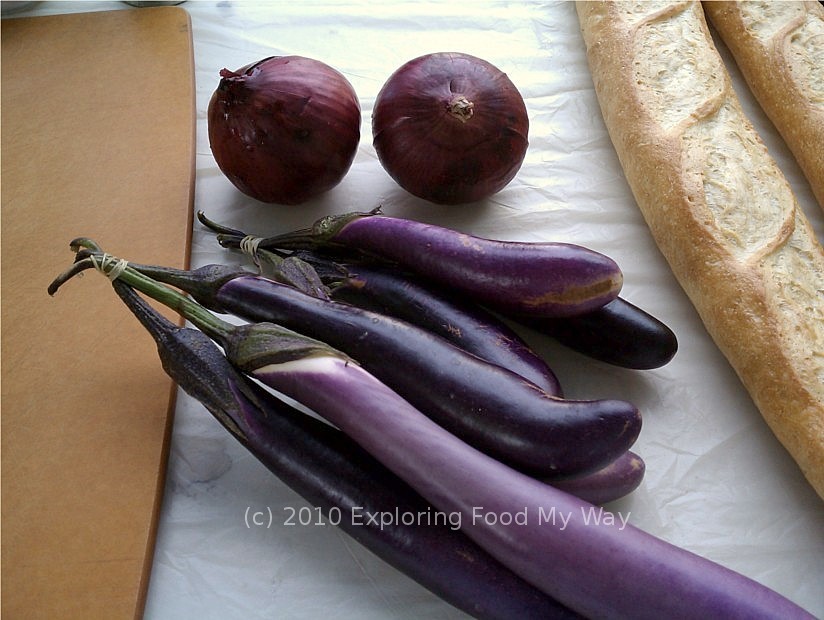
Between this vendor and another one, I also managed to add some red onions and Asian eggplants to the mix:

Red Onions and Asian Eggplant
The final fresh components came from one of the vendors offering fresh organic basil and garlic:

Fresh Organic Basil and Garlic
To prepare the salad, first I used my paring knife to core all of the tomatoes. I then switched to my chef's knife and did a rough dice of all the tomatoes. Since panzanella is a rustic salad, there was no need for a fine dice on any of the ingredients. After cutting all of my tomatoes and adding them to my mixing bowl, I turned my attention to the two medium-sized red onions. After peeling each, I cut them both into a rough dice as well, discarding the root ends. My general rule of thumb in vegetable preparation today was to try and cut all of the vegetables to the same size.

Since the Asian eggplant was long and slender (you could also use regular eggplant, too), I cut them into "coins" and then cut the larger coins in half where necessary. The Asian eggplant had a bit of a slight bitterness to it that I hoped would match well to the sweetness from the ripe tomatoes and the acidity from the vinaigrette. If there was one surprising item that I learned from today's demonstration, it was the fact that so many people didn't realize that you can eat eggplant raw. I can't count the number of times I heard, "Wait, you added raw eggplant?"

The small bulb of garlic I had purchased during my earlier shopping spree yielded about five good-sized cloves that I smacked with the side of my knife to release the paper husk. I then sliced the individual cloves thinly before adding them to my mixing bowl. For the final "fresh" ingredient, the basil, I picked the tender leaves from the stems, piled them up on my cutting board and used my knife to slice them into thin ribbons. Had the amount of leaves I needed been much smaller, I would have stacked the leaves, rolled them up and done a proper chiffonade on them. Since I had a limited amount of time before serving today's market-goers, I did a simpler, more rustic cut. I added the fresh basil to the mixing bowl and turned to the other star of the show: the bread.

Switching to my trusty serrated bread knife, I began thinly cutting the baguettes, probably about 1/8" thick. After slicing through one and a half baguettes, I stacked four or five of the slices on top of each other and cut the entire stack in half so that they were a similar size to the already cut up vegetables. I have also seen versions of this salad where the bread was torn from the loaf, sort of free form. I think either way will work just fine. I added all of the sliced and cut bread to the mixing bowl and began the final step of assembling the salad, building the red wine vinaigrette.

Here were the ingredients I used today to build my red wine vinaigrette:

Red Wine Vinaigrette Ingredients
The wonderful thing about vinaigrettes is that at its most basic you need oil, vinegar, Dijon mustard, salt and pepper ... that's it! And even the mustard is optional in a real basic vinaigrette. The Dijon mustard actually plays two roles in this particular vinaigrette. First, I love the bit of heat that the prepared mustard adds to the finished dressing. Second, mustard seeds contain a natural substance called lecithen which actually acts to emulsify the dressing so that the oil and vinegar don't separate after mixing.

To the small mason jar in the above photograph, I added two healthy spoonfuls of mustard, three nice pinches of kosher salt, several grinds of freshly cracked black peppercorns and enough red wine vinegar to go about one third of the way up the jar. I then added enough extra virgin olive oil until it was about three-quarters full. I placed the lid on the jar and screwed the cap down firmly, shook vigorously and tasted. I wanted a dressing that was tart, but not overly so. From this point it is all about adjusting the flavor to your taste. If it is too oily, add more vinegar; too tart, add more oil. It took about two or three adjustments of adding oil and salt before I got it to the perfect level.

I added the entire contents of the jar to my mixing bowl along with a nice pinch of sea salt and more freshly cracked black pepper, grabbed the large metal spoon and began to gently toss the salad, scooping from the bottom of the bowl and lifting to the top. I wanted to make sure that I was gentle so that I didn't break the ripe tomatoes down too much as I mixed. How did I know when the salad was ready? Basically, once the bread absorbed the vinaigrette and the juice that had come out of the tomatoes, it softened up a bit. At that point, I tasted it for seasoning, made some corrections, and ended up with this:

Finished Panzanella Salad
At this point I looked up and realized that quite the crowd had gathered round the demonstration booth. I knew that we needed to get the samples out as quickly as possible. Using the cardboard containers that the market's manager, J Hudson, had supplied, he and I quickly did an assembly line style plating and handed the dishes out to eager patrons:

Photo of the Cook
What had taken me about forty-five minutes to prepare took only twenty minutes to plate and serve. Honestly, given the size of the salad I had made, I was a little surprised it went so quickly. Once the bowl was completely empty, I fielded any remaining questions from the crowd and began to clean up and break down my station. I'm not exactly sure how many samples we handed out today at the market, but if I had to guess, it was probably somewhere between 40 and 50. Of course, you are certainly free to scale the amounts I used today up or down to feed the number of hungry mouths you have on hand.

Sadly, we are nearing the end of the picking season for this year. That being said, you still have a couple more weeks to get to the Hudson Farmers Market (or whatever market is closest to you) if you want to try out this salad. The tomatoes really do need to be at their peak of ripeness, so if you wait too long, it won't be until next summer before you have another shot at making this tasty and fresh salad.

[Ed. note: A quick thank you to Chef Brian from Hudson's Restaurant on the Green for helping me to expedite some of the samples handed out today.]

Monday, August 23, 2010

Kitchen Challenge: Bread Out Of A Campfire Oven?

I've come to discover over the years as a bread baker, good bread can come out of almost any oven. While most people assume that you need a top-of-the-line Viking or Wolf range costing in excess of $5,000 in order to get good results, it turns out that good technique almost always triumphs expensive hardware. While there are certainly kitchen tools that I use in my routine baking that I would be sad to see go (like my KitchenAid Pro 600 or my digital scale) since they make my job easier and more consistent, in the end, almost any oven will work and can be cajoled into sending out the wonderful aroma of baking bread.

To prove this point, I was recently contacted by Beth Knorr, manager of the Countryside Conservancy and more specifically, the Howe Meadow farmers market that I've written about several times before, and was asked if I'd like to do a cooking demonstration during one of the weekly Saturday markets. Intrigued (and honestly, quite flattered) by this notion, Beth and I compared datebooks until we agreed that my demo would take place from 9 am - noon on Saturday, August 21st. At the time Beth initially contacted me, I still had some time to plan what dishes I wanted to make and as my weekend got closer, I stopped by the market to see what types of products and produce I would be able to use.

Fortunately, one of the purveyors, Alex from Mud Run Farms, was still selling his two pound bags of freshly ground whole wheat flour. I had used this flour in a previous entry when I made whole wheat fettuccine (recipe is at the link) for a dinner I cooked for my grandmother and me. I decided that I should stick to what I know best and make my honey whole wheat bread while highlighting the flour that Alex was selling at his stand. I bought several bags of the flour from him a week prior to my demo anticipating that I might need some in doing my preparations the night before the big event.

The bread recipe I would be using today has gone through several iterations as I've added, removed, and changed ingredient amounts to make it taste better and better. For those who might feel challenged at making bread, I will give you the simpler "dump and stir" recipe. While it's still a tasty bread, the tweaks I will be presenting (and the extra time required) for the more complicated recipe are well worth your time and effort. Both recipes use the same amount of ingredients, it's just that my tweaked version has you using some of the ingredients the night before.

Here's the dump and stir recipe:

Honey Whole Wheat Bread
325 grams Bread flour
425 grams Whole Wheat flour
14 grams (1 tbsp) Canola oil or Light Olive oil
42 grams Honey
26 grams Wheat germ
50 grams Ground flax seeds
8 grams Instant yeast (use 10 grams of Active dried)
17 grams Sea salt
540 grams Water, room temperature

You will notice, gentle reader, that everything I measure is in grams or ounces. Weighing ingredients is FAR more accurate than measuring by volume (i.e., cups). It's worth your while to spend the $30 on a digital scale accurate to the gram. It's a shame that 99% of cookbooks out there don't measure by weight; I think people who are scared of baking because recipes don't turn out well would have much better results were they to measure by weight rather than volume.

Now that I've given you the basic recipe, let's proceed to my tweaked version. The night before you want to make the dough (or do this in the morning if you want to bake at night), you need to make two items, a soaker and a pre-ferment called a poolish. For these items you'll need both the bread flour and the whole wheat flour:


In a container big enough to hold both the whole wheat flour and the water, measure out:

200 grams Whole Wheat flour
250 grams Water, room temperature

Using a fork, gently stir the two together and make sure that all of the flour is hydrated. Cover the container and place it in the refrigerator. Congratulations, you've just made a soaker! A soaker is used to pre-hydrate some of the flour in order to not only give it a chance to fully hydrate before being used, but also to help start breaking down some of the more complex carbohydrates into simpler sugars that the yeast will use for food. The reason that you place the soaker into the refrigerator is that all flours contain naturally occurring wild yeasts in them and if you let it sit out overnight, those yeasts might actually start to grow.

Here is what the finished soaker should look like:


It doesn't look particularly appetizing to you or me, but trust me, the yeast will love it.

Next up we need to make the other pre-ferment, the poolish. A poolish almost always consists of equal weights of bread flour and water with just a tiny pinch of yeast. For the poolish, you will need:

250 grams Bread flour
250 grams Water, room temperature
2 grams Instant yeast

Place these ingredients into a large container and using a wooden spoon, vigorously stir the ingredients to combine. You are looking to not only hydrate the flour, but also start the activation of the gluten. It only takes about twenty seconds of vigorous stirring and what you end up with looks like a really thick pancake batter:


Again, cover the container and put it into the warmest part of your kitchen (I used the top of the refrigerator). After 8-10 hours, that little bit of starter will have transformed into this:


Note that when I first put the poolish into this container, it measured at less than 1 quart (I also made a double batch of poolish, so a 2 quart container will probably be big enough for a single batch). The finished poolish nearly tripled in volume. When you take the lid off, you will notice the delicate structure of the dough and all of the bubbles at the surface. Take a deep breath and smell decidedly alcoholic aroma which comes from the yeast's consumption of the sugars in the flour; this is a sign that it's ready to use.

Now that we've done our pre-dough work, let's take a look at the rest of the ingredients:


For today's bread, I ended up using grapeseed oil instead of Canola. You really can use any light tasting oil from your pantry. To add an extra layer of punch, you could also substitute pumpkin seed oil. Having finished my soaker and poolish, I went ahead and measured out the dry and wet ingredients for the following morning. This technique is called mise en place and is literally French for "everything in its place." It's a wonderful method for making sure you have all of the ingredients for your recipe by first measuring each out into its own container before combining to make the recipe.

First I measured out the remainder of my dry ingredients (minus the salt):

75 grams Bread flour
225 grams Whole Wheat flour
26 grams Wheat germ
50 grams Ground Flax seed (also called meal)
6 grams Instant yeast (or 1 packet of Active dried)

These I placed into a single container and mixed with a fork to combine:


I placed a lid on this and just left it on the counter for the next morning. Next, I measured out my wet ingredients and my salt:

14 grams Canola oil
42 grams Honey
17 grams Sea salt


Even though the salt is considered a dry ingredient, you don't want to mix it in with the yeast because it might kill it before you have a chance to activate it in your mixer. All my pre-baking work now done, I retired for the rest of the evening.

The following morning, I got up nice and early and pulled out my trusty KitchenAid mixer with dough hook attachment. In the large stainless steel bowl, I used a flexible scraper (you could also use a spatula) to add in all of the poolish and soaker into the bowl. I then dumped the contents of my pre-measured dry and wet ingredients into the bowl on top of them. I kept the salt aside for now.

At this point, I measured out:

40 grams Water, room temperature

You might need it, you might not. I attached both the bowl and dough hook to the mixer and turned it to the first position ("1") to begin mixing the ingredients. After about thirty seconds, I adjusted the mixer to the second position ("2") and gradually added the salt to the dough in a continuous stream. After adding the salt, I set my timer for six minutes and let the machine continue to knead the dough. Today I didn't need to add any additional water, but during those six minutes of kneading, use the extra water if the dough is looking dry and not coming together nicely. The dough should be fairly wet, which means it will be a little sticky to the touch.

After my six minutes of kneading, I turned the machine off, detached the bowl and walked it over to my large plastic proofing container:


It is important that you oil your container or the dough might stick very badly when it is time to turn it out onto your work surface. I used a pan release spray, but if you wanted to oil the container by hand, you could certainly do that, too. Use your flexible bowl scraper to transfer the dough from the bowl to the container and place the lid on.

The dough will now go through two rises. The first rise normally takes about 60-90 minutes, depending on the warmth of your kitchen. For me, I made my second dough, packed everything up into my car and headed to the market. Ninety minutes after making my first dough, it had grown quite a bit:


At this point, I used my flexible bowl scraper (it's quite the handy tool, no?) to "punch down" the dough by "grabbing" the dough at the edges of the container and folding the dough onto itself in the middle. I worked my way completely around the container. At this point, you re-cover the dough and let it go through a second rising. Folding the dough over onto itself allows you to redistribute both the yeast and the flour that feeds it. The second rising usually takes about 1/2-2/3 the amount of time as the first.

When the dough has risen for the second time, it is time to divide the dough evenly and create the final shapes. The recipe I've posted above makes roughly three (3) pounds of dough. When I bake on my pizza stone, I normally make three one pound balls, or boules. Because of the size of the camping stove I was using today, that wouldn't be possible. Instead, I brought out my loaf pans and made two 1 1/2 pound loaves instead.

Using my digital scale, I divided the dough evenly. I then prepped my loaf pans by spraying them with more of the pan release spray I had used earlier. To shape the loaves, take one of the halves and place it on your work surface. Flatten it out slightly and then grasp both the left and right ends and slightly pull them out before folding them back onto the dough. Then, using your thumbs and palm, start at the top and begin to fold the dough down towards the bottom, a little at a time, three to four tucks being plenty.

Then, using your palms, gently adjust the "log" so that it looks fairly even and place the formed loaf with the seem side down in your loaf pan:


Here were my two formed loaves:


Cover this with a tea towel and allow them to proof until the dough has mostly filled the pan. Depending on how warm it is (and it was pretty warm at the farmer's market), this could take 30-45 minutes.

When you've got about fifteen minutes left before the loaves are fully proofed, turn your oven on to 375 degrees Fahrenheit. Unfortunately, today's oven,


was wildly inconsistent in the temperature gauge. When I first turned it on, I set the knob for the oven to "hi". This yielded me an internal temperature of 500+ degrees (according to the temperature gauge on the oven itself). Even with the knob turned all the way to "low", the gauge still read a balmy 425 degrees. At this point, the bread was fully proofed and I had no other option than to just give it the old college try.

Place the loaves on the same rack in the middle of your oven, giving them a little space between the actual pans. After ten minutes, lower the oven temperature to 350 degrees and continue to cook for another 20-25 minutes. Half way through the cooking time, you may also have to rotate the loaves from from to back and left to right if your oven has hot spots (and most ovens do). To check whether the bread is done, remove a loaf from the oven and flip it out of the loaf pan using hot pads or a tea towel. Plunge an instant read thermometer into the bottom of the loaf (where no one will see the hole) and make sure the probe goes into the center of the loaf:


The proper internal temperature needs to reach 190-195 degrees Fahrenheit. Remarkably, in my case at the market, it had actually reached the correct temperature, so I removed the other loaf from the oven, flipped it out of the loaf pan and placed both loaves onto a cooling rack:


Having successfully made the first batch of bread, I turned to pan up my second batch only to discover that the heating element of the campfire oven had turned off and nothing I tried would successfully re-light it. In the end, the above two loaves were actually enough to feed the hungry and intrigued crowds who stopped by my booth to try and discover where the wonderful bread smell had originated. When I pointed out that the bread had just come out of the camping stove, I got many wide-eyed stares and the occasional, "REALLY?"

While you will want to wait 45-60 minutes for your bread to fully cool before slicing into it (this allows the gelatinized starches to fully set and give the bread its final structure), I only managed to stave off the hungry onlookers for about ten minutes before I acquiesced and began to feed the gathering masses:


Fortunately, the two loaves that I did manage to bake came out nearly perfect and somewhat serendipitously were just the right amount of samples to feed anyone who wanted a taste. Almost everyone commented on how wonderful the bread tasted, which I took both as a compliment to the recipe I've developed over the years, but also the fantastic flour that I bought from Mud Run Farms. If you want the best results from your cooking and baking, always start with the best ingredients you can afford.

The demonstration now complete, I packed up all my gear and lugged it back to my car. Physically I was tired and sore from all of the standing, but emotionally I was totally thrilled that not only did I get to meet some great market attendees, but also got to feed them some tasty and healthy bread as well. I hope you do give this recipe a try; it might just make a whole wheat bread convert out of you if you already aren't a lover.

Wednesday, May 26, 2010

Two Return Visits To The Golden Goose

I had been meaning to get back to the Golden Goose restaurant for a while now. Every time I visited my friends in Cuyahoga Falls and drove down State Street, I would see the sign posted outside of the restaurant and make a mental reminder to get back there for lunch. Obviously my mental notes didn't seem to stick very well as it took a good four or five months before I decided to do anything about it. Today, having returned from an interview in Beachwood, my thoughts drifted to the Goose. Seeing as I didn't have anything on my schedule until later that afternoon, I pulled into the parking lot around noon wondering what tasty treats lay inside.

When I walked in, I looked across the room and spotted Michael Bruno, pastry chef and son-in-law of the owner. I could tell he noticed me because he basically fixed his gaze on me for a solid minute. He had one of those "I know I know you!" kind of looks on his face. When he finally approached, he had managed to piece together who I was because he correctly called me by my first name. We chatted for several minutes about how business had been going. Apparently he has been trying to get customers to stop in first thing in the morning to pick up a cup of coffee and a croissant before heading off to work. When I asked him if he was taking advantage of the various social media like Facebook and Twitter, he admitted that he hadn't. I told him how places like Flury's Cafe, Vaccaro's Trattoria, and AMP 150 were using these networks to spread the word about daily specials. He seemed intrigued, but like most people who aren't used to using the latest and greatest technology to reach people, a little apprehensive.

After our conversation ended, I sat down and started looking at the menu. While most of the menu remained the same from my previous visit, there were a few new items. Deciding that I was more in a lunch mood than a breakfast one, I turned my attention to the sandwiches. When my server came over to take my order, I asked about the fried fish sandwich. "Pollock," was her answer when I asked what kind of fish. When I asked about the freshness of the fish, she assured me that not only was the fish fresh and not frozen, but it was hand dipped in the batter before being fried. Perfect! The fish sandwich came with potato chips, but I decided to add the French fry / coleslaw upgrade for an additional $1.50. Even better, one of today's lunch specials was the fish sandwich with fries and coleslaw for only $6.95, which was cheaper than doing the upgrade.

After a quite short period of time, my lunch arrived:


The tartar sauce is hidden behind the crown of the Kaiser roll. Here was a shot of just the fish sandwich:


This was a very tasty fish sandwich. The coating wasn't quite as crispy as I would've liked and the fish wasn't the ultimate in moistness, but overall this still had a nice flavor and was meaty. The bun was nicely toasted and added a nice textural contrast. The shredded lettuce was a bit of a pain to keep on the sandwich, but it was fresh and crisp. I spread a thick layer of the tartar sauce on the crown of the bun and it added a nice creamy counterpoint to the sandwich.


The French fries, clearly fried from frozen, were a bit overcooked and not quite as crispy as I like them. On the positive side, they weren't greasy at all and had been nicely seasoned. I applied some of the tableside bottled ketchup which had been placed into generic plastic squeeze bottles. I'm not sure what brand of ketchup the Golden Goose was using, but it was a bit thin and runny. The flavor was good, however.


When I finally got to the coleslaw, I could tell immediately that this was homemade. The way the cabbage and carrots had been shredded and had irregularly shaped bits of vegetables triggered my culinary Spidey sense. The dressing was the standard mayonnaise-based variety, but it was well balanced and tasted good. When my server returned to check on me, I asked about the coleslaw and she confirmed my suspicion that it was indeed made every day in the kitchen.


Finally, I wanted to include a shot of the tartar sauce. After seeing how chunky the sauce was and after tasting it, I also suspected that it, too, was homemade. When my server returned to check on me, she confirmed that it was. The tartar sauce was nicely balanced between creamy, sweet, salty, and tangy and was a nice foil against the fried fish.

As a final treat to myself during this visit, I decided to finish not with a pastry, but the "Gourmet Hot Chocolate" that was offered on the menu. What constitutes a gourmet hot chocolate, you ask? Valhrona 70% bittersweet chocolate for one. Whole milk that has not been treated with bovine growth hormones for two. And topped with either a homemade marshmallow or chantilly cream for three. Here was a shot of what I received:


And just like when ordering an old-school style milkshake, the remainder of the hot chocolate came out in an additional pitcher:


This was enough hot chocolate for two full mugs. The hot chocolate itself was rich and delicious. But honestly, I felt it was missing something ... perhaps a dusting of Vietnamese cinnamon on top would've been the perfect counterpoint to the rich chocolate flavor. If you are going to be decadent, be DECADENT. At nearly $4, this was a bit pricey, but you could easily split this with another diner at the table and it would be much more reasonable.

On a separate visit, I decided to stop in for a late lunch. After careful consideration, I decided to go with the chicken schnitzel sandwich. The last time I upgraded my sandwich to the French fries and coleslaw. This time I decided to just go with the potato chips that are served with every sandwich. After a short wait, this was what I received:


And here was a shot of the homemade potato chips:


Although the tomato slices on the sandwich weren't the greatest (it's not quite tomato season yet), overall the toppings on the sandwich worked well. Besides the lettuce and tomato you can see in the picture above, a layer of mayonnaise had been applied to the nicely grilled crown of the bun. Additionally, a honey mustard dressing was provided with the sandwich:


Applied normally to the pork version of this sandwich, my server thought it went well with the chicken, too, and brought me a side of it. After applying a liberal dose to my chicken, I packaged the sandwich together and took a bite. The flavors worked quite well together and the chicken was nice and crispy. The chicken breast wasn't the ultimate in juiciness, but neither was it the Sahara desert either. I did have to cut the chicken breast in two pieces so that it would lie flat on the sandwich bun, but that wasn't a big deal. The freshly made potato chips were crispy, seasoned well, and quite delicious. I realized that upgrading to the French fries in my previous meal because I didn't want something so pedestrian as a potato chip with my sandwich was a mistake. I think I'll stick with the potato chips next time.

I also wanted to mention that besides all of the wonderful pastries and sweet treats that Michael is turning out of his kitchen on a daily basis, he is also making some wonderful breads, too. On Wednesdays he turns out a European sourdough bread and on Fridays he is offering challah. I'm not sure about the challah, but the sourdough can be bought in 1, 2, or 3 pound loaves. I purchased two 1 pound loaves, one for myself and one to give away to some friends. I didn't get a shot of the bread before eating it, but I can tell you that it was delicious. It had a lovely tight crumb, a nicely caramelized crust (a darker European crust) and the sourdough flavor was tangy without overpowering the flavor of the wheat.

I encourage you to stop by and check out the Golden Goose for breakfast, lunch, or just some pastries or bread to go. They are committed to making so much of what they are serving from scratch and honestly, it comes through in the flavor. This is exactly the kind of locally owned mom and pop restaurant I love to find for myself and to tell others through the blog.

[Ed. Note: Since I wrote the above blog post, the Golden Goose has not only established a Facebook fan page, but they update it on a quite regular basis. Good for them!]
Related Posts with Thumbnails