Saturday, November 14, 2020

"C" May Be For Cookie, But "O"?

I just found out this morning that my longtime friend, T, has passed. Technically it was last Tuesday, but the obituary didn't show up in the local paper until yesterday. A mutual friend, who knew I had gone incognito from Facebook many years ago, had seen talk of T's passing from family members on social media and wondered if I had heard the news. In addition to not participating on Facebook anymore, my path with T's family (and T himself) had diverged back at the end of 2014. I was glad my friend called, because I was blissfully ignorant.

I met T for the first time during the summer break between my freshman and sophomore years at Case. My father, who also worked at Bridgestone/Firestone, managed to set me up with T in Office Services -- a fancy name for a group of people who moved office furniture and cut keys for office locks -- and although it was quite the manual job, often in brutally hot parts of the old warehouse, I really clicked with T and my coworkers. At the time, I was 19 years old and he was just under 40; however, we instantly bonded. From that point forward until the end of my college career, I looked forward to spending every summer (save one) and Christmas holiday working with T.

When I went off to college in the fall of 1990, my father had the half-baked idea of sending me to school with a personal fax/copy/answering machine combination. I protested the idea as being idiotic since no other college freshman would show up to their dorm room with a fax machine (and I was correct about that). His overriding argument was that since long distance calling was still very expensive and email messaging wasn't even on the horizon, he insisted that faxing each other was a cost effective way of communicating. He offered that we could send each other pages and pages of handwritten or typed out text instead of calling on the phone. All of those faxes would pay for themselves, wouldn't you know?

I mentioned all of this to T at work one time -- that I was the only freshman with a fax machine -- and completed the delivery of this information with an appropriate teen-aged eye roll. Wouldn't you know it, the only two people I received faxes from for the entirely of my college career were my father (mostly my freshman year) and T. Every year on my birthday, he and my Bridgestone coworkers would all sign and fax a piece of paper with birthday wishes on it. I remember getting back from class on my birthday, walking into my room and my roommate saying, "Dude, you actually got a fax while you were at class." The sight of seeing a curled up fax hanging off the machine, ready to be cut from the main roll, always left me with a huge grin on my face.

Over the next couple of years, I began to slowly meet and become friends with his family, both immediate and extended. My second summer working for T, I was invited to a surprise 40th birthday party being thrown at his home by his wife. That summer, during a down time at work, I was nonchalantly flipping through a dictionary that T kept in the office and I came across the word, "octoroon". It struck me as such a silly word and something I had never heard before that I couldn't imagine ANYONE knowing the actual definition, so I brought it to T's attention and challenged him to its meaning. T had never heard of it either and we had a tremendous laugh about the whole thing and relegated it to some weird work conversation. Fast forward to that surprise 40th birthday party where I met T's mom for the first time. Somehow, octoroon came into the conversation and without missing a beat, T's mom recited the (correct) definition for us. We were both stunned.

One thing that I quickly came to learn about T and his family was that -- on the whole -- they were snacking people, not necessarily meal people. "Snicky snacks" is how they referred to the spread that would inevitably be laid out around mid-to-late afternoon. Snicky snacks would be things like cubes of cheese, cut up pepperoni, bunches of grapes and strawberries, crackers, and potato chips and dip. I have no problem with snacking, but at some point, I'm used to a proper meal. T's family had grown use to this snacking-as-a-meal concept and for them the spread would often be plenty. I can't tell you how many times I remember guiltily slinking off and hitting up the local Wendy's for a proper sandwich just to tide my appetite over lest I be hungry all night. I laugh about it now and would trade all of my "proper meals" for just one more night of "snicky snacking" with T.

I was fortunate that my relationship with T and his family extended beyond my employment at Bridgestone. I graduated with my Bachelor's degree in 1996, but enjoyed nearly another 20 years as a family friend, being involved in weddings, births, funerals, and my favorite thing of all, just general merriment. I sometimes felt like I had two families in my life, my biological one and the one of my choosing. It was not unusual at all to spend holidays at multiple houses. Holidays proper were spent with my family until about 4 pm in the afternoon. Then I would head over to T's house for a rousing, fun-filled conclusion. It wasn't that I didn't enjoy spending time with my family, but there was a marked contrast to the two environments. It isn't ironic that the splitting of the day was very much like the splitting of the meal. I ate the savory part of the meal with my family (the much more somber -- and sober -- part) and then got to cut loose with dessert at T's house -- the fun part.

I was privileged and honored to be in T's world for as long as I was. But as things happen, towards the end of 2014, I was getting a fairly distinct signal that it was time to move on. I had made several overtures towards reconnecting with T and his family, but felt that the reciprocity and enthusiasm just wasn't there. All good things must come to a close and instead of lamenting it any further, I quietly slipped away. Then, in mid 2018, having just suffered through another security breach from Facebook (plus the eternal time-suck that is Facebook), I made a rather unannounced and curt decision to just leave Facebook altogether -- and with it any chance of monitoring T's family conversation, even if I wasn't actively part of it.

It turns out that T's health problems (which started around 2009) continued to plague him. Every time he seemed to get back up, life knocked him back down again. That makes me incredibly sad, because the T in my mind's eye is one of life, of exuberance, of happiness. And, honestly, I think that is how I will choose to remember him. I've always been sad with how things ended up -- although with time and perspective, I've come to accept them. But with T's passing, I truly feel like a major chapter of my personal history has come to an end.

My life is so much better off because of T and his family. Sometimes you just don't know how good things are until they are gone from your life. T always did appreciate a good Kennedy reference and I personally think of the golden years between myself and T and his family as the Camelot years. What I hope for T's family is peace and comfort from his years of struggle and his ultimate passing. T had made a lifelong indelible impression on me and I will always remember him as the affable and loving instigator of mischief and longtime proponent of ABBA (on vinyl, of course). Dancing Queen or Waterloo? Waterloo!

I'm currently sitting here at my keyboard drinking a Guckenheimer and 7-Up in his honor while listening to the Sibelius violin concerto and alternating between being small and contemplative and loud and ugly crying. To be fair, I feel like this will probably continue for the rest of the night. And I'm okay with that.

Just know that you will be forever missed and I will love you always.

Tuesday, December 22, 2015

No Salt Added at The Annex Bar and Grille

I must have driven by The Annex Bar & Grille on Pettibone Road in Solon several dozen times over the last number of years. Friend and fellow food blogger Nancy lives close by The Annex and every time I would drive to or from her house, I'd pass by the small structure. I never even gave it a second thought until recently when Nancy contacted me to tell me that two old friends, Walter Hyde and Scott Slagle (of Fat Casual fame) were now working certain shifts behind the bar and the grill. Not only that, but apparently they were doing some low/no sodium items on the menu for lunch.

After doing some initial research with Walter, I met up with Nancy and her husband for lunch just a few weeks ago to check things out. It turns out that The Annex has a policy of not salting anything on the menu. Here I was all prepared to say, "no salt, please" to everything I ordered, but as it turns out, there was no need to. Now, that being said, there are still only a couple of menu items that can be done low/no sodium successfully because much of the food is traditional bar food -- highly processed frozen items that can be quickly cooked or deep fried during service. These items (and there are many of them) can't be done without salt because they are seasoned even before they are cooked.

The first item I tried was the burger. The burgers come in two sizes, a one-third pound patty and a two-third pound patty. I was feeling particularly hungry that day, so I went with a two-third pound burger, medium rare with just some lettuce and tomato on a toasted (but not buttered) bun. While The Annex doesn't use salt, it does use butter, so if you want a toasted butter-free bun, make sure to order it that way. Paired with my burger was an order of their fresh-cut fries, also completely salt-free:


I have to say, for a measly $8 for this combination, this was a pretty damn good burger! Now, of course, there was some natural sodium in the beef and the bun was just a regular hamburger bun (so probably around 200-250mg of sodium), but for around 300-350mg of total sodium, this was a great way to kill the craving for a burger and fries. And at two-thirds of a pound of ground beef, it was VERY filling.

On every table (and presumably the bar), there was a container with standard condiments. Since I knew I wanted some ketchup and mustard with my meal and knowing that regular ketchup and mustard pack a large sodium wallop, I brought my own. I've done that twice now and nobody seems to care, so if you want sodium-free condiments, do what I did and bring your own. To be fair, malt vinegar was available for your French Fries, but I kind of prefer ketchup.

It was also during my first visit that Walter informed me that the chicken breast wasn't brined and would therefore be a good choice, too. I decided to take him up on that bit of information and several weeks after my first visit returned to order the grilled chicken sandwich with a side of the same fresh-cut fries:


In the second image you can see my sodium-free ketchup and mustard in the background. Heinz makes a nearly sodium-free ketchup that you can find in most regular grocery stores. Unfortunately, the downside to this ketchup is that it uses high fructose corn syrup (HFCS) as the sweetener. It turns out that you can't have your (condiment) cake and eat it, too. Either you get the "natural" ketchup with real sugar that has salt or you get the no salt added ketchup that has no added salt but HFCS. I figure that as rarely as I eat this ketchup, having it twice in six months was acceptable. The sodium free mustard I used was one from Westbrae and is available at Mustard Seed Market (the one in Fairlawn) for about $3 per jar. It comes both in organic and non-organic varieties (and the price varies accordingly). I've found this to be an excellent mustard that I can use liberally since it has 0mg of sodium per serving.

But I digress; back to my chicken sandwich. Based on how the menu reads, the chicken sandwich normally comes between two slices of bread. Figuring a hamburger bun would be slightly lower in sodium than two pieces of sandwich bread (200-250mg vs. 300-350mg), the only change I made was to ask for it on the hamburger bun, again without butter. While it was nice to have the option of either the grilled chicken or the burger, were I to do it again, I'd probably stick with the burger. In the end, it was just the better tasting of the two. The fresh-cut fries, however, were great both times.

The only other option you really have if you're not in the mood for a sandwich is to order a house salad with grilled chicken on top. The only problem is that while they have malt vinegar to dress your salad, I don't know that they have oil to go along with it (you might just want to bring your own).

Will I go back to The Annex? Absolutely. For $8(ish) for either a healthy-sized burger or chicken sandwich with fresh-cut fries, it's a great deal. Is it the best burger I've ever had (price aside)? No, but it's pretty darn good and I wouldn't hesitate recommending it to others, especially if they're looking for low sodium options.

The Annex Bar & Grille is located at 36200 Pettibone Road, Solon, OH 44139 and can be reached at 440-248-5725. Hours listed on their website indicate they are open Monday through Saturday from 10am-2:30am (kitchen 10am-10pm) and on Sunday from 12pm-12am (kitchen 12pm-10pm). That being said, I know they recently added breakfast hours on Saturday mornings.

Tuesday, December 15, 2015

A Low Sodium Fast Food Compendium

It would seem, at least at first, that the notion of eating a very low salt, no butter, no cheese diet would be at complete odds with the current state of the fast food industry. And to a large extent, you would be correct. However, in the vast sea of salt, fat, and sugar that comprises most of the fast food industry's offerings, there are a few nuggets of goodness that you can cling to when you are looking for a quick fix or are traveling and haven't had time to research local restaurants.

Having combed through more than a dozen published nutritional guides on the Internet, I've come to a few conclusions:

1) Many fast food restaurants offer some type of "garden salad" which is usually okay. Almost all only offer salted dressings, although as you'll see, some dressings are better than others.

2) Of those that offer garden salads, that's usually all they can offer that would be acceptably low sodium.

3) There are some fast food chains that offer nothing acceptably low sodium.

4) Grilled chicken breast is often as salty or saltier than beef (thanks to brining).

So, how do I differentiate between fast food and fast casual? I know it isn't a completely cut and dry set of rules, but in general, if the restaurant has a drive thru, I'd consider it fast food and not fast casual. That being said, I consider Subway to be fast food although I've seen very few Subway locations with a drive thru.

And with that distinction out of the way, here are the only fast food restaurants at which I've had any success.

Wendy's

While none of the proteins (chicken, beef, or fish) at Wendy's would even remotely qualify as low sodium, the one thing that Wendy's has on their menu that I find appealing is the presence of a baked potato. Now, of course, when you load up that baked potato with cheese, bacon, and sour cream, it is no longer low sodium, but according to their published nutrition information, a plain baked potato by itself has almost no sodium and if you decide to splurge and add chives and sour cream (just one container of sour cream), you top out at 35mg of sodium.

And while the garden salad has nothing particularly salty on it, you do have to be careful of the dressings. Your two best choices are the pomegranate vinaigrette (150mg of sodium for the entire packet) or the ranch dressing (170mg of sodium for the entire packet). Since I tend to not like overdressed salads, I usually use only half of the packet. Thus, for about 100-110mg of sodium, you can walk away with a baked potato with sour cream and chives and a garden salad with half a packet of pomegranate vinaigrette. Not bad.

Subway

Just like Wendy's, every single protein and cheese option is out at Subway if you are considering a sub sandwich. Which means that the only real choice you have if you want a sub sandwich is a 6" Veggie Delite on either 9-grain wheat, Italian, honey oat, or multigrain flatbread. Each of these types of bread has between 280mg and 290mg of sodium for the 6" version. Skip the cheese and load up on non-salty vegetables (lettuce, tomato, red onion, spinach, cucumber, green peppers, etc.). Fortunately, Subway is one of the few (maybe only?) fast food restaurants to offer plain old oil and vinegar as a dressing. Other non-salty toppers include ground pepper and dried thyme. Pair that with a package of apple slices from the kids menu and you've got a decent meal with about 300mg of sodium total.

If you're wanting to go more of the salad route, you can certainly go with the Veggie Delite option at 75mg of sodium or, the one protein-based salad that seems acceptable to me is the oven-roasted chicken salad at 280mg of sodium. Again, dressing will be limited to oil and vinegar. A possible third option is the Monterrey chicken melt salad, but it clocks in at 360mg of sodium. Plus, with the addition of cheese, you up the fat and saturated fat by a couple of grams each. Nothing heart-seizing, mind you, but the first two salads are the healthier options.

Steak 'n Shake

As you've seen so far, fast food proteins and low sodium don't mix. However, at Steak 'n Shake, you can get either the single steakburger (310mg sodium) or the double steakburger (330mg sodium) if what you crave can only be satiated by beef. Of course, realize that cheese is out, as are all forms of condiments. The standard burger toppings of lettuce, tomato, and onion will be okay additions.

For sides, you could go with applesauce (0mg), apples and caramel (75mg), small French fries (80mg), regular French fries (140mg), small garden salad (105mg), or a cup of Mandarin oranges (15mg). I'm guessing by the fact that the garden salad has 105mg of sodium that it probably has cheese or croutons, which you can either pick off yourself or ask for it to be served without, which would substantially lower the sodium content. While I don't see oil and vinegar as an option from the salad dressings portion of the nutritional spreadsheet, one ounce of the honey mustard dressing does clock in at only 115mg of sodium. As with Wendy's, a light touch with the dressing can reduce that number by half.

If breakfast is what you are after at Steak 'n Shake, you also have a couple of options from that menu, too. Two eggs, any style, will set you back 140mg of sodium. Other choices include a cup of Mandarin oranges (15mg), the parfait (95mg), oatmeal (260mg), or hash browns (300mg). While the combination of eggs and hash browns is a bit high for my liking (440mg for both), combining two eggs with a parfait seems like a perfectly reasonable amount of sodium (235mg for both) when eating out at a fast food restaurant and getting something that is nutritious and filling.

So, there you have it -- three recommendations for those looking to both maintain a low salt lifestyle and still be able to occasionally stop in for a quick meal at a fast food restaurant. Are there others out there that might qualify? Of course, I'm sure there are. I really only researched fast food chains that are common to the northeast Ohio area. And for those that hoped Swenson's might make the list, even though it is a local chain here in northeast Ohio, unfortunately, they haven't published any nutritional information about their food, so I ruled them out.

Please feel free, gentle reader, to suggest other fast food chains (and more specifically, menu items) that might make the cut.

Tuesday, December 8, 2015

A Return Visit To Flury's Cafe

As any long-time reader of Exploring Food knows, I've reviewed Flury's Cafe several times before on this blog. And I've been enjoying owner Kimberly White's food from my very first visit many, many years ago. I find it ironic when I reread my previous reviews that I occasionally ding'ed particular items she made for having too little (or no) salt, such as her hashed browns or eggs. Interestingly, it is exactly that feature that now draws me in on a regular basis for breakfast or lunch.

I was quite surprised when I first approached Kim with my new diet that she was able to point to quite a few items on her current menu that would be appropriate for me. I also learned that she shares my philosophy that there is way more salt in our food than is necessary. When possible, she would rather make dishes lower in sodium and allow the guest to add salt where he or she thinks it appropriate.

While there are certainly items on the menu where salt is inherently built in (anything with cheese, sausage gravy, fried sides such as French fries or onion rings), I thought I would point out a few of the items on the menu that I've been able to order off of the menu without too many substantial changes (other than my usual request for "no salt, butter, or cheese").

Let's start with the potato pancakes, scrambled eggs, and a small cup of sour cream, all lightly dusted with paprika:


The difference between the potato pancakes and the regular hashed browns is the addition of onions and eggs to the potato pancakes. Cooked in a combination of canola and olive oil, the potato pancakes are crispy on the outside and tender on the inside. The majority of salt on this plate comes from the scrambled eggs, about 120mg of sodium for two eggs. The sour cream, interestingly, does have sodium, but at only 10mg of sodium per tablespoon, it is an acceptable amount and adds a nice acidity and richness to the pancakes.

Next up is my standard breakfast order, the vegetarian omelet with hashed browns. Occasionally Kim makes awesome homemade jam, and if it is available, I may also get a slice of dry wheat or rye toast as a vehicle for jam delivery*:


* The omelet comes with hashed browns and toast, I sometimes just omit the toast.

Kim uses regular sandwich bread for her toast (which can have anywhere from 150 to 200mg of sodium per slice). Considering that the only other sodium in the dish is the 120mg in the eggs for the omelet, having a single slice of toast is an acceptable amount. The omelet is filled and topped with sauteed spinach, tomatoes, mushrooms, onions, and red bell peppers. Both the original Tabasco sauce (the red one) as well as the jalapeno-based sauce (the green one) are available if you like things a little spicy. The green one is completely out (150mg of sodium per teaspoon), but every now and again I'll shake on a bit of the red one (35mg of sodium per teaspoon).

While regular sandwich bread is used for toast, Kim bakes her own buns for sandwiches and revealed to me that each bun only has about 150mg of sodium. Paired with a single or double burger or the grilled chicken breast, it makes for a delicious sandwich that can be kept under 300mg of sodium:


Of course, you have to forgo any condiments or the delicious housemade pesto (which I adore, but can't have due to the presence of cheese in the pesto), but you still get a juicy burger or chicken sandwich with lettuce and tomato that's also filling. Unusually, Kim uses chicken that isn't brined before grilling, so the chicken is 100% okay to order at Flury's.

As I mentioned before, none of the usual sandwich sides like French fries or onion rings are on the low sodium list, so whenever I get a sandwich, I usually order the spinach salad minus the bacon and substitute the housemade balsamic vinaigrette for the warm bacon dressing:


The vinaigrette isn't necessarily low sodium, but if I just use a very small amount to lightly dress my salad, I'm not too concerned about it.

Kim always has some kind of baked good to tempt you with at the end of your meal. In the past I've normally said no to these (even when I was eating salt). However, in the past couple of months, she has also had fresh fruit available to be eaten at the restaurant or to go. I almost always say yes to an orange, apple, or banana, even if I don't intend to eat it at that very moment.

Normally I hit up Flury's Cafe for breakfast on days that I don't walk in the early mornings, so maybe once a week. But Kim and Flury's Cafe has been on my no-salt radar since I first realized I had to change my diet. Whenever I'm craving breakfast food, this is the first place that pops into my head. Most breakfast/diner places can offer you eggs without salt, but Flury's appeal is that you have additional options, too.

One thing to note about Flury's Cafe is that they recently moved from their old location on Sackett Avenue in Cuyahoga Falls to their new location on the corner of Front Street and Portage Trail, also in Cuyahoga Falls. Free parking is available in one of the two parking garages just north or south of the restaurant. They are open Monday through Saturday for breakfast and lunch and can be reached at 330-929-1315.

Wednesday, December 2, 2015

A Cornocopia Of Choices At 111 Bistro

Fair warning -- I cannot give you an unbiased review of the food at 111 Bistro. Perhaps this surprises you, gentle reader, given the myriad of reviews on this blog where I assert that very quality, an unbiased attempt at describing to you what the average consumer can expect in terms of food and service when dining at an establishment.

In fact, my relationship with 111 Bistro has always had a personal quality to it. The original sous chef invited me to the "friends and family" night prior to the restaurant's actual opening back in June 2014. I had first learned of the restaurant's planned existence earlier in 2014 when the chef, Anthony Scolaro, and sous chef, Joe Holmes, each hosted a course at a Dinner In The Dark event at Crave in Akron. And, of course, at the friends and family event, I first met Anthony in person.

Is the food fantastic? Yes. Is the service great? Yes, with the caveat that I almost always sit at the bar, so I tend to be waited on by the same bartenders/servers over and over again. Have I ever had to send food back to the kitchen? Once, because of a mix-up with how my order was entered into the system. The kitchen made my entree with salt because they didn't realize it was for me. However, one of the line cooks saw that I had received the salted entree and immediately flagged me down. Grateful for the assist, I sent the plate of food back to the kitchen and they re-fired the entree, this time sans salt.

So what value can I add without this sounding like an (unpaid) advertisement for 111 Bistro? What I like about the menu at 111 Bistro is that not only does Anthony draw elements from other ethnic cuisines (although the menu is billed as "modern American", Japanese, Thai, Indian, French, and Italian all play a role), but dishes for diners with more common dietary restrictions are already represented on the menu, everything from vegetarian to vegan to gluten-free. And as I've already mentioned, when it comes to salt and seasoning, restaurants come in two varieties: those that season during prep and those that don't. 111 Bistro, more or less, comes squarely in the second camp.

That doesn't mean that the entire menu is fair game. Some elements are seasoned during prep because there is a marinade or brine involved; some of the confit preparations involve the traditional use of salt to bring out moisture from the protein. However, where I can normally expect maybe one thing on the menu to be low-salt/salt-free, at 111 Bistro, at any given moment, there will be a dozen items that I can order. They also run seafood specials quite often and many times, those dishes can be made salt-free.

Think I'm exaggerating? Let's take a look at their current menu (Fall/Winter 2015). Here are the items I can order and know that the kitchen can reasonably accommodate me:
  • 111 "Poutine" (minus the cheese)
  • 111 Fries (plain with the house made salt-free ketchup)
  • Pork Belly Steam Buns (minus the sambal mayo)
  • Shrimp Fried Rice (minus the soy)
  • Greens Salad (as is)
  • Greens Salad add-on proteins -- chicken, salmon, tuna, or shrimp
  • 111 Burger (no cheese, bun has a very low amount of salt)
  • Smoked Bison Meatloaf (subbing roasted potatoes for potato gratin)
  • Faroe Island Salmon (minus bacon)
  • Lake Erie Walleye (as is)
  • Brussels-bacon-onion (minus bacon)
  • Roasted carrots (as is)
  • Fingerling potatoes (as is)
You can also usually add the weekly seafood special to this list. Here is a picture of last night's seafood special, a pan-seared barramundi over coconut curry rice and roasted heirloom carrots with a piquillo pepper puree:


Or, how about last weekend's seafood special, a pan-seared black sea bass over chanterelle and porcini farro, truffle honey drizzle, and micro greens:


Seafood isn't your only option -- I tend to have the 111 Burger about once a week with either unseasoned French fries or a side of fresh fruit:


This particular burger had the optional fried egg on it.

It's hard to believe, but all of these entrees are no salt added, no butter, and no cheese. That's not to say they are salt-free (as in 0mg sodium), but I'd venture to guess that any one of these three entrees probably has under 300mg of sodium for the entire plate of food (the burger with egg on it probably having the most natural sodium). For those who are managing their salt intake, the menu and the preparations at 111 Bistro are truly a godsend. The fact that they are utilizing quality ingredients and preparing them correctly just makes it an even more attractive package.

I do occasionally indulge in dessert. While there is at least one item on the dessert menu that is 100% off-limits -- salted caramel cheesecake, I'm looking at you -- the seasonal creme brulee or just a scoop of the vanilla bean ice cream (occasionally with a freshly brewed espresso poured over it, affogato-style) is sometimes all I want.


I will say that the dessert menu has become less adventurous over time (and not necessarily in a bad way). When the restaurant opened, Joe Holmes (mentioned earlier) was both the sous chef and the pastry chef. When Joe and 111 Bistro parted ways mid-summer 2015, Anthony decided to not only scale back the desserts (smaller portions and simpler desserts), but the prices as well. I'd be lying if I said I didn't miss some of Joe's desserts, but at the end of the meal, often times you just want a small taste of something sweet, not another full-blown course.

I'm in a unique position in that I've had the opportunity to try 111's food both as a salt-eater and now as a salt-free eater. As a salt-eater, one of the qualities that always stood out for me was Anthony's philosophy on salt -- add just enough to enhance the flavor of the food, but never enough to make the salt noticed. As a salt-free eater, now I can completely appreciate the food on an entirely different level, both the high quality of the ingredients and the creative use of elements on the plate to balance savory, sweet, bitter, and spicy.

As you can imagine, I really highly recommend you give 111 Bistro a try, and not just because I eat there multiple times a week. Co-owners Anthony Scolaro and Meghan Pender (Meghan manages the front of the house) want you to have a fantastic experience and in my opinion they take that goal very seriously. They have been open to constructive feedback (and I've given them both positive and negative feedback over the last eighteen months) and I can't stress enough how much I appreciate the kitchen's flexibility in being able to provide the myriad of no-salt-added choices on the menu.

If you're interested in seeing more of my images from 111 Bistro (and trust me, there are nearly 300 to look through currently), feel free to visit my Flickr album.

111 Bistro is located at 2736 Medina Road, Medina, OH 44256 (it's in the same building as the new location for the Medina On Tap Bar and Grill) and can be reached at 330-952-1122. They are open Tuesday through Saturday for dinner and Sunday for brunch. Reservations are accepted and based on what I've seen, I'd encourage them for the weekends.

If you do decide to go, look for the guy sitting at the end of the bar with the large camera. Chances are, it'll be me.

Monday, November 23, 2015

Tackling The Restaurant Problem, Part 2

While I had never intended my last post to be the first in a series of entries about successfully navigating the restaurant scene while managing a food restriction, I realized as I was writing it that the rabbit hole goes much deeper than I originally thought. And while the first part of this series had some excellent overall tips when attempting to eat out, this entry will be discussing menu items, or more specifically, common proteins that you'll find in a variety of food cuisines. If the post were to have a subtitle, it would be "A Protein Primer".

Chicken

Surely chicken is okay, right? Not fried chicken, mind you, but plain old grilled chicken breast? You know, healthy grilled chicken breast?

In a vast majority of cases, you'd be wrong.

Even though most restaurants are happy to comply with a request to not add salt to a chicken breast when it is cooked, by that point it is too late. Most (and I'm talking like 90%) restaurants either receive their chicken breasts already brined or brine them once they receive them. Brining* the chicken does several things:

1. Seasons it (obviously)
2. Keeps it juicier when cooked (and helps it from drying out when overcooked)
3. Prevents variation in seasoning of the final product when cooked by different cooks working the line (e.g., everything is seasoned the same)

Chicken breast, when unbrined, has roughly 55-80mg of sodium per 4 ounce serving. So, if you're looking over the nutritional information for a restaurant and the chicken entree has some 1000mg of sodium when paired with steamed broccoli and a plain baked potato, rest assured that the sodium is in the chicken and it has probably been brined.

Ironically, the best places to find unbrined chicken are Asian restaurants. Since most of the salt comes from sauces (soy sauce, fish sauce, chili sauce, hoisin, oyster sauce, etc.), they don't usually brine the chicken. That being said, I've found that sometimes it can be difficult to communicate that saying "no salt" also means saying no to additional sauces as well.

Chicken wings are a mixed bag. Obviously, nearly all the sauces that would coat the wings are out. The chicken wings themselves are okay as long as they aren't brined or marinated before cooking. This is going to vary by restaurant and it's best to ask the appropriate person before ordering.

* For those unfamiliar with the term "brining", brining a protein involves placing it into a vessel containing (at a minimum) water and dissolved salt for a particular length of time.

Eggs

The typical large chicken egg has about 60mg of sodium in it. Eggs are a great source of protein, but be careful with that three egg omelet ... even unsalted, you are already at nearly 200mg of sodium without even considering the additional fillings (which could add their own natural salt content).

Beef

The good news about beef is that other than beef jerky, corned beef, or BBQ brisket, it is rarely brined and only seasoned as it is being grilled. Depending on the cut of beef, it is sometimes "rubbed" and the rub usually contains salt. It always pays to ask, of course. If the beef is ground (such as for hamburger), salt may be mixed into the grind to season it throughout. It's been my experience that of all the restaurants that have only one thing on the menu I can eat, many times it is the hamburger.

Pork

Like chicken, pork that hasn't been brined is perfectly acceptable. Unfortunately, like chicken, pork is often brined in order to keep it juicy when cooked. Unlike chicken at Asian restaurants, a lot of the pork found at this style of restaurant has already been prepared in such a way that it contains additional salt (I'm referring to the twice-cooked pork often found in stir fries).

Turkey

See chicken above. An additional note is that commercial turkeys (think Butterball), while not brined in the traditional sense, are often injected with a saline solution for exactly the same purpose as brining. It's always best to read the nutritional label to be certain. In a restaurant setting, this will vary.

Fish

Here I am talking about things like salmon, tuna, sea bass, grouper, etc. Fish is almost never brined, but I have, on occasion, seen it "glazed", usually with something salty like soy sauce, miso, or hoisin. You are usually completely safe ordering the fresh fish (canned fish can be another matter), but again, if you aren't 100% sure, ask your server to confirm with the chef that the fish is unseasoned/unglazed.

Seafood

Here I am lumping together all other water-based non-fish items. Bivalves like scallops, oysters, clams, and mussels are LOADED with natural salt. So much so that once your palate adjusts to eating very low levels of salt, they will simply taste like little salt bombs. Shrimp can be okay, but it also depends on how they were processed. Typically the tiny little shrimp found in dishes that cost $6.99 are usually more highly processed than the shrimp fettuccine dish at a more expensive place that costs $18. Squid and octopus are out as well as they also have a lot of natural salt. Fresh crab I've found to be on the border of too salty. For you sushi lovers, eel is popular. Unfortunately, almost all eel is served with a "sauce" that has been painted on top; it's the sauce that has the salt.

Tofu

Tofu is an excellent source of nutrition and by itself contains almost no sodium. That's the good news. The bad news is that tofu is almost never served by itself and acts like a sponge to absorb all the flavors (and sauces) around it. Tofu served as an entree is usually marinated to give it flavor and seasoning. Tofu blended into a smoothie should be fine (as the tofu is there to give the smoothie body).

Non-Meat Alternatives

I'll be the first to admit that I don't have enough experience with meat alternatives such as seitan or TVP (textured vegetable protein) to offer any guidance. If you're purchasing the ingredients at the grocery store, use the nutritional label as your guide. If you're eating at a restaurant, you may want to wait until you can do your research with the chef (or the published nutritional guide) before selecting it off of the menu.

So there you have it, a fairly complete (but certainly by no means exhaustive) list of proteins you can expect to find offered on most menus. Do you have additional questions? Feel free to leave a comment below.

Wednesday, November 18, 2015

Tackling The Restaurant Problem

If you've read my last two posts, you already know that I've severely cut back on salt, almost cut out butter, and completely cut out cheese from my diet. While this seemed daunting at first, it didn't seem impossible to achieve when cooking for myself at home, where I have 100% control over what goes into my mouth. But what do you do when you want to go out for a nice meal? Is this even possible when it's pretty common knowledge that restaurants often load their food with the very items you are trying to avoid?

Yes, it is.

However, in order to stay in control, you have to do three things: research, research, and research. You can take NOTHING for granted. Your server may be the most sincere and helpful person on the planet, but they aren't the ones prepping and cooking your food*. Managers are usually better (at least in chain restaurants), but you need to go into the situation as if you've prepped for battle. It's nice that the restaurant gives you a menu when you sit down at your table, but you have to already know what you can and can't have before you even walk through the front door.

(* I'm not saying that servers can't be helpful, I'm simply saying that you shouldn't necessarily rely on them for accurate information when it comes to what it is in the food.)

There are really three situations you're likely to encounter when you go out for a meal:
  1. National or local chain restaurants that have published nutritional information (usually on their website).
  2. Local chain restaurants that have not published nutritional information because they aren't yet big enough and not required to do so.
  3. Independently owned restaurants that have not published nutrition information because they are a single location and not required to do so.
Let's talk about each of these options in turn.

#1

Restaurants that publish nutritional information are worth their weight in gold. After reviewing the information provided, you may discover that there is absolutely nothing that you can eat, but at least you know that before even stepping foot inside the front door. Here's the thing to remember about chain restaurants (be they local or national) ... the owner(s) want the experience to be the same regardless of which location you attend. Thus, they have put in place a series of suppliers and processes to reliably deliver the same food quality and nutrition across all of their locations.

In this blog's previous incarnation, I would've almost immediately turned down a request to review a national chain restaurant. They stand to offer little local character to the food scene and quite frankly, the food can be rather uninspiring. Now that things have changed for me and most chains publish their nutritional information, I find that chain restaurants offer me the opportunity to vet them on my computer at my own leisure without the pressure of having to make an uninformed choice when sitting at the restaurant. And I know that if I find something on the menu that I can actually have, all the locations will be able to provide it with the same nutritional content (in other words, one location won't be salting it more than the others).

Most restaurants' nutritional information is offered via a downloadable PDF file that is organized in a spreadsheet-like format. After figuring out which column represents sodium, scan through the list of offerings to find items that fit within your daily sodium budget. Occasionally, I've found websites where you had to essentially submit requests item by item in order to retrieve nutritional information (I'm looking at you, Outback Steakhouse). My rule of thumb is that if I can't easily scan through a list of items to find the information I need, you're out. Buh-bye.

If you're surprised that I would even consider Outback Steakhouse, know that I found a very low sodium meal that I can have at PF Chang's (gluten-free Buddha's Feast with steamed vegetables and brown rice -- 80 mg for the entire meal). Yes, this is the same PF Chang's that offers an item that has nearly 8000 mg of sodium for a single dish (a bowl of their Hot & Sour soup)! You just don't know until you start doing the research.

#2

Next up, we have the local chain restaurants (some national ones, too, like Cracker Barrel) that haven't published any nutritional information. Honestly, I don't even bother with these. If they aren't willing to divulge, then I'm not willing to be used as a guinea pig.

#3

Finally, we have the local independent restaurants. While they don't publish nutritional information, at these types of establishments, you have the opportunity to actually talk to the person/people who actually cook your food. That is all well and good, of course, but I've found that independent restaurants fall into two categories:
  1. Restaurants that season the food as it is being prepped and then do a final seasoning as it is cooked for service.
  2. Restaurants that don't season the food as it is being prepped and only do a final seasoning as it is cooked for service.
And, of course, know that most restaurants fall in between those two extremes. So, you may come across some items on a restaurant's menu that are seasoned during prep (such as house-made charcuterie or a confit duck or chicken) and others such as sauces that are only seasoned during final cooking for service. Once you manage to track down the person making the food, it pays to ask very specific questions. I would 100% never, ever, ever, ever walk into a restaurant which I haven't vetted, either by looking at published nutritional information or talking with the chef (or at least a manager) ahead of time. It's not fair to the restaurant and it's not fair to you. Even with my dietary restrictions, I still want my dining out experience to be pleasant and anything I can do to make it as smooth as possible is welcomed both by the restaurant and by me.

Here's the thing about eating a very low sodium diet (along with no butter and no cheese): expect that most restaurants that can accommodate you will pretty much be able to offer only one thing on the menu that you can eat. If you're lucky, two. If you're REALLY lucky, you'll come across a restaurant that can offer you four or five choices. When you find those restaurants, thank your lucky stars and give them patronage whenever you can. Opening a dialogue with the chef goes light years towards helping you achieve your nutritional goals and helps the restaurant understand exactly what you can and can't have. Once you've established that repertoire with a kitchen, it can be very easy, for instance, to find out if the daily special can be done within your dietary restrictions. "Chef says that the special is all salt-free except for the chicken, which is brined." Good to know!

So, this leads to the question of how to initiate that dialogue, especially if you don't know the chef or if you haven't ever been to the restaurant.

Go to the restaurant's website and/or Facebook page. If there is a contact email listed, use it. Leaving a public comment on a restaurant's Facebook page is kind of hit or miss; it'll depend on how actively the restaurant monitors their own page. I've also been known to send a Twitter message if a Twitter account is all that I can find. Explain your predicament and ask for advice in steering you towards menu items that would be appropriate. Here is a recent example of a message I sent to a restaurant:

"Sir/madam --

I have friends who have invited me to join them for dinner at your restaurant in a couple of weeks. I am writing to you ahead of time because I have several dietary restrictions (no salt, butter, cream, or cheese) and was hoping you might be able to suggest an item or two on your current dinner menu that would be easy for the kitchen to accommodate me during service. Oil (olive, canola, vegetable, etc.) is perfectly fine. Please direct any response or additional questions to my email address.

Thank you for your time."

You'll get one of three responses:
  1. Yes, we can accommodate you and here are your choices.
  2. No, I'm sorry, but we can't accommodate you.
  3. No response.
#1 happens pretty often. #2 happens, but more rarely. #3 happens more often than you'd like to think. To be honest, I'd rather hear back from a restaurant stating that they can't accommodate me than not hearing back at all. That being said, #3 just means that in the game of consumer choice, the restaurant simply loses by default.

So far, this has been my strategy for tackling the restaurant problem and I've had good results. If you're scared at the thought of talking to an honest-to-goodness chef (the Food Network does seem to put them on a pedestal), know that almost every chef I've interacted positively with absolutely wants you to enjoy your experience at their restaurant and as long as you are courteous and willing to work with them, they are happy to give you the information you need to make your visit a success.

Do you have any tips for successfully navigating the restaurant scene? I'd love to hear them in the comments.

Tuesday, November 17, 2015

Wait ... No Salt?! Now What?

When I first made the decision to go as low sodium as possible, I knew I was going to have to start by cleaning house. My own house, that is. While I didn't quite know what I was going to be able to eat on a regular basis, I knew that I had high-sodium products in my refrigerator and my pantry that would just have to go. What I didn't quite realize was HOW MANY of the items I used to eat did not even remotely qualify as no or low sodium.

First off, let's define a few terms. According to this page from the FDA's website, here are some terms with which you should become familiar:

  • "Light" : if food is "Low Calorie" and "Low Fat" and sodium is reduced by at least 50%.
  • "Light in Sodium": if sodium is reduced by at least 50%.
  • "Lightly Salted" : 50% less sodium than normally added to reference food.
  • "Very Low Sodium" : 35 mg or less per RACC* (and per 50g if RACC* is small). For meals and main dishes, 35mg or less per 100g.
  • "No Salt Added" and "Unsalted" : must declare "This is Not A Sodium Free Food" either adjacent to the claim or on the information panel.
  • "Sodium Free" : less than 5 mg per RACC* and per labeled serving (or for meals and main dishes, less than 5 mg per labeled serving).
*  RACC = Reference Amounts Customarily Consumed

Okay, so there is the terminology. Now let's take a look at what these things actually mean:

  • "Light", "Light in Sodium", and "Lightly Salted" : while better than the regular product (usually by at least 50%), these can still be quite high in salt. If the original product had 1000 mg of sodium per serving, these versions will have 500 mg. Depending on how much sodium you are allowed to have, these might fit your daily requirements. For me, these products are out.
  • "Very Low Sodium" : in general this is perfectly acceptable, but you do have to figure out what the serving size is and how much of the product you consume when using it. For instance, the original Tabasco brand hot sauce (the red one, not the green one) has 35 mg of sodium per teaspoon. If you are the kind of person who shakes only a tiny bit of Tabasco onto your food, you'll be perfectly fine. If you're the kind of person who seriously loves the spicy flavor of Tabasco and you shake on a couple of tablespoons, that 35 mg per serving begins to add up and balloons into a couple of hundred milligrams of sodium.
  • "No Salt Added" : this one you have to be VERY CAREFUL with. What I didn't understand (and I'm sure I'm not the only one) was that a lot of food has natural sodium in it. I'm not talking about things like bacon; I'm referring to carrots, tomatoes, unbrined chicken breast, beef ... these all have trace (or not-so-trace) amounts of sodium. While no salt has been added to the product, it does not mean it is an appropriate choice. I was SHOCKED to discover that the "No Salt Added" Kitchen Basics Vegetable Stock has 210 mg of sodium PER CUP. Vegetable stock ... I know, right?!
  • "Sodium Free" : with less than 5 mg of sodium per serving, have at it!
So now that we've had a primer in labeling terminology and what it actually means, let's get back to the "cleaning house." I systematically went through my refrigerator and pantry to rid myself of any products that I could no longer use. I knew that items like canned soup and soy sauce would be out, but I was shocked to learn that I had to throw out nearly every single sauce and condiment I owned. Crackers, out. Bread, out. Bottled salad dressing, out. Regular peanut butter, out. I seriously began to wonder what the hell I was going to be able to eat.

It slowly began to dawn on me that I was going to have to adopt a cook-for-myself whole foods approach to eating. Meaning that I was going to have to go the grocery store and buy raw ingredients and actually cook them (without salt, of course) for my meals, breakfast, lunch, and dinner. Knowing that restaurants could be a major source of both sodium and butter (I think at some level, we all know this), I suspended all restaurant visits for a couple of weeks until I could begin doing the research required to safely go out for a meal.

Fortunately, freaking out (which I found out I'm quite adept at) over my high blood pressure fueled this initial sodium purge and cook-for-myself attitude for a good solid month. And I won't lie, for the first couple of weeks I did think the food I made for myself was utterly bland. But then something interesting happened -- my palate began to adjust to not having salt. And the crazy thing is that I began tasting foods almost as if it were the first time. Foods tasted cleaner and more pure. I found that I wasn't missing the salt like I thought I would.

Now, I'm not saying this happened overnight and it took a good month for me to adjust, but it did happen. And now, whenever I have the rare "cheat day", I don't eat salty foods. I tried this once and about blew my palate out because the smoked salmon I had eaten and enjoyed just a month prior tasted like nothing but a salt bomb. Instead, on cheat days, I'll have something sweet, like a scoop of vanilla ice cream or a creme brulee (however, that salted caramel cheesecake is still out).

Another tip, and perhaps this works for me since I live alone, is that I never keep sweets in my house. If I want a scoop of ice cream, I'll go to a restaurant or shop and order the smallest size possible (even sweets can have hidden salt if you're not careful). This way, I satisfy the craving with a single serving and can walk away. If I kept these things at home, a) I'd have them more often and b) I'd be tempted to have more than a single serving at a time. I do keep plenty of fresh fruit at home, so if I'm craving something sweet and I'm home, I'll have a banana or an apple.

I'll conclude with this little bit of advice: if you are serious about reducing sodium, carefully read every single label. Don't just look at the amount of sodium per serving, but also the serving size as well. MANY companies make the serving size of their product unrealistically small in order to make it appear that their product is healthier than it really is. The FDA is putting new rules into place that will change this so that companies are required to use a serving size that reflects what consumers actually use, but this isn't in effect yet. Until then, it is up to you to do the math in your head and figure out how much sodium is in each serving you consume.

Monday, November 16, 2015

Exploring Food: A New Beginning

As any astute reader might surmise from the fact that it has been almost eighteen months since my last post, it seems that I have run out of things to say. This has been true, to a degree. While restaurants come and go all of the time, by the time I stopped writing food reviews back in 2013, I had covered much of the local Akron scene. Between that and the fact that my life was pulled in new directions, I decided that while I would leave this blog and its myriad of reviews up, I wouldn't force myself to write additional posts if I didn't have something valuable to add to the conversation.

Additionally, if you've been with me and my adventures for any length of time, one might be forced to inquire, "How does he manage to eat all of that rich food and stay healthy?" The short answer is, I didn't. And everything kind of came to a head back in May when a routine doctor visit uncovered several very important issues, the biggest of which was high blood pressure. Facing the possibility of a lifetime of medication, I decided to take the matter into my own hands and make some radical lifestyle changes to see if I could tackle the issue without having to resort to medication.

First up? Cut out salt. Until I began looking at how much salt I was actually eating, I had no idea the pervasiveness of salt in the modern American diet. Now, I'm certainly not saying that YOU have to cut out salt from your diet, gentle reader. What I am saying is that because I have to, I've become highly attuned to the kinds of foods I can have if I want to stay within my daily salt budget.

Second? Cut out booze. Completely. This wasn't really an issue for me, but I did enjoy (and post about) a cocktail with dinner from time to time. That being said, attending a wine dinner or even the occasional Dinner In The Dark becomes moot; why pay for something you can't participate in? There isn't much point in going to a wine dinner when you can't drink the wine.

Third? No cheese. Cheese has salt (and most has a lot of it) and thus was eliminated from the "can have" list.

Finally? No butter. Although I have relaxed this rule slightly because many desserts have butter in them and I still enjoy a sweet treat from time to time (still adhering to my rule of avoiding salt), I still try and steer clear of butter as much as I can. I figured if I was going to clean up my diet, butter and saturated fats had to go. In place are heart healthy oils: olive, avocado, canola, nut, seed, and the omegas found in wild salmon.

That seems like a lot of changes. When you consider how much of our diet has salt, butter, or cheese in it, it can be pretty overwhelming to start to grapple with the simple question, "Well, then, what the hell can I eat?" And I have to admit, the first couple of months I spent pondering the answer to exactly that question. I did a LOT of reading and asked a LOT of questions. Along the way, I spoke to a number of very supportive people (both readers and non-readers) who suggested that I write about my experiences because others in the same boat might find it useful. But, as I stated at the beginning of this post, if I didn't have something new to add to the conversation, I'd rather just wait.

So I waited. And now I think I have something useful to say.

So, Exploring Food My Way will continue to document my journey through the food world, both in the kitchen and in the restaurant world, but funneled through the lens of someone looking to eat healthier: low sodium, healthy oils, more heart-healthy. This means no more reviews on double bacon cheeseburgers. But it does mean pointing out the places where you can get a delicious no-salt-added medium-rare hamburger with lettuce and tomato. Will this new format appeal to 95% of my old readers? Probably not. And I'm okay with that. My hope is that by putting this new energy out into the Internet, I'll find a home for new readers, ones who might be new to the game of no/low sodium or seasoned veterans (pardon the pun) who might like to leave tips in the comments.

I invite you to come along on this new and interesting journey to good food and better health.

You'll be seeing lots of the #nosalt #nobutter #nocheese hashtags in the upcoming months.

[Editorial Note: I am in no way trying to dispense medical advice. I am not a doctor. Radically changing my diet and incorporating regular exercise to get my blood pressure under control is what worked for me. If your doctor advises a different method for you, by all means, listen to him/her.]

Monday, June 16, 2014

When It Goes From Bad To Worse

Greetings, gentle readers. The more astute among you may have noticed that the amount of time since my last post has been right around a year. I've posted in the past the reason for the long gaps and what was true then remains true now: I just don't have the luxury of the time required to write this blog on a consistent basis. So what brings me (temporarily) out of retirement today? A troubling tale I am prepared to tell, involving a food truck, squishy Italian hoagie rolls, and a blatant disregard for the safety of customers.

This isn't the first time I've written about food trucks on this blog. Some of them, including The Orange Truk, Wholly Frijoles, Zydeco Bistro, and Boca Loca Burrito Factory have set out and accomplished the main goal of a food truck: to be unique and serve quality, freshly prepared food to the people for a reasonable price. The best food trucks seek to recreate the same food experience one would find at a great restaurant (at least in terms of the food). Of course, I suppose you can't have the best without having the worst. While I want every restaurant (and food truck) to succeed, real world studies indicate that nearly 60% of restaurants will fail over a three year period. Today's visit to the Nacho Mama Food Truck out of Kent, Ohio proved exactly why this is the case.

Being a lovely sunny day in the low 70's was too much of an allure to stay indoors. Coupled with the announcement I saw by one of the many food trucks I follow on Facebook, I discovered that there would be a "round up" of seven trucks at the Home Depot in Cuyahoga Falls. When I got to the round up around noon, I was relieved to find that the lines were fairly short. After getting my camera equipment set up in the back of my car, I walked around to survey the goods. While I enjoyed the crepe I had at Premier Crepes at a past round up, I wasn't really in a crepe kind of mood today. Surveying my other options, I finally settled on Nacho Mama Food Truck. I had seen it at other round ups, but had yet to try their food. Today was as good as any to give it the college try.

I approached the truck and began to read the menu. The first red flag was that the chorizo dog they were offering was misspelled as a "chirizo" dog. Thinking the misspelling might have been done on purpose as a marketing gimmick, I asked the woman taking orders if that was indeed the case. When she stared back at me blankly, my question was answered without her having to actually say anything. Other menu items for today were nachos (as the name of the truck would imply), burritos, and a few other things aimed at children. My philosophy when trying out a new restaurant (or truck) is generally to buy two or three items, photograph them all, eat one and take the other(s) home for later consumption.

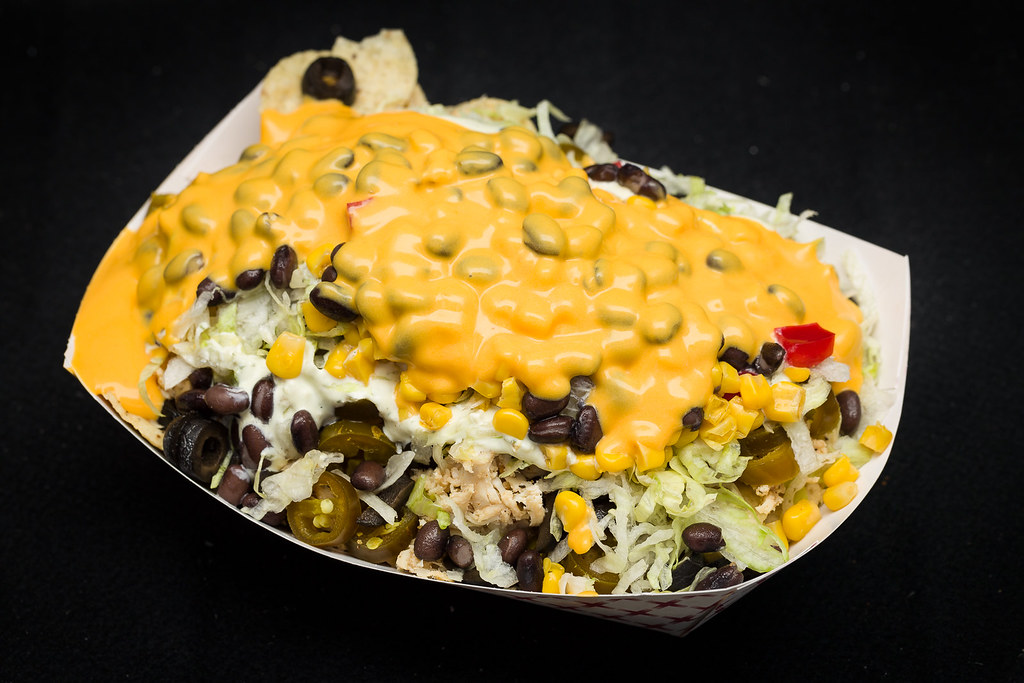
After ordering my chorizo dog topped with the spicy slaw, I set about attempting to order the tequila lime chicken nachos. This was where things started to get a little dicey. While people like to claim that they want choice in their lives, when faced with too much choice, the average human being becomes paralyzed with fear over having to actually make said choice. And with some fifteen toppings from which to choose, it took me a minute to get my bearings. Nacho Mama might be better served by offering a "standard" - beans, lettuce, tomatoes, shredded cheese, and salsa - and then allow customers to modify it to suit their taste. For whatever reason I was feeling in a nacho cheese kind of mood, so I added it as one of the toppings.

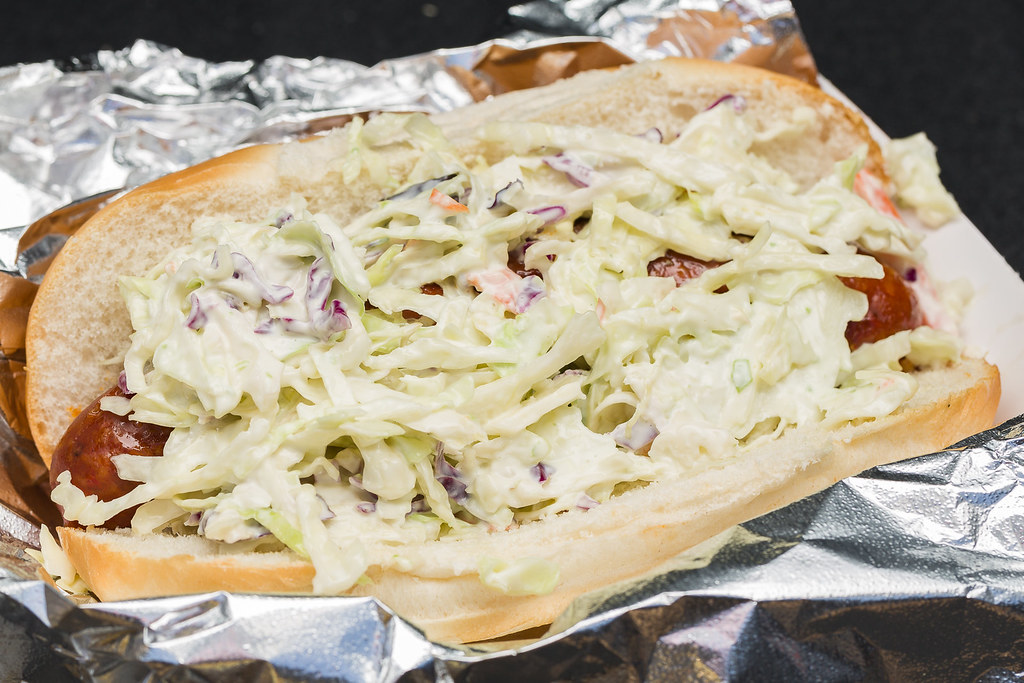
After paying the $15 for my haul (I included one of the Pepsi products as well), I walked to the other end of the truck to wait for my food. Within a minute or so, the woman inside the truck handed me the chorizo dog. While waiting for my nachos, she helpfully informed me that the chorizo link was actually from a place with which I am quite familiar, Dumas Meats in Mogadore, Ohio. That, to me, was a good sign. The bad sign, sadly, was the white squishy Italian hoagie bun on which the dog had been served. More on that later.


The last step before handing me my finished nachos was the ladling on of the cheese. Sadly, this happened straight from a very large can that had no cover on it that was labeled, "Nacho Cheese." One might find this type of product at any Gordon Food Service (GFS) / Sam's Club / food wholesale place and would have probably been more correctly labeled "pasteurized cheese food product" rather than just "cheese." Regardless, after the ladling of the cheese, she handed it to me. The first thing I noticed besides the dayglo orange color of the cheese was the heft of the basket in my hand. For $7, you certainly got your money's worth, I thought.


As I crossed the parking lot to my waiting car, I began to notice a problem. The nacho cheese had been poured too closely to one of the edges of the cardboard container and as it settled, had started to ooze over the edge. Not wanting to set this down anywhere in or on my car, I did the only thing a person holding a soda pop and chorizo dog in one hand and a container of nachos in the other hand could do: I decided to lick the cheese off the cardboard. I figured I just wouldn't photograph that side of the dish. I put the cardboard container to my mouth and gently licked the offending cheese off with a quick swipe of my tongue and gasped in amazement: the nacho cheese was ROOM temperature!

Now, those of you reading with no commercial food preparation or restaurant experience may think my negative reaction was due to the fact that I (and probably you) prefer your nacho cheese food product served hot. Tepid liquid cheese is just not something I relish the thought of eating. In reality, my surprise was due to the fact that by not holding the cheese at a proper serving temperature, the Nacho Mama Food Truck folks were playing Russian roulette with their customer's health.

Most food safety guidelines indicate that to avoid bacterial growth, food must be held below 40 degrees or above 135 (some say 140)  degrees Fahrenheit. As for time spent in between those two extremes, the cumulative time must be calculated and the food must be discarded after it reaches four hours. In addition to the inappropriate holding temperature, the can of cheese was just sitting on the counter, completely uncovered. Who was to say that something couldn't fly in through a window and contaminate the product?

So, let me see if I've got my math straight. The food trucks started serving food at 11 am and I was there at noon. Best case scenario, let's assume that the staff opened a fresh can of nacho cheese sauce right at 11 am. So, an uncovered can has already sat there for an hour right in the middle of the temperature danger zone? You can see why I was so alarmed. And honestly, if they can't hold this food at the proper temperature, what makes me think they know how to hold any other food at the proper temperature to avoid potentially getting people sick?

After photographing both items, I turned my attention to the chorizo dog. Upon my first bite, I was rewarded with a nice snap from the dog and creamy cole slaw. Unfortunately, the spicy part of the "spicy slaw" I ordered to top the dog was nowhere to be found. This was straight up cole slaw, and I'd venture to say given the provenance of the other ingredients coming out of the truck, it was probably food service cole slaw. But for me, the bigger issue with the dog was the bun.

The large Italian-style hoagie bun was straight out of squishy white bread hell and couldn't contain the dog and the slaw. Within another couple of bites, the dog had broken through the spine and by the time I got halfway done with it, the bun had completely split along the spine, offering no additional structural support to keep everything together. Fortunately, I had the presence of mind to grab a plastic fork from the truck and while I had originally envisioned using it with the nachos, found a more appropriate use for it to clean up the mounds of slaw that had fallen into the waiting basket below. The only real positive for me about this dog was the chorizo link itself from Dumas Meats.

I ended up disposing of the nachos in the garbage can, not even wanting to eat a single bite. I packed my camera gear away, got back in my car, and drove off. I do not plan on eating at the Nacho Mama Food Truck again, really for two reasons. First, the food safety issue (and that is the elephant in the room). Second, the quality and uniqueness of the food just didn't appeal to my sense of adventure. It felt like really bad Americanized versions of Mexican staples and honestly, there are plenty of other places I can already go to for that. You can definitely cross this food truck off of my list of places I'd recommend.

Friday, July 19, 2013

Rosewood Grill: Where Do The Desserts Come From?

I'll be the first to admit that sometimes it takes a little push to get me going. I knew that Turner's Mill had transitioned into Rosewood Grill several years ago. I also knew that they were serving upscale cuisine and that initial wait times for a table were crazy long. So I kept putting it off and off until I finally forgot about it. That is, until two friends and fellow photographers told me that they had gone for a meal to celebrate their anniversary and loved it.

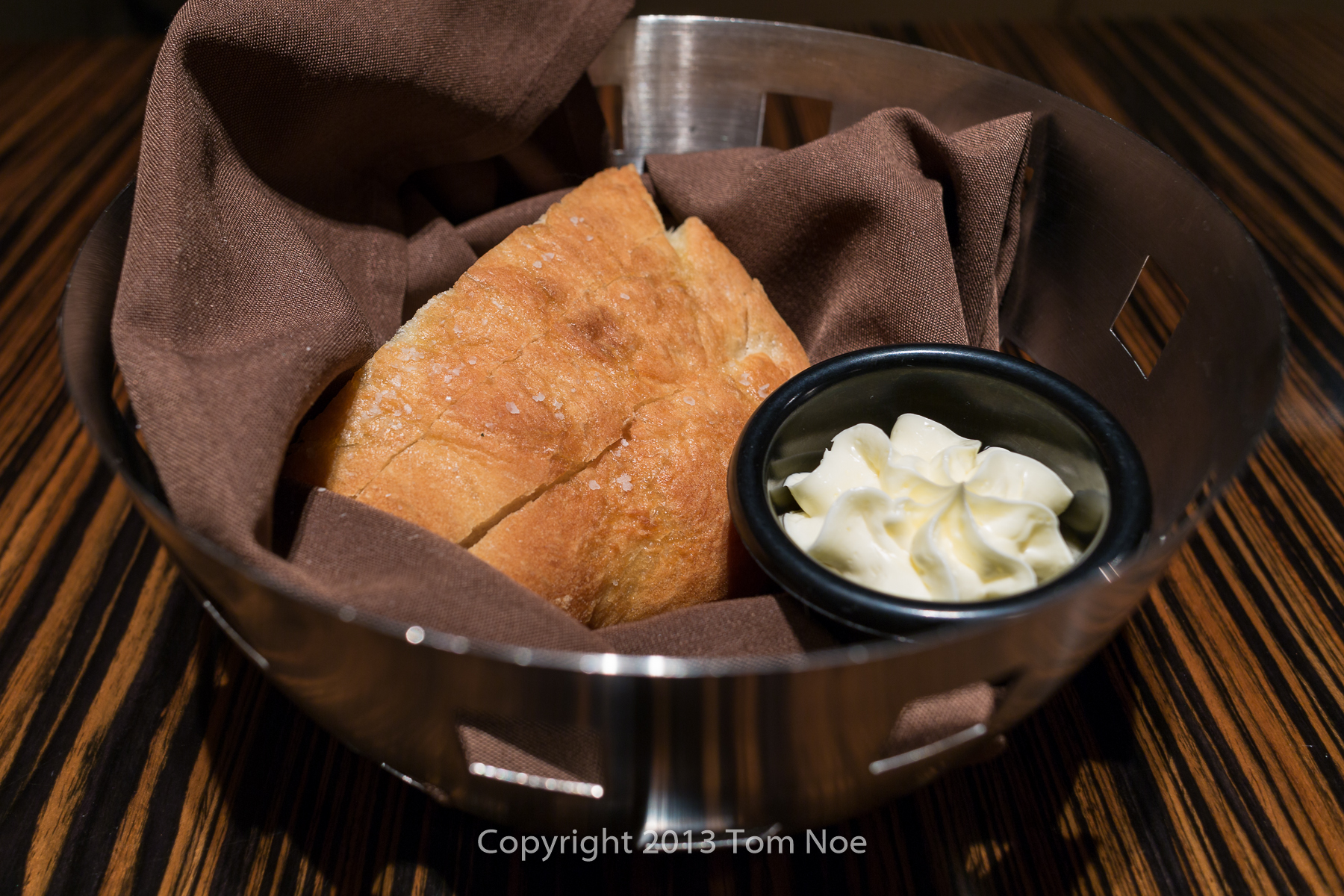
Seizing the opportunity, I stopped out for two meals, after work, both weeknights. Fortunately, weeknights seem to be the time to go in order to assure a table with minimum wait. After being seated, handed the menu, and told about the specials, I only had to deliberate for a short time before the server came back to my table to take my order and deliver the standard Bread Service:

Bread Service

The butter was cold and firm, but the hot, salted bread more than made up for it. The cold nuggets of dairy that I dug out of the ramekin with my knife melted easily into the bread and I was rewarded with a delicious starter to my meal.

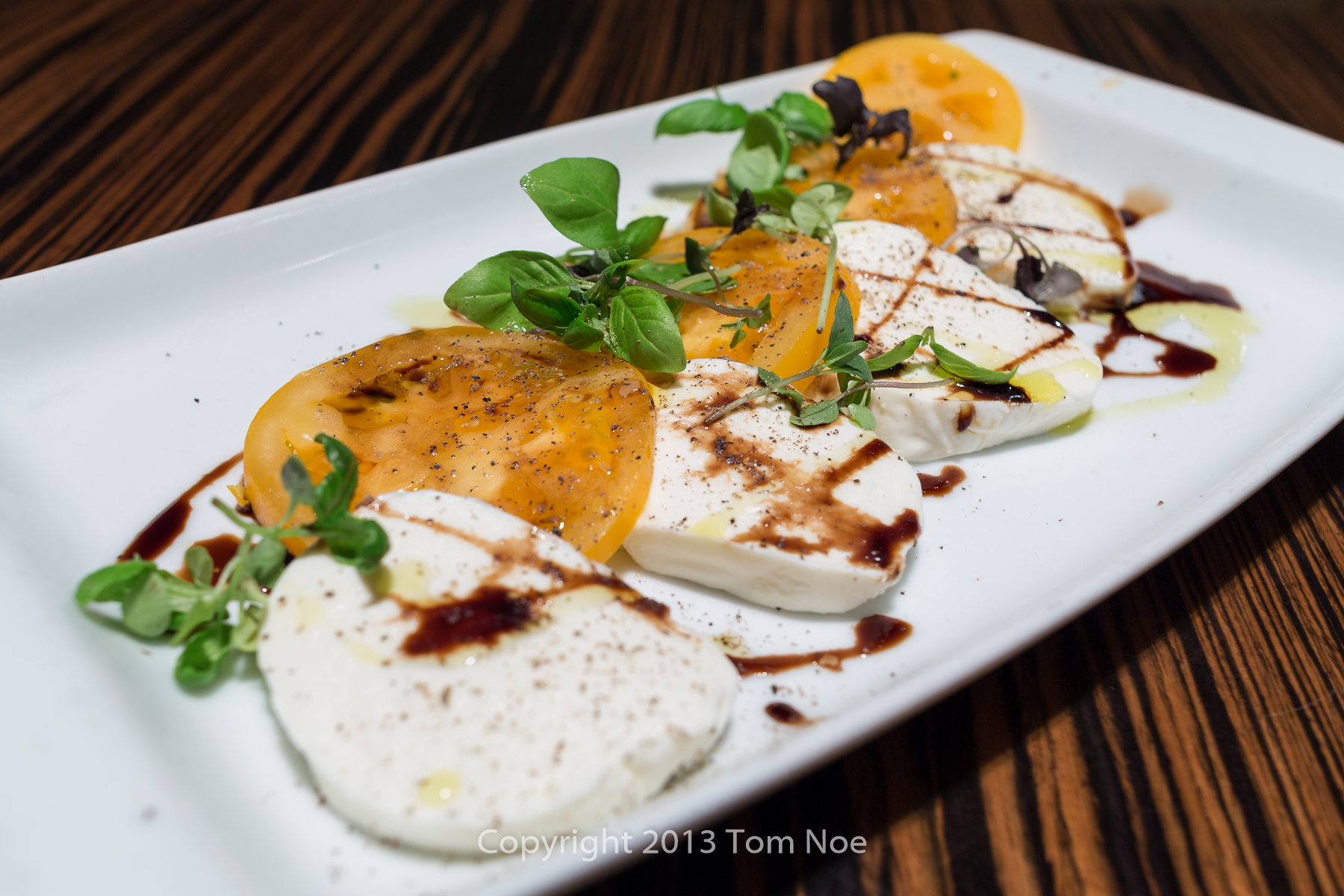
Hearing that one of the specials for the night was a Salad Caprese, I knew that a simple salad like this could easily be terrific or terrible. Shortly after the bread arrived at the table, my salad was delivered:

Salad Caprese

I've had many a salad caprese in my days and this one was right up there with the best of them. Really, it is a salad that is only as good as its ingredients. The mozzarella was tender and soft, the tomatoes were perfectly sweet and acidic, the fresh basil added a great herbaceous quality to the dish, and the balsamic vinaigrette tied all of the flavors together to bring home a true taste of summer.

While there were lots of interesting choices on the dinner menu, for some reason the Lobster Ziti was speaking to me tonight:

Lobster Ziti

The ziti was cooked perfectly al dente and the sauce nicely coated the pasta. I would've liked a bit more lobster meat, but generally this was a pleasing and filling dish. The spinach was a nice touch in terms of color, texture, and flavor. The mushrooms and grated cheese added a bit of earthiness and body to the pasta. Overall, a very good dish.

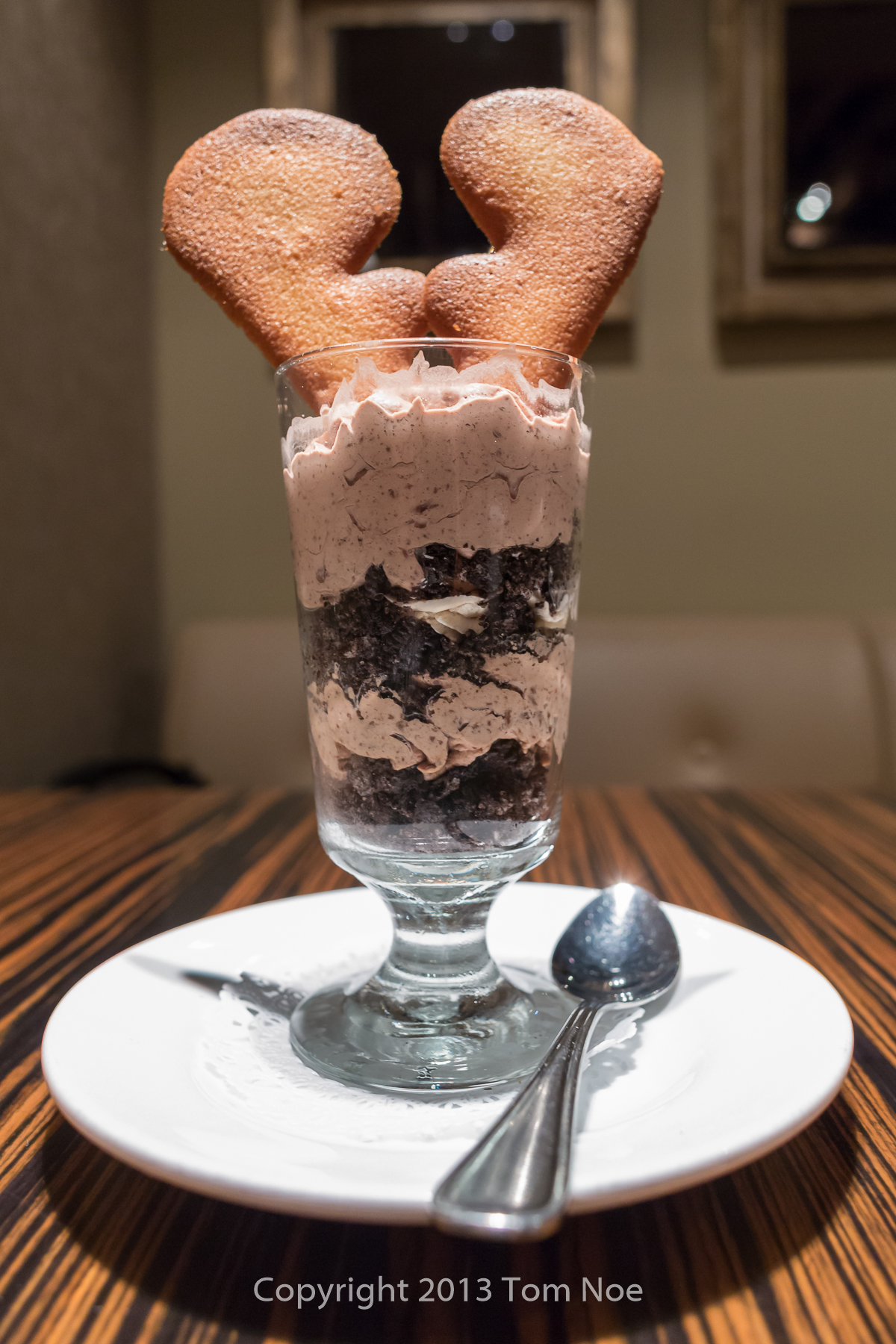
I decided to entertain the notion of dessert and thus took a look at the four item menu. When my server handed me the menu, as I quite often do, I asked her which desserts were made in-house. She declared that only the first two, the creme brulee and the chocolate "moose" were done on premises. Seeing as the creme brulee was straight up vanilla (and by vanilla, I mean both in flavor and excitement level), I ended up choosing the Chocolate "Moose" along with a cup of decaffeinated coffee:

Chocolate "Moose"

The Chocolate "Moose" was a parfait-like concoction of chocolate mousse and crushed oreo cookies with moose antler cookies sticking out of the top. While definitely a tasty dessert, there were a couple of items with which I took issue. First, this seemed like an awfully simple dessert for a restaurant of Rosewood Grill's caliber. It felt like a dessert a non-pastry person would have come up with. Second, and the more important of the two items, was that the mousse itself had been overwhipped slightly and the result was a slightly grainy texture. Sort of like little nuggets of butter had formed throughout the mousse.

For my second visit, I decided to skip the bread service and go with one of the on-menu salads, the Berry and Bibb Salad:

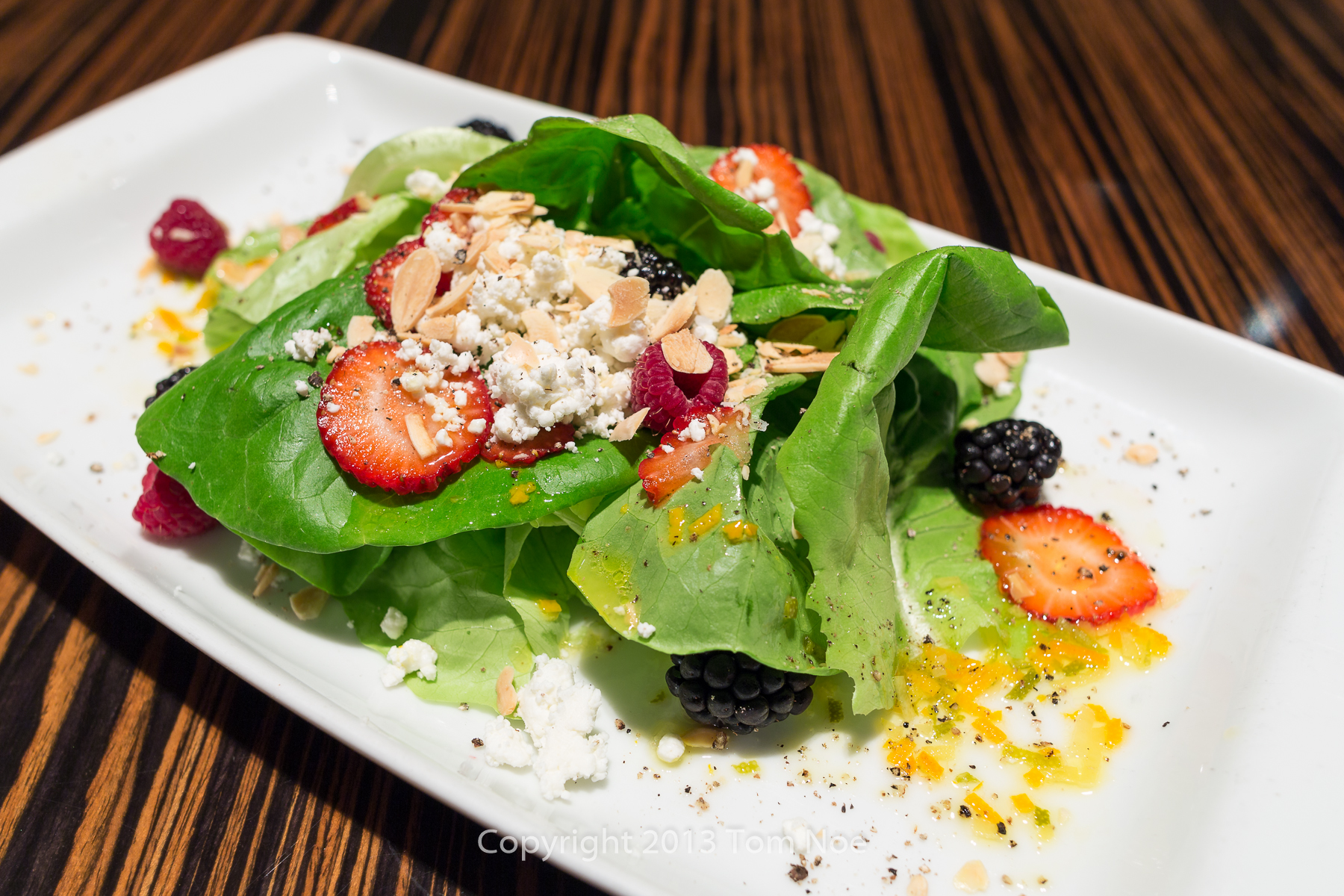
Berry and Bibb Salad

I love the theory of this salad. Combining Bibb lettuce with strawberries, raspberries, and blackberries, crumbled goat cheese, toasted almonds and dressing the whole thing in a citrus vinaigrette sounded delicious in my head. However, the execution was a bit off as most of the Bibb lettuce wasn't coated with any of the vinaigrette. This undressed lettuce had a serious bitterness that the sweetness from the vinaigrette would've gone a long way at alleviating. That being said, were this salad more properly tossed, I think it would've been a hit. I did enjoy that the toasted almonds added a lovely little crunch to each bite.

After hearing about one of the nightly entree specials, I found myself waiting with anticipation. Fortunately, I didn't have to wait long as the Pan-Seared Salmon with Asparagus and Red Lentil Hash arrived shortly after my salad plate was cleared:

Pan-seared Salmon

The preparation of the salmon was executed with immaculate textbook-like precision, seasoned perfectly and pan-seared with a crisp exterior and a melt-in-your-mouth medium rare interior. The skinny asparagus and the accompanying buerre blanc added a further lusciousness to the dish. The red lentil hash was a nice idea on paper, but it felt a bit too overworked in the ingredient department. It definitely didn't need the added pop of color from the spinach. The rather large onions (compared to the small lentils) felt out of place. Perhaps had all of the ingredients been cut to the same size and the resulting mixture been pressed into a ring mold, this might have worked better for me.

Dessert during my second visit to Rosewood took an unexpected turn. After handing me the dessert menu, I asked my server which of the desserts were made in-house, the very same question I asked the other server I had during my first visit. Expecting him to point out just the creme brulee and the chocolate "moose", I was a bit surprised when he claimed that all of the desserts (with the exception of the Mitchell's ice cream) was made in-house. When I told him what my previous server said, he claimed that she was misinformed. In fact, he had personally witnessed one of the items previously considered out-of-house being made on premises.

With that new nugget of knowledge, I decided to continue with my chocolate dessert theme and ordered the Chocoholic:

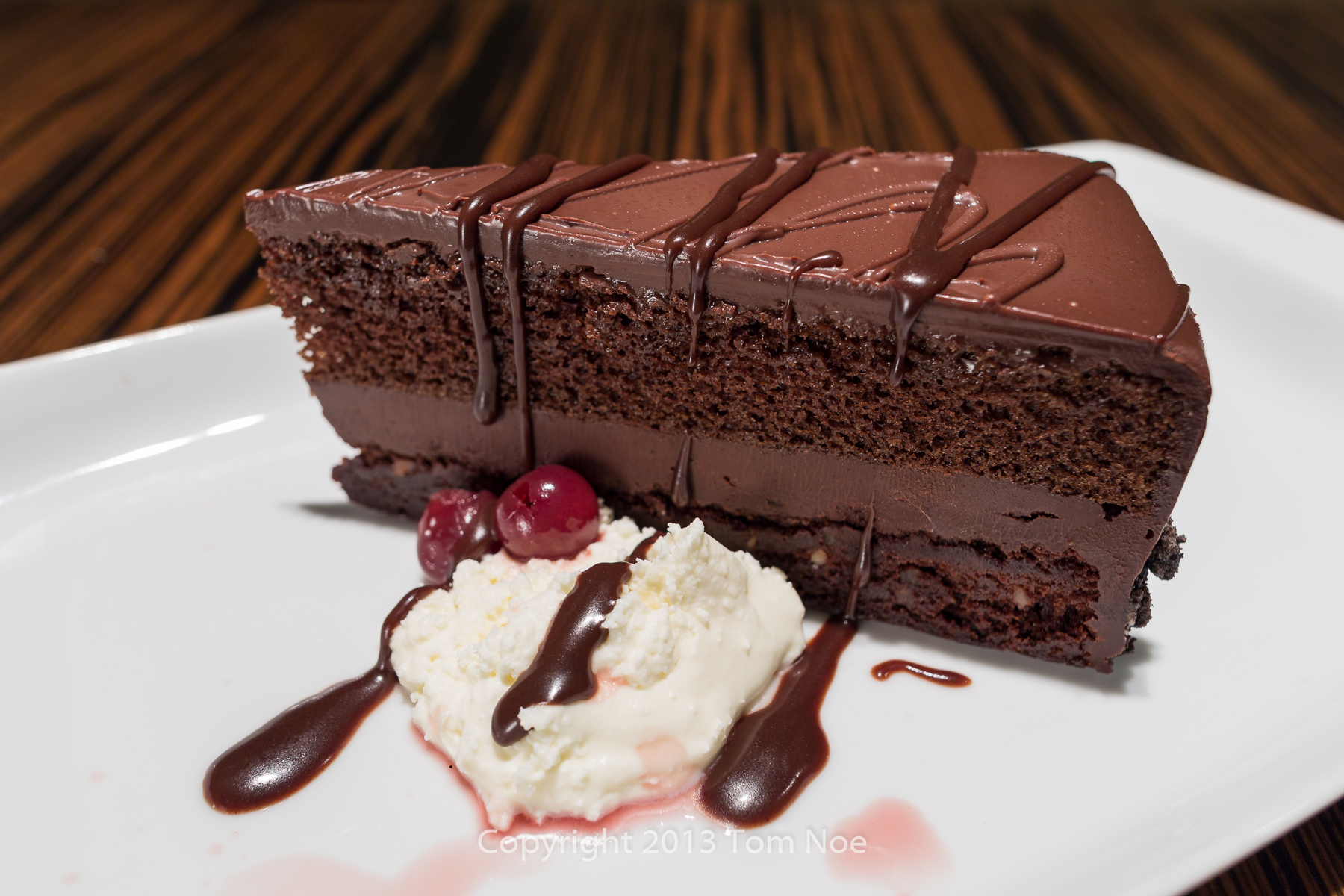
Chocoholic

The menu didn't lie. For $6, I received an enormous portion that could've easily fed two people. Positioned between thick creamy layers of dark chocolate ganache were a brownie with nuts layer and a chocolate cake layer. Additional chocolate sauce was drizzled over the top and the plate was dressed with slightly sweetened whipped cream and macerated cherries.

I had decided to forego the usual cup of unsweetened decaffeinated coffee that I often use to cut the sweetness of desserts. My server had asked me if I wanted a cup of Mitchell's vanilla ice cream to accompany my dessert and I said, "No," thinking that I really didn't need the additional sweetness. That was a mistake on my part because you need something, ANYTHING, to help cut through the incredible chocolate flavor avalanche you are about to embark upon. I actually liked the Chocoholic quite a bit, other than there was just too damn much of it. Fortunately, this wasn't my server's first rodeo and he graciously brought me a complimentary scoop of vanilla ice cream anyway. As odd as it sounds, the vanilla flavor was a welcome relief every now and again to the intense chocolateness of the dessert.

Like my previous visit, the check before tip and tax was roughly $40-$45. Despite the various quibbling over under dressed salads and dessert provenances, I rather enjoyed both of my meals at Rosewood Grill. The service was pleasant and (mostly) well-informed both nights I went and I was able to get a table within about ten minutes of arriving. I would strongly recommend calling for reservations if you are planning a visit on a weekend.

Rosewood Grill is definitely recommended.

Rosewood Grill on Urbanspoon

Wednesday, July 10, 2013

Goldilocks Rebooted

Come, gentle readers, gather 'round. It's story time and I have one that will be right up your alley. Er, or maybe not.

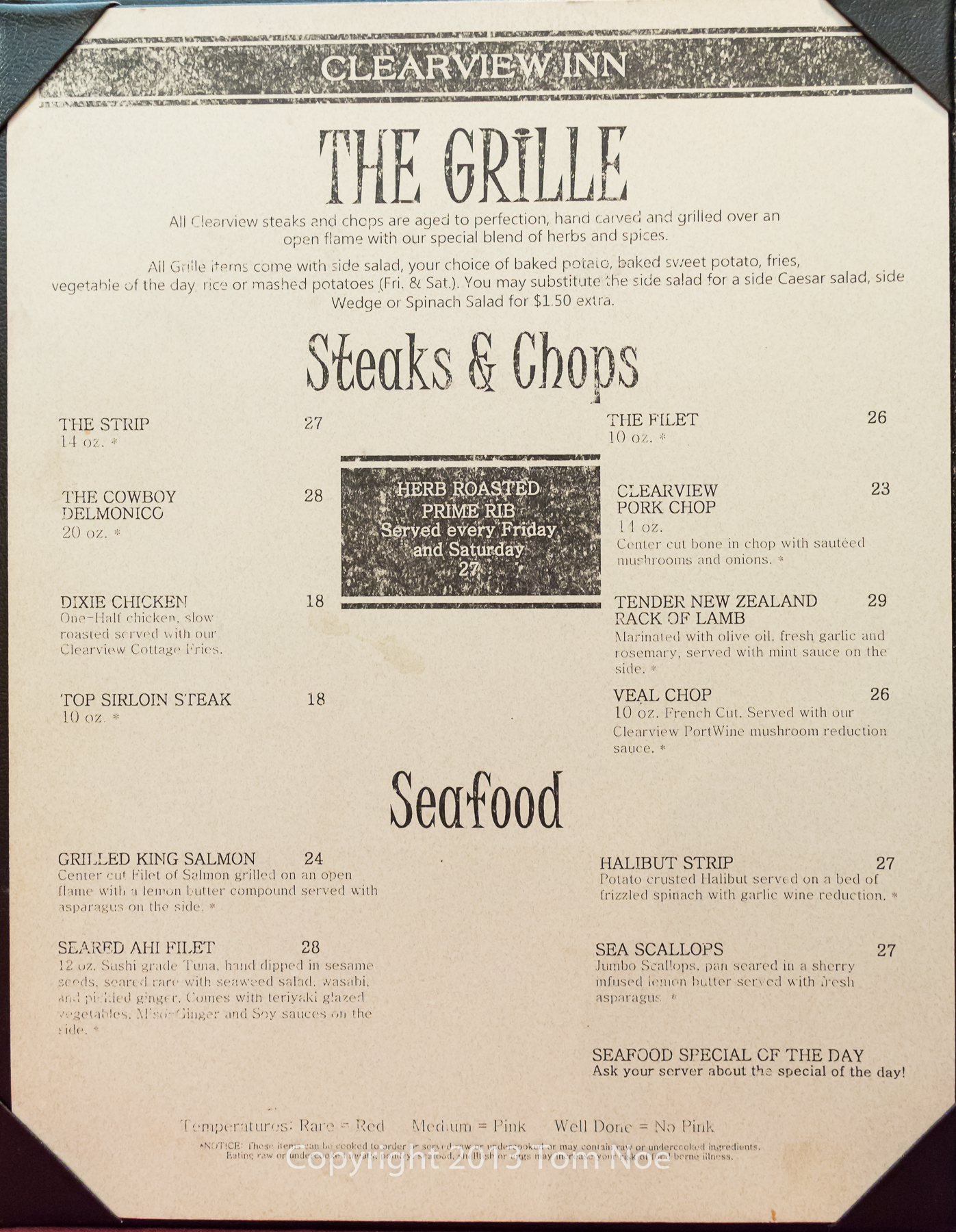
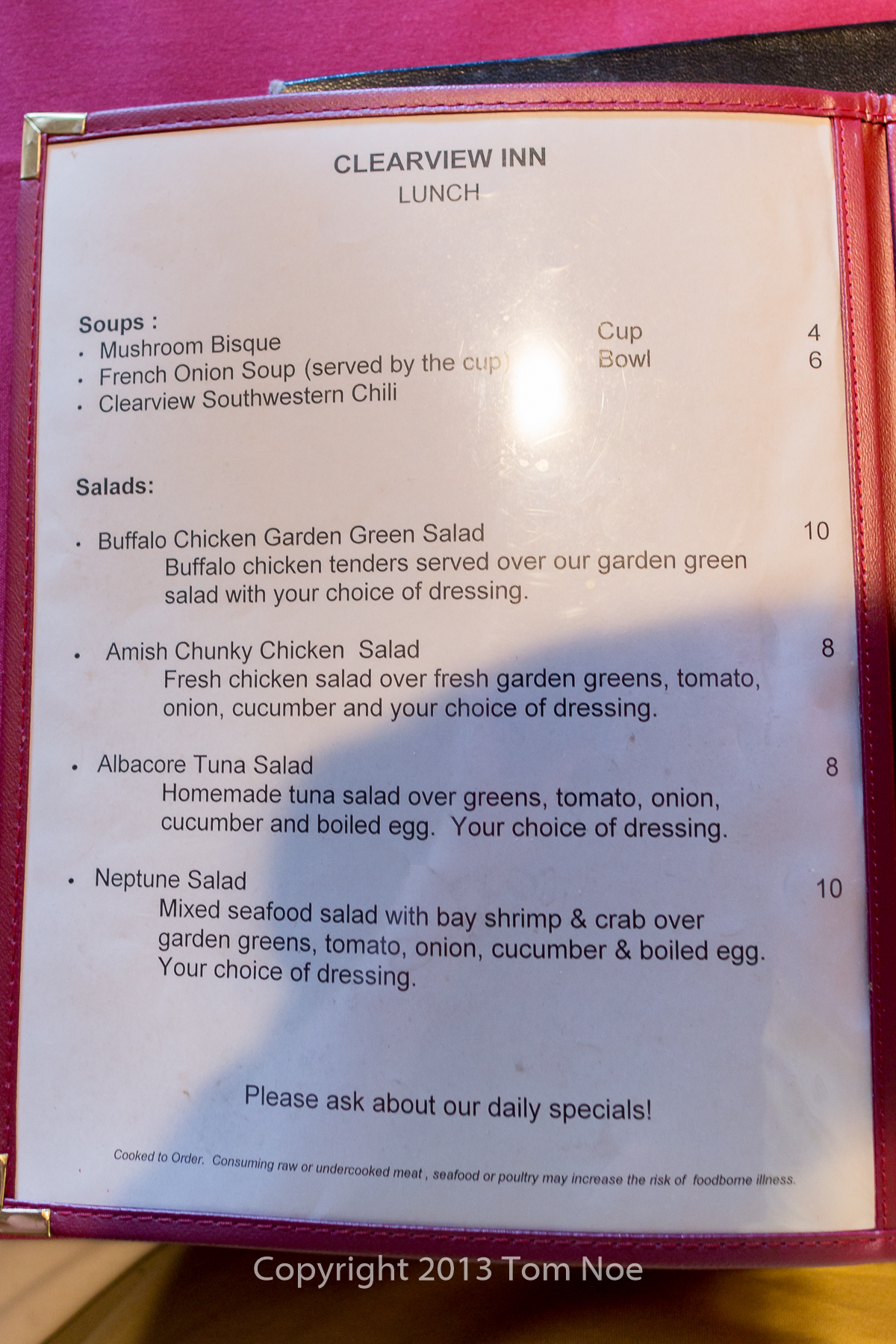
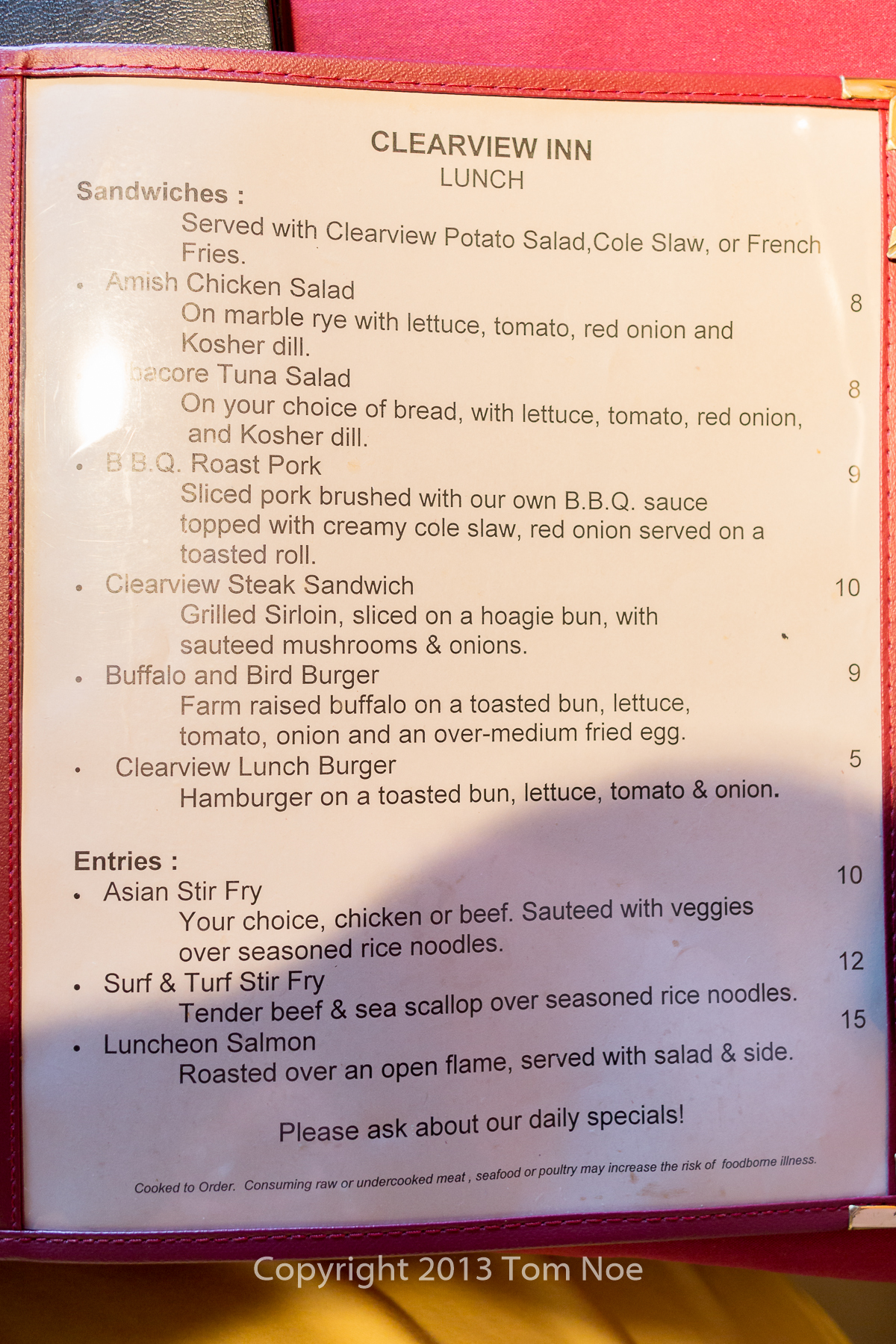
As a result of my multiple trips up to dine at Cork & Cleaver Social Kitchen and gather intel for my review on them, I noticed a restaurant called Clearview Inn on the corner of Cleveland-Massillon and Everett Roads. Should you go to the almighty Google to locate them on Google Maps, DO NOT believe the results. Google Maps puts the restaurant about a half a mile further south on Cleveland-Massillon Road than they actually are.

Having driven past the restaurant enough times, it finally piqued my curiosity enough to actually look them up online. Interestingly, while they do have a perfectly fine and functioning website, when it comes time to take a gander at their menus online, while there is a landing page for both the lunch and the dinner menu, links and/or PDF files are suitably missing. Sadly, no amount of digging around the Internet would yield anything other than the fact that the Clearview Inn specializes in steaks, chops, and seafood. I decided to remedy the situation with a visit.

My first visit was on a Thursday night, around 6:30, on a night when there wasn't any entertainment (which according to my server is a big thing at Clearview Inn). When I walked in, I discovered more of a bar-like atmosphere than a restaurant, although there were plenty of empty linen-covered tables. The woman tending the bar told me I could sit wherever I'd like. A glass of water and a menu followed shortly thereafter.

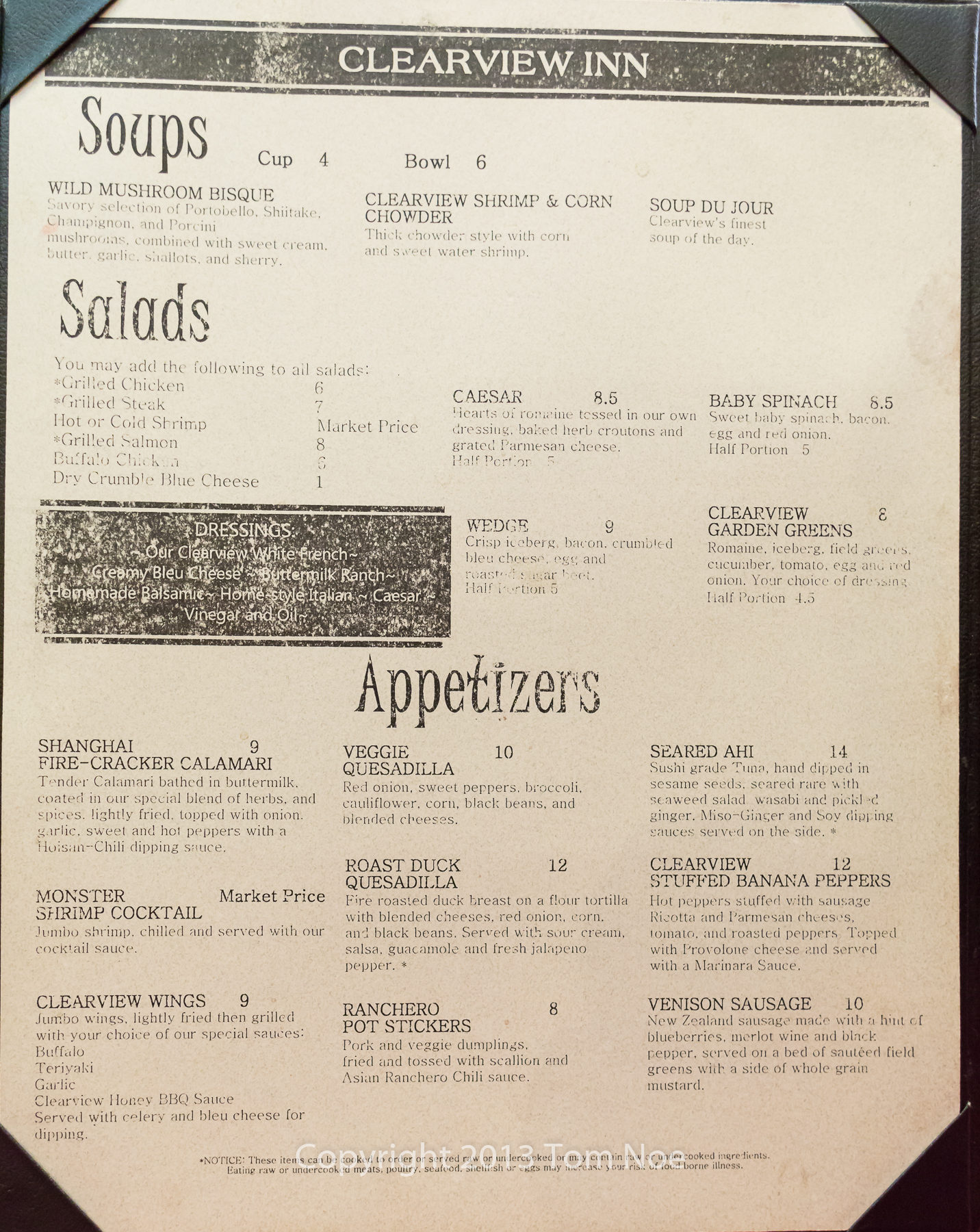
Here was the Dinner Menu:


Dinner Menu

Based on how much the print had faded on my menu, I'm guessing the menu didn't change very often. I also noticed that most of the steaks, chops, and seafood were in the $20-$30 price range, a touch on the pricey side for the Akron area. However, with Ken Stewart's two joints just down the road, the Clearview Inn seemed in-line to compete with them. On the last page was a section called, "On The Lighter Side". Reading the items in this section (Southern Fried Chicken?), it occurred to me that "lighter" must refer to the price points rather than the calorie counts.

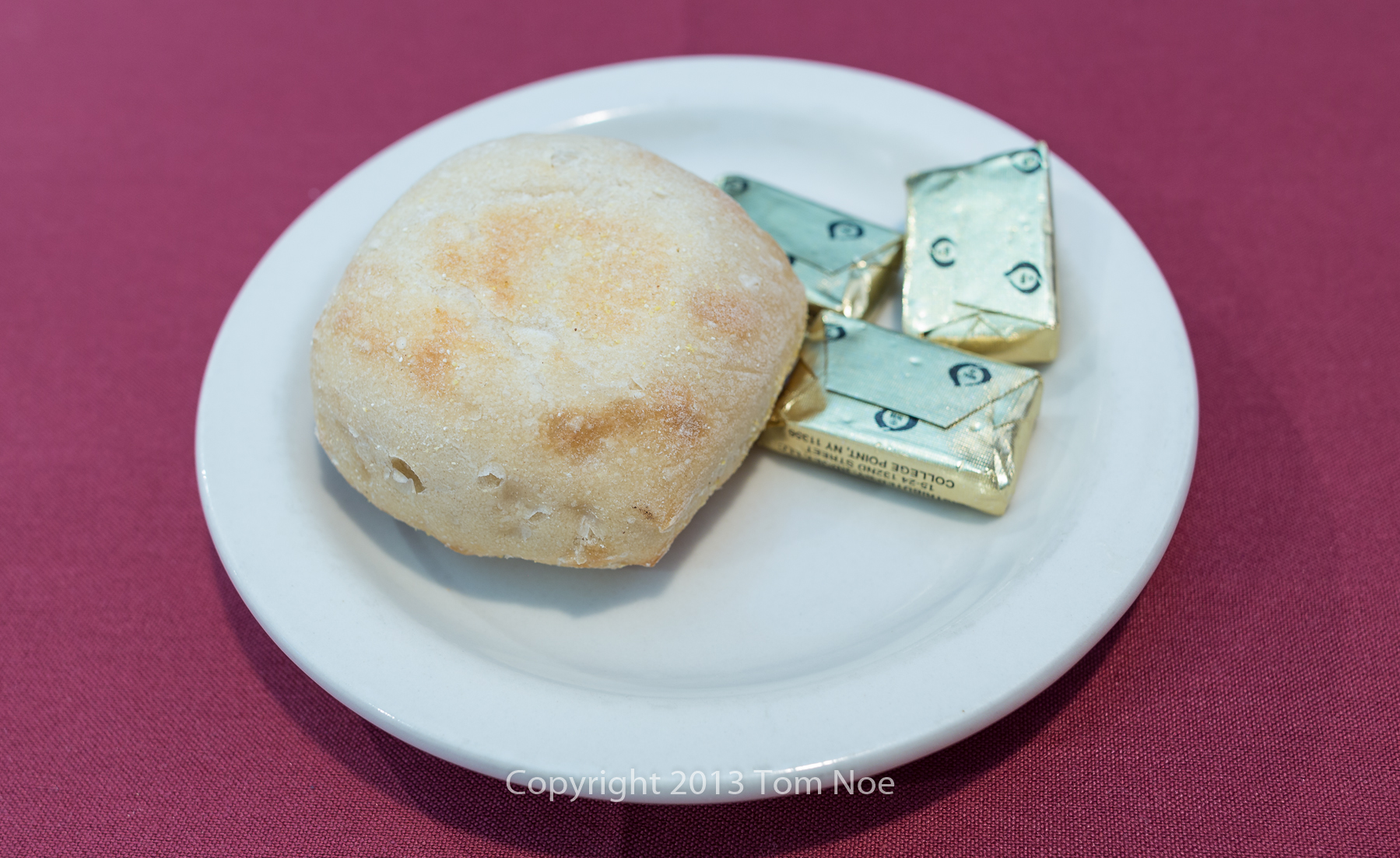
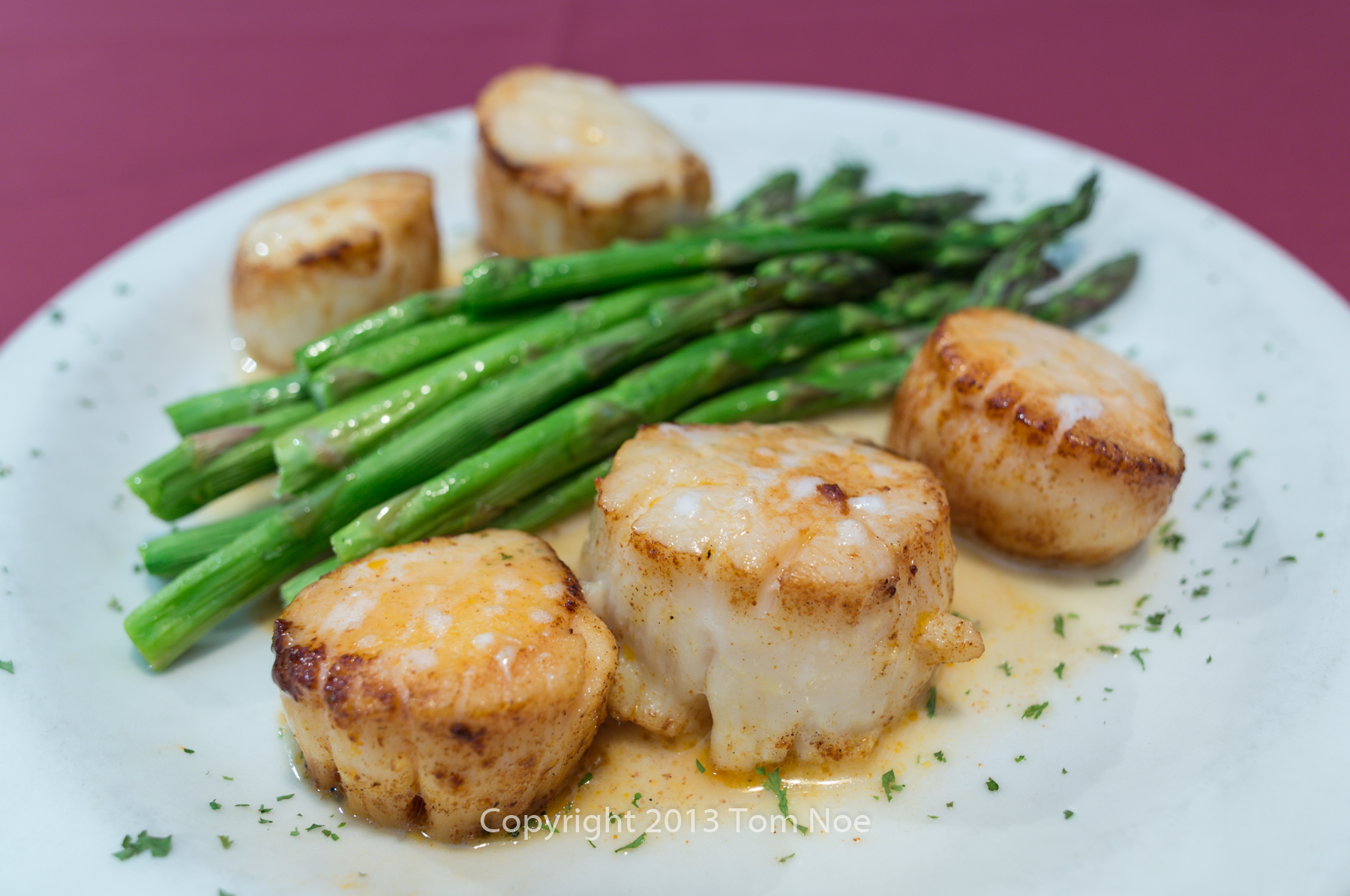
While I wasn't quite in the mood for a steak, the scallops sounded like a lovely choice. After placing my order, standard bread service arrived a few minutes later:

Dinner Roll and Butter

The roll was fresh and warm and the butter soft. What can I say? It was a good roll.

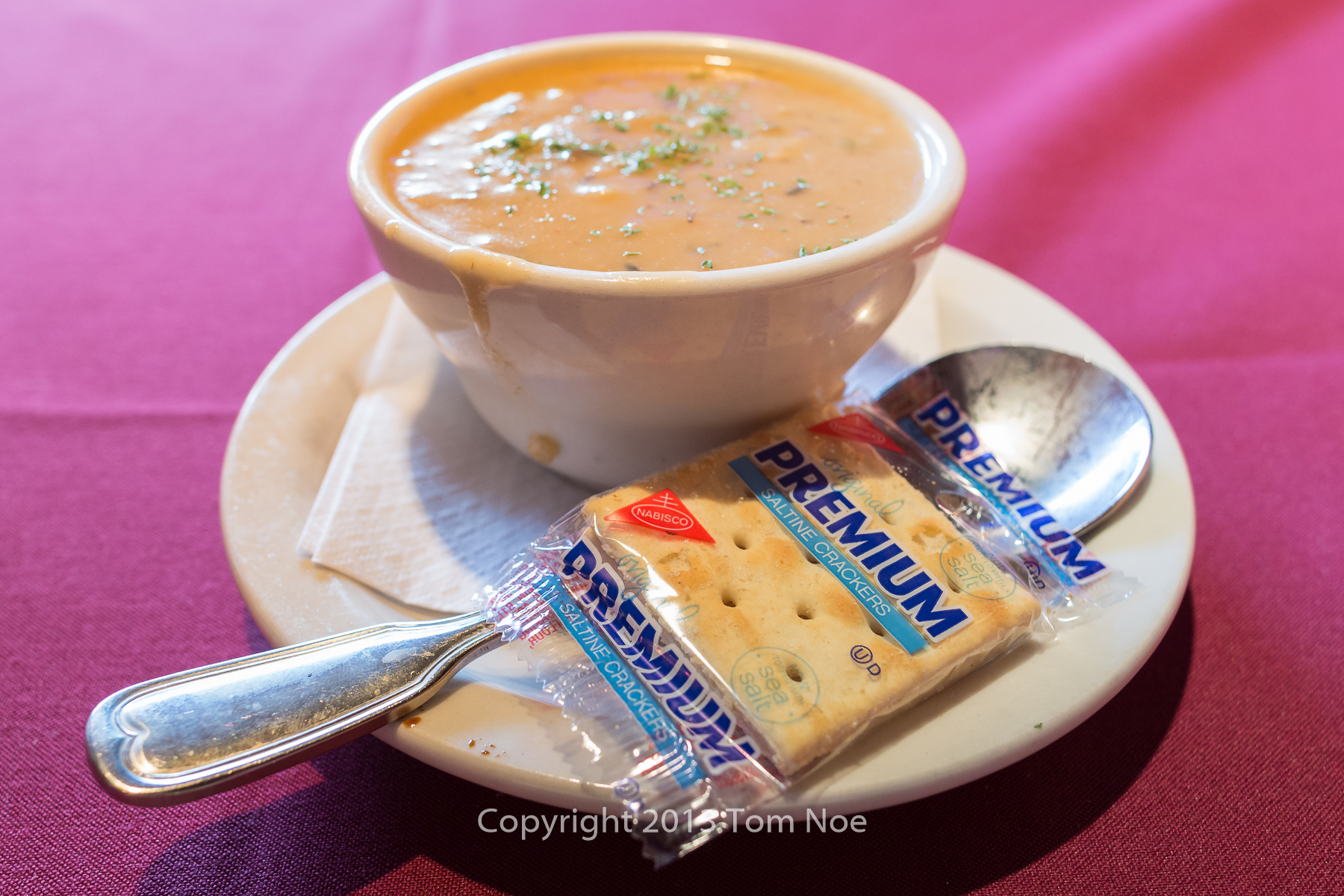
In addition to my entree, I decided to start my meal out with a cup of the Shrimp and Corn Chowder:

Shrimp and Corn Chowder

While the soup was hot and had a nice flavor, the two items that I noticed right away were the thinness of the soup (almost a broth) and the lack of actual shrimp in the soup. While I wasn't expecting whole pieces of shrimp to be floating in the soup, by the time I reached the bottom of the bowl the only shrimp I found was a few links of the tail-side end of the shrimp ... sans shrimp! I don't doubt that shrimp and shrimp shells were used to flavor the soup, but it'd be nice to see a bit of the actual shellfish given its use in the description.

My entree came with a rather standard garden salad. I asked for mine with the homemade White French Dressing on the side:

Garden Salad with White French Dressing

Containing an assortment of iceberg lettuce, grape tomatoes, cucumber slices, and red onion, there was nothing particularly special about this salad. The white french dressing added some necessary zip, flavor and seasoning. Sometimes you eat something because it tastes good; sometimes you eat something because it is (or at least you think it is) good for you. This salad falls into the latter category.

My entree, the Seared Sea Scallops with Asparagus, showed up just as I was finished my salad:

Sea Scallops

Let me break down the plate for you a bit, gentle reader. In addition to what appeared to be half a pound of asparagus, there were five scallops of various sizes arranged around the plate. Some were seared nicely to a golden brown and others, a tad more blonde. A sherry butter sauce lined the plate and a dusting of chopped parsley added a bit of color to the whiteness of the backdrop. At a $27 price point for the scallops, I expected quite a bit more in terms of uniformity of scallops, the inclusion of a starch of some kind, and honestly, just better plating. I'm not sure who decided that a half-pound of asparagus was a wise portion size for the average diner, but I would've preferred half the asparagus and the inclusion of some rice pilauf or maybe some mashed or roasted potatoes.

Regardless of the presentation, what really counted was how well the food was prepared and how it tasted. Sadly, like Goldilocks and the Three Bears, because the sizes of the scallops were all over the place, the smaller ones were overcooked and rubbery, the middle one was nearly perfect and the larger ones were undercooked and raw in the middle. The sherry butter sauce was tasty, if a bit on the thin side. I only managed to eat half of the asparagus, although it was tender and had good flavor. Overall, I'd say the dish was average, which is not what I expected for $27.

I decided to return for my second meal on the following Friday, this time for lunch. In addition to the dinner menu, a standard lunch menu was also available:


Lunch Menu

Having already experienced the dinner menu, I decided to focus on items from the lunch menu, starting with a cup of the Mushroom Bisque:

Mushroom Bisque

As opposed to the shrimp and corn chowder I had experienced during my previous visit, the mushroom bisque was thick, hearty, and full of not only great mushroom flavor, but also mushroom pieces themselves. A bowl of this and a nice salad and you'd have yourself a very filling lunch. Fortunately, the cup provided a lovely taste while still leaving room for more food.

For my lunch proper, after scanning the menu quite thoroughly, I opted for the Buffalo and Bird Burger:

Buffalo and Bird Burger

I am a big proponent of ordering straight off the menu when evaluating food for the blog. Sometimes the chef just knows better and I don't want to go mucking around with a recipe that was designed to be a specific way. However, when I saw that the egg was cooked over-medium, I asked instead if they would cook it sunny side up. I mean, isn't the runny yolk part of the appeal of putting a fried egg on a burger? Fortunately, my server said that it wouldn't be a problem.

When my burger finally arrived at the table, I used a steak knife to cut the burger in half to examine the middle. Knowing that buffalo meat could be fairly lean, I had ordered the burger cooked medium. Sadly, while the burger had been cooked closer to well done, at least it wasn't dried out. I also noticed that the burger meat was adulterated with bits of red pepper and onions strewn throughout the patty, presumably to add flavor and help keep the meat juicy. I was eating more of a meatloaf-esque buffalo burger than a straight up 100% ground buffalo patty.

As for the taste, it was a decent enough burger. The seasoning was right and the bun was toasted and substantial. It wasn't the best burger I've ever had, but it was far from being the worst. The menu indicates that the burger comes with lettuce, tomato, and onion, but my plate came devoid of any vegetation for the burger. I chose a side of the homemade potato salad which basically consisted of potatoes, celery, scallions, mayonnaise-based dressing and seasoning. It was potato salad, yes, but it was rather plain, to be honest.

Lunch was obviously far more economical than my previous dinner, coming it at around $15 plus the tip. I realized fairly early on in my experience with the Clearview Inn that this is the kind of dining establishment that would've appealed to my late grandfather. When he went out for dinner, he expected the steak to arrive on one plate with a sprig of parsley and the potato to come on a separate plate. Plate presentation was of little importance to him. That he could have ordered a Black Velvet manhattan and probably gotten one at this establishment says more about a previous generation of restaurant goers.

In the end, I was only moderately impressed with the food. However, the service when I went both times was responsive and pleasant. To be fair, I didn't go during a day when they had entertainment; your mileage may vary if you go then. For value, I'd recommend lunch over dinner and quite frankly, dinner only gets an average passing grade for the quality and execution of the food. If I had $27 to blow on scallops, I can think of several other restaurants who would get that business instead.

Clearview Steak & Chop House on Urbanspoon
Related Posts with Thumbnails