Wednesday, November 18, 2015

Tackling The Restaurant Problem

If you've read my last two posts, you already know that I've severely cut back on salt, almost cut out butter, and completely cut out cheese from my diet. While this seemed daunting at first, it didn't seem impossible to achieve when cooking for myself at home, where I have 100% control over what goes into my mouth. But what do you do when you want to go out for a nice meal? Is this even possible when it's pretty common knowledge that restaurants often load their food with the very items you are trying to avoid?

Yes, it is.

However, in order to stay in control, you have to do three things: research, research, and research. You can take NOTHING for granted. Your server may be the most sincere and helpful person on the planet, but they aren't the ones prepping and cooking your food*. Managers are usually better (at least in chain restaurants), but you need to go into the situation as if you've prepped for battle. It's nice that the restaurant gives you a menu when you sit down at your table, but you have to already know what you can and can't have before you even walk through the front door.

(* I'm not saying that servers can't be helpful, I'm simply saying that you shouldn't necessarily rely on them for accurate information when it comes to what it is in the food.)

There are really three situations you're likely to encounter when you go out for a meal:
  1. National or local chain restaurants that have published nutritional information (usually on their website).
  2. Local chain restaurants that have not published nutritional information because they aren't yet big enough and not required to do so.
  3. Independently owned restaurants that have not published nutrition information because they are a single location and not required to do so.
Let's talk about each of these options in turn.

#1

Restaurants that publish nutritional information are worth their weight in gold. After reviewing the information provided, you may discover that there is absolutely nothing that you can eat, but at least you know that before even stepping foot inside the front door. Here's the thing to remember about chain restaurants (be they local or national) ... the owner(s) want the experience to be the same regardless of which location you attend. Thus, they have put in place a series of suppliers and processes to reliably deliver the same food quality and nutrition across all of their locations.

In this blog's previous incarnation, I would've almost immediately turned down a request to review a national chain restaurant. They stand to offer little local character to the food scene and quite frankly, the food can be rather uninspiring. Now that things have changed for me and most chains publish their nutritional information, I find that chain restaurants offer me the opportunity to vet them on my computer at my own leisure without the pressure of having to make an uninformed choice when sitting at the restaurant. And I know that if I find something on the menu that I can actually have, all the locations will be able to provide it with the same nutritional content (in other words, one location won't be salting it more than the others).

Most restaurants' nutritional information is offered via a downloadable PDF file that is organized in a spreadsheet-like format. After figuring out which column represents sodium, scan through the list of offerings to find items that fit within your daily sodium budget. Occasionally, I've found websites where you had to essentially submit requests item by item in order to retrieve nutritional information (I'm looking at you, Outback Steakhouse). My rule of thumb is that if I can't easily scan through a list of items to find the information I need, you're out. Buh-bye.

If you're surprised that I would even consider Outback Steakhouse, know that I found a very low sodium meal that I can have at PF Chang's (gluten-free Buddha's Feast with steamed vegetables and brown rice -- 80 mg for the entire meal). Yes, this is the same PF Chang's that offers an item that has nearly 8000 mg of sodium for a single dish (a bowl of their Hot & Sour soup)! You just don't know until you start doing the research.

#2

Next up, we have the local chain restaurants (some national ones, too, like Cracker Barrel) that haven't published any nutritional information. Honestly, I don't even bother with these. If they aren't willing to divulge, then I'm not willing to be used as a guinea pig.

#3

Finally, we have the local independent restaurants. While they don't publish nutritional information, at these types of establishments, you have the opportunity to actually talk to the person/people who actually cook your food. That is all well and good, of course, but I've found that independent restaurants fall into two categories:
  1. Restaurants that season the food as it is being prepped and then do a final seasoning as it is cooked for service.
  2. Restaurants that don't season the food as it is being prepped and only do a final seasoning as it is cooked for service.
And, of course, know that most restaurants fall in between those two extremes. So, you may come across some items on a restaurant's menu that are seasoned during prep (such as house-made charcuterie or a confit duck or chicken) and others such as sauces that are only seasoned during final cooking for service. Once you manage to track down the person making the food, it pays to ask very specific questions. I would 100% never, ever, ever, ever walk into a restaurant which I haven't vetted, either by looking at published nutritional information or talking with the chef (or at least a manager) ahead of time. It's not fair to the restaurant and it's not fair to you. Even with my dietary restrictions, I still want my dining out experience to be pleasant and anything I can do to make it as smooth as possible is welcomed both by the restaurant and by me.

Here's the thing about eating a very low sodium diet (along with no butter and no cheese): expect that most restaurants that can accommodate you will pretty much be able to offer only one thing on the menu that you can eat. If you're lucky, two. If you're REALLY lucky, you'll come across a restaurant that can offer you four or five choices. When you find those restaurants, thank your lucky stars and give them patronage whenever you can. Opening a dialogue with the chef goes light years towards helping you achieve your nutritional goals and helps the restaurant understand exactly what you can and can't have. Once you've established that repertoire with a kitchen, it can be very easy, for instance, to find out if the daily special can be done within your dietary restrictions. "Chef says that the special is all salt-free except for the chicken, which is brined." Good to know!

So, this leads to the question of how to initiate that dialogue, especially if you don't know the chef or if you haven't ever been to the restaurant.

Go to the restaurant's website and/or Facebook page. If there is a contact email listed, use it. Leaving a public comment on a restaurant's Facebook page is kind of hit or miss; it'll depend on how actively the restaurant monitors their own page. I've also been known to send a Twitter message if a Twitter account is all that I can find. Explain your predicament and ask for advice in steering you towards menu items that would be appropriate. Here is a recent example of a message I sent to a restaurant:

"Sir/madam --

I have friends who have invited me to join them for dinner at your restaurant in a couple of weeks. I am writing to you ahead of time because I have several dietary restrictions (no salt, butter, cream, or cheese) and was hoping you might be able to suggest an item or two on your current dinner menu that would be easy for the kitchen to accommodate me during service. Oil (olive, canola, vegetable, etc.) is perfectly fine. Please direct any response or additional questions to my email address.

Thank you for your time."

You'll get one of three responses:
  1. Yes, we can accommodate you and here are your choices.
  2. No, I'm sorry, but we can't accommodate you.
  3. No response.
#1 happens pretty often. #2 happens, but more rarely. #3 happens more often than you'd like to think. To be honest, I'd rather hear back from a restaurant stating that they can't accommodate me than not hearing back at all. That being said, #3 just means that in the game of consumer choice, the restaurant simply loses by default.

So far, this has been my strategy for tackling the restaurant problem and I've had good results. If you're scared at the thought of talking to an honest-to-goodness chef (the Food Network does seem to put them on a pedestal), know that almost every chef I've interacted positively with absolutely wants you to enjoy your experience at their restaurant and as long as you are courteous and willing to work with them, they are happy to give you the information you need to make your visit a success.

Do you have any tips for successfully navigating the restaurant scene? I'd love to hear them in the comments.

Tuesday, November 17, 2015

Wait ... No Salt?! Now What?

When I first made the decision to go as low sodium as possible, I knew I was going to have to start by cleaning house. My own house, that is. While I didn't quite know what I was going to be able to eat on a regular basis, I knew that I had high-sodium products in my refrigerator and my pantry that would just have to go. What I didn't quite realize was HOW MANY of the items I used to eat did not even remotely qualify as no or low sodium.

First off, let's define a few terms. According to this page from the FDA's website, here are some terms with which you should become familiar:

  • "Light" : if food is "Low Calorie" and "Low Fat" and sodium is reduced by at least 50%.
  • "Light in Sodium": if sodium is reduced by at least 50%.
  • "Lightly Salted" : 50% less sodium than normally added to reference food.
  • "Very Low Sodium" : 35 mg or less per RACC* (and per 50g if RACC* is small). For meals and main dishes, 35mg or less per 100g.
  • "No Salt Added" and "Unsalted" : must declare "This is Not A Sodium Free Food" either adjacent to the claim or on the information panel.
  • "Sodium Free" : less than 5 mg per RACC* and per labeled serving (or for meals and main dishes, less than 5 mg per labeled serving).
*  RACC = Reference Amounts Customarily Consumed

Okay, so there is the terminology. Now let's take a look at what these things actually mean:

  • "Light", "Light in Sodium", and "Lightly Salted" : while better than the regular product (usually by at least 50%), these can still be quite high in salt. If the original product had 1000 mg of sodium per serving, these versions will have 500 mg. Depending on how much sodium you are allowed to have, these might fit your daily requirements. For me, these products are out.
  • "Very Low Sodium" : in general this is perfectly acceptable, but you do have to figure out what the serving size is and how much of the product you consume when using it. For instance, the original Tabasco brand hot sauce (the red one, not the green one) has 35 mg of sodium per teaspoon. If you are the kind of person who shakes only a tiny bit of Tabasco onto your food, you'll be perfectly fine. If you're the kind of person who seriously loves the spicy flavor of Tabasco and you shake on a couple of tablespoons, that 35 mg per serving begins to add up and balloons into a couple of hundred milligrams of sodium.
  • "No Salt Added" : this one you have to be VERY CAREFUL with. What I didn't understand (and I'm sure I'm not the only one) was that a lot of food has natural sodium in it. I'm not talking about things like bacon; I'm referring to carrots, tomatoes, unbrined chicken breast, beef ... these all have trace (or not-so-trace) amounts of sodium. While no salt has been added to the product, it does not mean it is an appropriate choice. I was SHOCKED to discover that the "No Salt Added" Kitchen Basics Vegetable Stock has 210 mg of sodium PER CUP. Vegetable stock ... I know, right?!
  • "Sodium Free" : with less than 5 mg of sodium per serving, have at it!
So now that we've had a primer in labeling terminology and what it actually means, let's get back to the "cleaning house." I systematically went through my refrigerator and pantry to rid myself of any products that I could no longer use. I knew that items like canned soup and soy sauce would be out, but I was shocked to learn that I had to throw out nearly every single sauce and condiment I owned. Crackers, out. Bread, out. Bottled salad dressing, out. Regular peanut butter, out. I seriously began to wonder what the hell I was going to be able to eat.

It slowly began to dawn on me that I was going to have to adopt a cook-for-myself whole foods approach to eating. Meaning that I was going to have to go the grocery store and buy raw ingredients and actually cook them (without salt, of course) for my meals, breakfast, lunch, and dinner. Knowing that restaurants could be a major source of both sodium and butter (I think at some level, we all know this), I suspended all restaurant visits for a couple of weeks until I could begin doing the research required to safely go out for a meal.

Fortunately, freaking out (which I found out I'm quite adept at) over my high blood pressure fueled this initial sodium purge and cook-for-myself attitude for a good solid month. And I won't lie, for the first couple of weeks I did think the food I made for myself was utterly bland. But then something interesting happened -- my palate began to adjust to not having salt. And the crazy thing is that I began tasting foods almost as if it were the first time. Foods tasted cleaner and more pure. I found that I wasn't missing the salt like I thought I would.

Now, I'm not saying this happened overnight and it took a good month for me to adjust, but it did happen. And now, whenever I have the rare "cheat day", I don't eat salty foods. I tried this once and about blew my palate out because the smoked salmon I had eaten and enjoyed just a month prior tasted like nothing but a salt bomb. Instead, on cheat days, I'll have something sweet, like a scoop of vanilla ice cream or a creme brulee (however, that salted caramel cheesecake is still out).

Another tip, and perhaps this works for me since I live alone, is that I never keep sweets in my house. If I want a scoop of ice cream, I'll go to a restaurant or shop and order the smallest size possible (even sweets can have hidden salt if you're not careful). This way, I satisfy the craving with a single serving and can walk away. If I kept these things at home, a) I'd have them more often and b) I'd be tempted to have more than a single serving at a time. I do keep plenty of fresh fruit at home, so if I'm craving something sweet and I'm home, I'll have a banana or an apple.

I'll conclude with this little bit of advice: if you are serious about reducing sodium, carefully read every single label. Don't just look at the amount of sodium per serving, but also the serving size as well. MANY companies make the serving size of their product unrealistically small in order to make it appear that their product is healthier than it really is. The FDA is putting new rules into place that will change this so that companies are required to use a serving size that reflects what consumers actually use, but this isn't in effect yet. Until then, it is up to you to do the math in your head and figure out how much sodium is in each serving you consume.

Monday, November 16, 2015

Exploring Food: A New Beginning

As any astute reader might surmise from the fact that it has been almost eighteen months since my last post, it seems that I have run out of things to say. This has been true, to a degree. While restaurants come and go all of the time, by the time I stopped writing food reviews back in 2013, I had covered much of the local Akron scene. Between that and the fact that my life was pulled in new directions, I decided that while I would leave this blog and its myriad of reviews up, I wouldn't force myself to write additional posts if I didn't have something valuable to add to the conversation.

Additionally, if you've been with me and my adventures for any length of time, one might be forced to inquire, "How does he manage to eat all of that rich food and stay healthy?" The short answer is, I didn't. And everything kind of came to a head back in May when a routine doctor visit uncovered several very important issues, the biggest of which was high blood pressure. Facing the possibility of a lifetime of medication, I decided to take the matter into my own hands and make some radical lifestyle changes to see if I could tackle the issue without having to resort to medication.

First up? Cut out salt. Until I began looking at how much salt I was actually eating, I had no idea the pervasiveness of salt in the modern American diet. Now, I'm certainly not saying that YOU have to cut out salt from your diet, gentle reader. What I am saying is that because I have to, I've become highly attuned to the kinds of foods I can have if I want to stay within my daily salt budget.

Second? Cut out booze. Completely. This wasn't really an issue for me, but I did enjoy (and post about) a cocktail with dinner from time to time. That being said, attending a wine dinner or even the occasional Dinner In The Dark becomes moot; why pay for something you can't participate in? There isn't much point in going to a wine dinner when you can't drink the wine.

Third? No cheese. Cheese has salt (and most has a lot of it) and thus was eliminated from the "can have" list.

Finally? No butter. Although I have relaxed this rule slightly because many desserts have butter in them and I still enjoy a sweet treat from time to time (still adhering to my rule of avoiding salt), I still try and steer clear of butter as much as I can. I figured if I was going to clean up my diet, butter and saturated fats had to go. In place are heart healthy oils: olive, avocado, canola, nut, seed, and the omegas found in wild salmon.

That seems like a lot of changes. When you consider how much of our diet has salt, butter, or cheese in it, it can be pretty overwhelming to start to grapple with the simple question, "Well, then, what the hell can I eat?" And I have to admit, the first couple of months I spent pondering the answer to exactly that question. I did a LOT of reading and asked a LOT of questions. Along the way, I spoke to a number of very supportive people (both readers and non-readers) who suggested that I write about my experiences because others in the same boat might find it useful. But, as I stated at the beginning of this post, if I didn't have something new to add to the conversation, I'd rather just wait.

So I waited. And now I think I have something useful to say.

So, Exploring Food My Way will continue to document my journey through the food world, both in the kitchen and in the restaurant world, but funneled through the lens of someone looking to eat healthier: low sodium, healthy oils, more heart-healthy. This means no more reviews on double bacon cheeseburgers. But it does mean pointing out the places where you can get a delicious no-salt-added medium-rare hamburger with lettuce and tomato. Will this new format appeal to 95% of my old readers? Probably not. And I'm okay with that. My hope is that by putting this new energy out into the Internet, I'll find a home for new readers, ones who might be new to the game of no/low sodium or seasoned veterans (pardon the pun) who might like to leave tips in the comments.

I invite you to come along on this new and interesting journey to good food and better health.

You'll be seeing lots of the #nosalt #nobutter #nocheese hashtags in the upcoming months.

[Editorial Note: I am in no way trying to dispense medical advice. I am not a doctor. Radically changing my diet and incorporating regular exercise to get my blood pressure under control is what worked for me. If your doctor advises a different method for you, by all means, listen to him/her.]

Monday, June 16, 2014

When It Goes From Bad To Worse

Greetings, gentle readers. The more astute among you may have noticed that the amount of time since my last post has been right around a year. I've posted in the past the reason for the long gaps and what was true then remains true now: I just don't have the luxury of the time required to write this blog on a consistent basis. So what brings me (temporarily) out of retirement today? A troubling tale I am prepared to tell, involving a food truck, squishy Italian hoagie rolls, and a blatant disregard for the safety of customers.

This isn't the first time I've written about food trucks on this blog. Some of them, including The Orange Truk, Wholly Frijoles, Zydeco Bistro, and Boca Loca Burrito Factory have set out and accomplished the main goal of a food truck: to be unique and serve quality, freshly prepared food to the people for a reasonable price. The best food trucks seek to recreate the same food experience one would find at a great restaurant (at least in terms of the food). Of course, I suppose you can't have the best without having the worst. While I want every restaurant (and food truck) to succeed, real world studies indicate that nearly 60% of restaurants will fail over a three year period. Today's visit to the Nacho Mama Food Truck out of Kent, Ohio proved exactly why this is the case.

Being a lovely sunny day in the low 70's was too much of an allure to stay indoors. Coupled with the announcement I saw by one of the many food trucks I follow on Facebook, I discovered that there would be a "round up" of seven trucks at the Home Depot in Cuyahoga Falls. When I got to the round up around noon, I was relieved to find that the lines were fairly short. After getting my camera equipment set up in the back of my car, I walked around to survey the goods. While I enjoyed the crepe I had at Premier Crepes at a past round up, I wasn't really in a crepe kind of mood today. Surveying my other options, I finally settled on Nacho Mama Food Truck. I had seen it at other round ups, but had yet to try their food. Today was as good as any to give it the college try.

I approached the truck and began to read the menu. The first red flag was that the chorizo dog they were offering was misspelled as a "chirizo" dog. Thinking the misspelling might have been done on purpose as a marketing gimmick, I asked the woman taking orders if that was indeed the case. When she stared back at me blankly, my question was answered without her having to actually say anything. Other menu items for today were nachos (as the name of the truck would imply), burritos, and a few other things aimed at children. My philosophy when trying out a new restaurant (or truck) is generally to buy two or three items, photograph them all, eat one and take the other(s) home for later consumption.

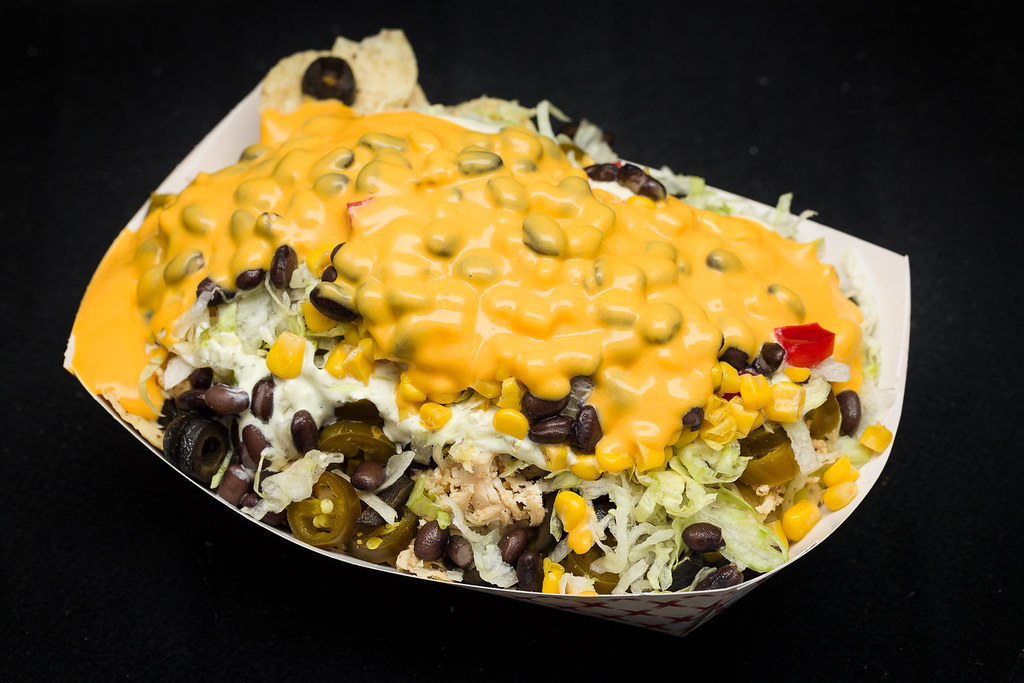
After ordering my chorizo dog topped with the spicy slaw, I set about attempting to order the tequila lime chicken nachos. This was where things started to get a little dicey. While people like to claim that they want choice in their lives, when faced with too much choice, the average human being becomes paralyzed with fear over having to actually make said choice. And with some fifteen toppings from which to choose, it took me a minute to get my bearings. Nacho Mama might be better served by offering a "standard" - beans, lettuce, tomatoes, shredded cheese, and salsa - and then allow customers to modify it to suit their taste. For whatever reason I was feeling in a nacho cheese kind of mood, so I added it as one of the toppings.

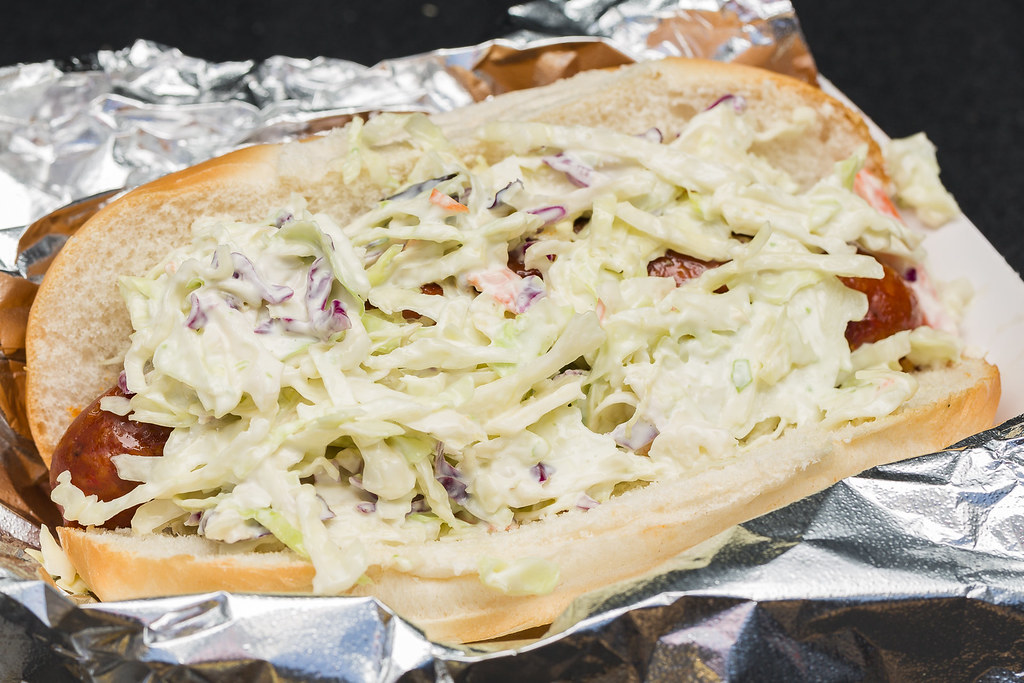
After paying the $15 for my haul (I included one of the Pepsi products as well), I walked to the other end of the truck to wait for my food. Within a minute or so, the woman inside the truck handed me the chorizo dog. While waiting for my nachos, she helpfully informed me that the chorizo link was actually from a place with which I am quite familiar, Dumas Meats in Mogadore, Ohio. That, to me, was a good sign. The bad sign, sadly, was the white squishy Italian hoagie bun on which the dog had been served. More on that later.


The last step before handing me my finished nachos was the ladling on of the cheese. Sadly, this happened straight from a very large can that had no cover on it that was labeled, "Nacho Cheese." One might find this type of product at any Gordon Food Service (GFS) / Sam's Club / food wholesale place and would have probably been more correctly labeled "pasteurized cheese food product" rather than just "cheese." Regardless, after the ladling of the cheese, she handed it to me. The first thing I noticed besides the dayglo orange color of the cheese was the heft of the basket in my hand. For $7, you certainly got your money's worth, I thought.


As I crossed the parking lot to my waiting car, I began to notice a problem. The nacho cheese had been poured too closely to one of the edges of the cardboard container and as it settled, had started to ooze over the edge. Not wanting to set this down anywhere in or on my car, I did the only thing a person holding a soda pop and chorizo dog in one hand and a container of nachos in the other hand could do: I decided to lick the cheese off the cardboard. I figured I just wouldn't photograph that side of the dish. I put the cardboard container to my mouth and gently licked the offending cheese off with a quick swipe of my tongue and gasped in amazement: the nacho cheese was ROOM temperature!

Now, those of you reading with no commercial food preparation or restaurant experience may think my negative reaction was due to the fact that I (and probably you) prefer your nacho cheese food product served hot. Tepid liquid cheese is just not something I relish the thought of eating. In reality, my surprise was due to the fact that by not holding the cheese at a proper serving temperature, the Nacho Mama Food Truck folks were playing Russian roulette with their customer's health.

Most food safety guidelines indicate that to avoid bacterial growth, food must be held below 40 degrees or above 135 (some say 140)  degrees Fahrenheit. As for time spent in between those two extremes, the cumulative time must be calculated and the food must be discarded after it reaches four hours. In addition to the inappropriate holding temperature, the can of cheese was just sitting on the counter, completely uncovered. Who was to say that something couldn't fly in through a window and contaminate the product?

So, let me see if I've got my math straight. The food trucks started serving food at 11 am and I was there at noon. Best case scenario, let's assume that the staff opened a fresh can of nacho cheese sauce right at 11 am. So, an uncovered can has already sat there for an hour right in the middle of the temperature danger zone? You can see why I was so alarmed. And honestly, if they can't hold this food at the proper temperature, what makes me think they know how to hold any other food at the proper temperature to avoid potentially getting people sick?

After photographing both items, I turned my attention to the chorizo dog. Upon my first bite, I was rewarded with a nice snap from the dog and creamy cole slaw. Unfortunately, the spicy part of the "spicy slaw" I ordered to top the dog was nowhere to be found. This was straight up cole slaw, and I'd venture to say given the provenance of the other ingredients coming out of the truck, it was probably food service cole slaw. But for me, the bigger issue with the dog was the bun.

The large Italian-style hoagie bun was straight out of squishy white bread hell and couldn't contain the dog and the slaw. Within another couple of bites, the dog had broken through the spine and by the time I got halfway done with it, the bun had completely split along the spine, offering no additional structural support to keep everything together. Fortunately, I had the presence of mind to grab a plastic fork from the truck and while I had originally envisioned using it with the nachos, found a more appropriate use for it to clean up the mounds of slaw that had fallen into the waiting basket below. The only real positive for me about this dog was the chorizo link itself from Dumas Meats.

I ended up disposing of the nachos in the garbage can, not even wanting to eat a single bite. I packed my camera gear away, got back in my car, and drove off. I do not plan on eating at the Nacho Mama Food Truck again, really for two reasons. First, the food safety issue (and that is the elephant in the room). Second, the quality and uniqueness of the food just didn't appeal to my sense of adventure. It felt like really bad Americanized versions of Mexican staples and honestly, there are plenty of other places I can already go to for that. You can definitely cross this food truck off of my list of places I'd recommend.
Related Posts with Thumbnails